
S ince ascending the Ecumenical Throne in November 1991, Patri- arch Bartholomew has worked tirelessly to bring about a greater international awareness of Orthodox Christianity and to bind more closely together the Or- thodox faithful dispersed throughout the world.
In the five years since becoming the Ecumenical Patriarch of Constantinople, Bartholomew has helped the church to progress on several fronts.
He has greatly advanced Orthodox-Roman Catholic relations through fre- quent contacts between Orthodox and Vatican officials and delegations and in meetings with Pope John Paul II.
His All Holiness has increased ecu- menical efforts through frequent dialogues with Luther- ans, Baptists and others in Europe through the World Council of Churches.
The Patriarch also has taken a highly active role in post-communist Eastern Europe by strengthening con- tacts and relations with the various Orthodox national churches and through direct visits to several Orthodox nations.
Along with his role of overseeing the resurgence of Orthodoxy in this region, Patriarch Bartholomew has ini- tiated regular biennial meetings of all Orthodox hierarchs from around the world to discuss their common progress and concerns. In addition, he has traveled to various nations on several continents with Orthodox populations to nurture the faith.
He has shaped developments in our own Archdiocese with the recent selection and election of Archbishop Spy- ridon and by maintaining close ties with many lay lea- ders and groups through their regular visits to the Pha- nar.
The environment has also been of great concern to His All Holiness over the years. He has sponsored sem- inars to address this issue with participants from through- out the world taking part.
He has made the Orthodox presence better known in Western Europe as well, through conferences and in meet- ings with other religious and political leaders.
The 270th Successor to the Apostle Andrew
He was born Demetrios Archontonis on Feb. 29, 1940, on the Aegean island of Imbros.
Following his primary and secondary schooling on Im- bros and in Constantinople, he enrolled at the theo- logical school of Halki and graduated in 1961.
After his ordination on Aug. 13, 1961 by Metropolitan Meliton of Imbros and Tenedos, he took the name Bar- tholomew. After serving his military obligation in the Turk- ish army, Bartholomew pursued postgraduate studies at the Institute of Eastern Studies in Rome, the Ecumenical Institute in Bossey, Switzerland and the University of Munich, specializing in ecclesiastical law. He then earned his doctorate at the Institute for Eastern Studies at the Gregorian University in Rome.
Returning to Constantinople, he was named assistant dean of Halki Theological School and was elevated to the position of Archimandrite by Patriarch Athenagoras a few months later.
In 1972, he was named director of the patriarchal of- fice and was elevated to the position of Metropolitan of Philadelphia the following year. He became Metropolitan of Chalcedon in 1990.
On Oct. 2, 1991, Bartholomew's predecessor, Dimi- trios I, who in 1990 became the first ecumenical patri- arch to visit America, died. Bartholomew was unani- mously elected as the new patriarch and Archbishop of Constantinople and New Rome on Oct. 22. He was en- throned on Nov. 2.
Bartholomew is a founding member of the Society of Law of the Eastern Churches and a member of the Faith and Order Commission of the World Council of Churches, serving as its vice chairman for eight years.
Roman Catholic-Orthodox Relations
The Patriarch's training and experience in Italy have served him in good stead in the continuing dialogue with the Roman Catholic Church.
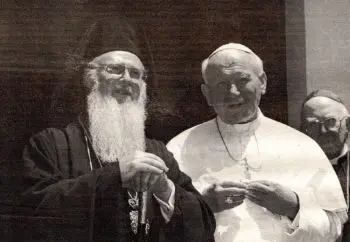
PATRIARCH BARTHOLOMEW and Pope John Paul II, during the Patriarch's visit to the Vatican in 1995. At right is Johannes Cardinal Willebrands of the Secretariat for Promoting Christian Unity.
(Nicholas Manginas photo)
Less than a month after his enthronement, a delega- tion from the Vatican headed by Edward Cardinal Cassi- dy participated in activities relating to the Feast of St. Andrew on Nov. 30-Dec. 1.
Their discussions centered on the progress of the Joint International Commission for the Theological Dia- logue between the Roman Catholic and Orthodox churches. The dialogue had recently encountered difficulties be- cause of tensions between Catholic and Orthodox com- munities in Central and Eastern Europe over the Uniate issue.
The Patriarch emphasized the importance of the an- nual exchange of visits between Rome and Constantino- ple on their respective feast days, and also spike of the progress of the theological dialogue. The cardinal as- sured the Patriarch of the Catholic Church's commitment to work closely with him for the establishment of a new spirit based on love.
However, a few months later the Uniate situation had caused a deterioration in ecumenical relations and Patri- arch Bartholomew warned that if a majority of Orthodox Churches wanted to break off dialogue with the Catholic Church, he would have to follow suit.
But during the Catholic delegation's visit the following year, Bartholomew commented that "even if the peace between us has been shaken, we believe that the love between us has not been chilled."
In a message to Pope John Paul II in June 1994, the Patriarch wrote, "Most Holy Brother, we are convinced that the rapprochement of our Churches in a spirit of complete sincerity will greatly contribute to restoring spiritual , i.e., gospel values in the world...we maintain a deep, unshakable hope in the future of the dialogue and in its successful outcome."
Patriarch Bartholomew's efforts to improve Orthodox-Roman Catholic relations took a great leap forward in late June 1995 when Pope and Patriarch met in Rome for a three-day visitation and series of meetings.
The two leaders signed a joint statement pledging their separated Churches would seek greater unity as the year 2000 approaches. The statement said improved relations between the world's Roman Catholics and Or- thodox Christians would help the cause of peace. They also issued an appeal to save the environment and for Eastern European countries to be allowed to join the European Union.
Ecumenical Dialogues
Parallel to the continuing dialogue with the Roman Ca- tholics, Patriarch Bartholomew has also made strides in talks with other religious bodies, including leaders of the NewYork-based appeal of Conscience Foundation headed by Rabbi Arthur Schneier, and Roman Catholic Archbish- op Theodore McCarrick of Newark, N.J., in January 1992. They discussed the situation in Eastern Europe and for- mer Soviet Union. It marked the first time that an ecu- menical patriarch met with American ecumenical lead- ers.
In May 1993, World Council of Churches General Sec- retary Konrad Raiser made his first official visit to the Pa- triarch. Bartholomew pledged that the Patriarchate would continue its "unequivocal support of every WCC activity undertaken to promote Christian unity, to proclaim to the world the good news of the gospel, to redress injus- tices, to serve humankind and to alleviate suffering."
Raiser thanked the Patriarch for his "numerous initia- tives, leading role and inspiring contribution to the world- wide ecumenical movement."
Other ecumenical efforts of the Patriarch resulted in overtures for talks with the Baptist churches, which came in January 1995, with "pre-conversations" taking place in May of this year. Talks with the Lutheran Church also took place earlier this year.
Intense Activity in Eastern Europe and Russia
The fall of communism brought an unprecedented op- portunity for the resurgence of Orthodoxy.
Patriarch Bartholomew quickly seized the momen- tum, traveling to the various Orthodox countries includ- ing Serbia, Bulgaria, Romania and Russia.
On his visit to Russia in early July 1993, Patriarch Bar- tholomew met with Patriarch Aleksy of Moscow and All Russia.
Bartholomew stressed that Orthodoxy constituted the dominant cultural force in Eastern Europe and the Bal- kans and would continue to do so in the future. He criticized groups in Western Europe and the Vatican try- ing to impose Western European culture.
But the issue of the Estonian Orthodox Church soon arose that, for a brief period, drove a wedge between the Russian Church and the Ecumenical Throne. In Au- gust 1993, on a visit to Estonia by the Patriarch, a dele- gation of the Holy Synod of the Estonian Orthodox Church discussed their demand for full autonomy from the Mos- cow Patriarchate. Prior to the invasion of Estonia by the Soviets, the church had been autonomous.

A GATHERING of all Orthodox hierarchs for the Sunday of Orthodoxy and synaxis in March 1992. From left, Metropolitan of Prague Dorotheos, Pa- triarch Maximos of Sofia and All Bulgaria, Patriarch Aleksy of Moscow and All Russia, Patriarch Diodoros of Jerusalem and All Palestine, Pope and Patriarch Parthenios of Alexandria and All Africa, Archbishop of Constantinople and New Rome and Ecumenical Patriarch Bartholomew, Patriarch Ignatios of Antioch and All the East, Patriarch Theoctistos of Bucharest and All Romania, Metropolitan Vasilios of Warsaw and All Poland, Archbishop Seraphim of A- thens and All Greece, Archbishop John of Karelia and All Finland, Patriarch Paul of Belgrade and All Serbia.
The Patriarch later sent a high-level delegation to Mos- cow to discuss the issue with Russian Church leaders. Finally, in February of this year, the Holy Synod of the Ecumenical Patriarchate granted the Estonian Church's request for autonomy. Immediately the Moscow Patriar- chate broke communion with Constantinople. But follow- ing a series of confidential discussions, the Patriarchates resumed communion in May and agreed on a moratorium in Estonia.
The Balkans have been another area in which Patri- arch Bartholomew has taken an active role.
In June 1992, he selected Metropolitan Anastasios of Androusis as the new Archbishop of Tirana and all Alba- nia, who had directed the restructuring of the Orthodox Church in Albania following the collapse of communism.
The conflict in former Yugoslavia between Serbian, Cro- atian and Bosnia factions brought strong condemnation from His All Holiness at a two-day conference of about 100 Christian, Moslem and Jewish leaders in Constanti- nople in February 1994. "We must put behind us the di- visions and feuds brought about by excessive nation- alism," the Patriarch said. "We were once united by the great empires but the peace that comes at the tip of the sword is no longer acceptable."
Bartholomew also traveled throughout the Balkans, visiting Greece, Romania, Montenegro, Serbia, where he decried Western prejudice against Eastern Orthodoxy and denounced attacks against the Serbian Orthodox Church, and Bulgaria, where he met with the Bulgarian president and other leaders.
Involvement in Western Europe
Elsewhere in Europe, Patriarch Bartholomew has rep- resented Orthodoxy on many occasions. In April 1994, he became the first patriarch to speak before repre- sentatives of the European Parliament meeting in Stras- bourg, France. In his formal declaration to the Assembly, the Patriarch expressed his satisfaction at the mission of European unity, which "had the task of creating the conditions which permit the promotion of collaboration and unity between peoples and men." He said that the Orthodox Christians of Europe are ready to participate in the "unified Europe which will not only exist for itself, but for the good of all humanity."
In a press communique, the Patriarch declared that "our contribution ... to the construction of Europe must be intensified in the face of current challenges, by hum- bly serving the needs of man."
During an interview with the Paris daily, Le Monde, Patriarch Bartholomew said he disapproved of all forms of political alliance under the name of the Orthodox Church, in response to a question relating to the war in Yugoslavia. But he vigorously defended the role of Pa- triarch Pavle of Belgrade, rejecting suggestions by the interviewer that Pavle had been reluctant to denounce the attitude of the Serbian authorities in the conflict.
Various European academic institutions have bestowed honorary degrees upon His All Holiness. He was awarded an honorary Doctor of Divinity degree in May 1994 from the City University of London. In his acceptance speech, the Patriarch noted that "the frantic pursuit of the future has sacrificed the inner peace of the past. We need to regain our religious outlook."
The Patriarch received an honorary doctorate in Feb- ruary 1996 from the Louvain Catholic University in Bel- gium. University officials cited Bartholomew for his work in providing unity in the Christian world, for establishing ties between the Orthodox and Roman Catholic Churches and for the spiritual endeavors he has undertaken within the European Union.
Patriarch Bartholomew attended the second session of an international ecological conference in early May 1995, organized under the sponsorship of Prince Philip. He trav- eled to Finland at the end of the month for an official vis- it to the autonomous Orthodox Church of Finland, which is under the Ecumenical Patriarchate's jurisdiction.
In mid-June, the Patriarch consecrated the first Greek Orthodox church in Zurich, Switzerland, built by great benefactor Panagiotis Angelopoulos in memory of his broth- er, Demetrios.
He made his first official visit to France in November
(Nicholas Manginas photo)
1995, where he marked the centennial of St. Stephen's Greek Orthodox Ca- thedral in Paris, and also met with French President Jacques Chirac, Prime Minister Alain Juppe, the Secretary gen- eral of UNESCO, and attended the Ple- nary Assembly of Catholic Bishops tak- ing place in Lourdes.
The Patriarch made his first official visit to Britain in December, where he delivered the annual Constantinople Lec- ture before the Archbishop of Canter- bury. He stressed several times in his speech that the coming third millen- nium should be a spur to Christian uni- ty. "The participation of Orthodoxy in ecumenism is the fulfillment of a sa- cred obligation. We will do all in our pow- er for reconciliation," he said.
In May of this year, the Ecumenical Patriarch met with European People's Party President, and former Belgian prime minister, Wilfried Martens, who attended an en- vironmental conference organized by the Patriarch. The two also discussed human rights.
Also underscoring the Patriarch's interest in maintain- ing a presence in Western Europe, the Patriarchate o- pened an office in Brussels in early 1994.
The Patriarch made his first major trip abroad in May 1993, a week-long official visit to the Middle East.
In Egypt, Bartholomew met with Patriarch Parthenios of Alexandra and All Africa, and with Pope Shenouda of the Coptic Orthodox Church. He also made a pilgrimage to St. Catherine's Monastery on Mount Sinai.
He continued on to Syria, where he was the guest of Patriarch Ignatios IV of Antioch and All the East, and also met with Syrian Orthodox Patriarch Ignatios Zakka.
During a visit to the theological institute in Balamand, Lebanon, Bartholomew paid special tribute to the Antio- chian Patriarch for his support of higher education.
Denounces Fanaticism
In Syria, the Ecumenical Patriarch, in a media inter- view, denounced religious fanaticism, calling it an obsta- cle to peace. He said it was the job of religious leaders to steer their people away from fanatical ideas.
The Patriarch also called for cooperation among world religious leaders. "We have to coordinate all spiritual pow- ers ... to promote unity among divided Christians and all religions in order to create a better situation in the 21st century," he said.
His itinerary included taking part in services in and around Damascus and meeting with Syrian President Ha- fez-al-Assad.

HIS ALL Holiness brings a doll for a little girl in the Balukli hospital
(Nicholas Manginas photo)
The following year, in October 1994, His All Holiness traveled to Patmos and the Dodecanese islands. On Pat- mos, he announced plans to convene all Orthodox lea- ders at a peace summit there in 1995.
The Patriarch also met with Greek Prime Minister An- dreas Papandreou and his son, Education Minister George Papandreou. They discussed the Orthodox Church in the Bal- kans.
Bartholomew made several major trips in 1995. In January, he traveled to Ethiopia, where he met with Pa- triarch Pavlos of the Church of Ethiopia. In a statement, the Patriarch said that the dialogue between the Ortho- dox Church and other ancient Eastern churches, includ- ing the Ethiopian, is on a very satisfactory course.
In early April, he made his longest trip up to that point, visiting Orthodox Christian communities in Japan and Korea. It marked the first time that an Ecumenical Patriarch visited the region.
His All Holiness went to Japan at the invitation of Brit- ain's Prince Philip, the international president of the World- Wide Fund for Nature, to participate in an international sum- mit on religion and the environment.
During his stay, the Patriarch held private talks with the president of the Japanese senate, with Metropolitan Theodosius, head of the autonomous Orthodox Church of Japan, and with the ambassadors of Greece, Turkey and the United States.
In Korea, Bartholomew visited the Orthodox Exarchate of the Ecumenical Patriarchate in Seoul, presided over the Divine Liturgy at St. Nicholas Cathedral, inaugurat- ed a new wing of the Orthodox mission center in the city, and consecrated two churches on visits to Orthodox com- munities in other parts of South Korea. He also met with South Korea's president.
In mid-May, the Patriarch went to Jerusalem where he visited the Holocaust memorial of Yad Vashem. In an interview with the Jerusalem Post, he said that he op- poses the persecution of Jews, as he would of anyone, whatever their belief or ideology.
Later this month, His All Holiness will undertake his long- est journey yet, traveling to Australia (story on page 7).
Perhaps Patriarch Bartholomew's most important visit abroad, especially for North American Orthodox faithful, will be his planned visit to the United States set for next October. The Patriarch will take part in events marking the 75th anniversary of the Greek Orthodox Archdiocese and the 60th anniversary of Holy Cross School of Theo- logy.
Orthodox Leadership Role
One of the hallmarks of Patriarch Bartholomew's five-year tenure on the Ecumenical Throne has been his suc- cess at forging closer links among the world's Orthodox Christians in a spirit of Pan Orthodox unity.
Less than a year after his enthronement, at the end of August 1992, His All Holiness made history when he called the first meeting of Greek Orthodox hierarchs of the Throne from around the world to a meeting at the Ecumenical Patriarchate to discuss common issues. He continues to hold the meeting biennially.
In a newspaper interview, Bartholomew said that the assembly of hierarchs "provides great comfort and en- couragement to the children of the Church scattered in the four corners of the earth..."
The Patriarch also officiated at a service commemo- rating Sept. 1 as the beginning of the new ecclesiastical year and the Day of the Environment, a practice begun in 1989 by his predecessor, Patriarch Dimitrios.
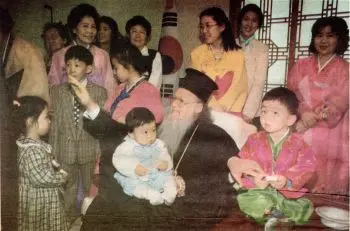
NANASUH BANGAWOHWYO* — The Patriarch meets with several Korean Or- thodox Christians on a visit to one of the parishes in the "Land of Morning Peace." ( translation: A happy gathering)
(Nicholas Manginas photo)
In the summer of 1993, the Patriarch called together a rare Great Synod of leaders from all the Greek Ortho- dox Churches in the world to deal with complaints that the Jerusalem Patriarch had intruded into the Ecumenical Patriarchate's jurisdictional areas, particularly Australia.
The situation threatened the internal unity and canon- ical order of the Churches but, under Bartholomew's lea- dership, the crisis subsided and the Patriarch of Jeru- salem agreed to withdraw from the disputed areas. The Synod reinstated communion with the Jerusalem Patri- archate in December of that year.
On several occasions, Patriarch Bartholomew has ex- pounded the Church's position on many important issues.
In December 1994, in an official statement respond- ing to a decision by the Church of England to ordain wo- men, he outlined the Orthodox position on the role of women in the Church. He said that "the Orthodox Church follows, for theological, canonical and historical reasons, the tradition of the undivided Church," separating the func- tions of men and women, and limiting the priesthood to men, while admitting the tradition of women deaconesses.
Care for the Environment
One issue that the Patriarch holds very dear is his concern for the environment. On his visit to Britain in late May of 1992, His All Holiness met with Prince Philip, a baptized Greek Orthodox Christian, to discuss their mutual concern for the environment. The prince lauded the Orthodox. Churches "for their outstanding work for the environment." The two leaders agreed to work close- ly on the issue.
In September 1995, in commemoration of the 1,900th anniversary of the Revelation of St. John the Divine, His All Holiness and the Prince co-sponsored a symposium on the environment held Sept. 20-26 on board a cruise to Patmos that attracted more than 100 scientists, businessmen, administrators and writers concerned with the issue. Also present were 12 of the Church's 15 pri- mates.
In his opening address, the Patriarch stressed that "theology and science ought to be partners in this work...We are assembled on a kind of latter-day ark. I hope and expect that this conference will increase our understanding of the various ways in which we may perceive and engage with the world around us."
In early July of this year, the two men opened the third in a series of summer seminars on the environment on the island of Halki. In his remarks to the conference, Patriarch Bartholomew called for the mobilization of mo- ral and spiritual forces to achieve harmony between hu- manity and nature.
Guiding the Church in America
As demonstrated over the past few months, His All Ho- liness has shown a keen interest in the Greek Orthodox Archdiocese of America, the premier exarchy of the Ecu- menical Patriarchate.
He invited clergy and lay leaders from the Arch- diocese to the Patriarchate to hear their views on the selection of a new archbishop on two occasions — in Jan- uary and again in late April. The second meeting under- scored the need for a calm transition into the new era following the retirement of Archbishop Iakovos. The de- sire was expressed for cooperation and a positive con- tribution in the spirit of harmony and unity among all in- volved under the spiritual guidance of the Mother Church.
Patriarch Bartholomew's insight into the needs of the faithful in America resulted in his nomination and sub- sequent election in July of Metropolitan of Spyridon of It- aly as our new archbishop.
The Patriarch also has met with a number of Amer- ican political leaders visiting Istanbul, including first lady Hillary Clinton on March 28 of this year.
On many occasions over the years, His All Holiness al- so has received visits from members of the Archons, Order of St. Andrew the Apostle, from Philoptochos lea- ders, and others who have come to offer humanitarian support for the various ministries of the Patriarchate.
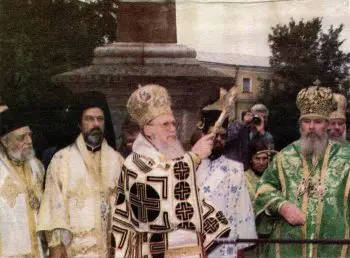
(Nicholas Manginas photo)
The Ecumenical Patriarch concelebrated liturgy with Patriarch Aleksy of Mos- cow at the Zagorsk Monastery during his visit to the Moscow Patriarchate. To his left are the Metropolitans Ioakeim of Chalcedon and Gabriel of Kolonia.
In late 1994 and early 1995, concern over the issue of Orthodox unity in America prompted His All Holiness to convene a meeting of the Holy Synod which included hierarchs from the Archdiocese to clarify misunder- standings arising from the actions taken. The result was the reinforcement of ties to the Mother Church.
Interest In youth
Over the years, Patriarch Bartholomew has reached out to Orthodox young people. In July 1994, he held a series of meetings with members of Syndesmos, the World Fellowship of Orthodox Youth at the Patriarchate in which he outlined a series of important issues facing the Church, ranging from autocephaly and autonomy of var- ious churches, to tensions in former Yugoslavia and the conflict in Bosnia, the future of the Patriarchate and oth- er issues.
The Patriarch blessed the activities of Syndesmos in the service of the Church. He said that the central aims of the organization must be "unity, concord, and obe- dience" and stressed the importance of a close relation- ship with the Church's bishops.
Undercurrent of danger
The many achievements of Patriarch Bartholomew with- in this brief period have been accomplished amid an element of danger in the unfriendly environment in which the Ecumenical Patriarchate functions, which is somewhat reminiscent of that of the early Church com- munities of the first Christian centuries.
In the past three years, there have been demon- strations by fanatic Moslems, incidents of vandalism at Orthodox cemeteries, terrorist bombings and bomb scares and personal threats against the Patriarch which have appeared in the press.
Additionally, Bartholomew's pleas in meetings with Turkey's leaders in 1992 and 1996 to reopen the Theo- logical School at Halki have not been answered, although His All Holiness continues to have hope.
Compiled by Jim Golding
[ pp. 1, 4, 5, 24 ]
Archbishop, Political Leaders Condemn Bombing
NEW YORK — Archbishop Spyridon and many political and religious leaders swiftly condemned the Sept. 30 gre- nade attack on the Ecumenical Patriarchate and urged Turkish government leaders to bring the perpetrators to swift and sure justice.
His Eminence called upon President Clinton and politi- cal and religious leaders in the United States - Christian, Jewish and Muslim - to condemn those claiming respon- sibility for the attack and to act to protect the Patri- archate from continuing harassment.
Following his plea, the following government officials and national and international organizations also issued statements of condemnation after the bombing, including the State Department, U.S. Sens. Edward M. Kennedy of Massachusetts and Olympia Snowe of Maine, U.S. Reps. Carolyn Maloney, Lee Hamilton, Eliot L. Engel and Ben Gil- man of New York, Richard A. Gephardt of Missouri, John Porter of Illinois, Nancy Pelosi of California, Michael Bili- rakis and Ileana Ros-Lehtinen of Florida, the World Coun- cil of Churches, AHEPA, World Council of Hellenes A- broad, and the Hellenic American National Council.
A statement issued by Nicholas Burns, spokesman for the U.S. Department of State, says, "Our mission in Tur- key has confirmed the report of a grenade attack against the Ecumenical Patriarchate of the Orthodox faith in Is- tanbul. The grenade was thrown into the Patriarchate's gar- den. According to the best available information, no-one was injured in the attack although there was some dam- age from the explosion.
We understand that a claim of responsibility has been made in the name of the Great Eastern Islamic Raiders Front. We strongly condemn this act of violence. We are in contact with the Turkish government and the Patri- archate regarding an investigation of this matter."
Sen. Robert Dole also issued a statement, saying that he supports religious freedom for the Ecumenical Patri- archate. "The integrity of the Patriarchate must be en- sured, the Halki School of Theology must be reopened and the perpetrators of terrorist attacks against the Pa- triarchate must be apprehended and brought to justice," he said.
Konrad Raiser, general secretary of the World Council of Churches, in a message to Turkish Prime Minister Nec- mettin Erbakan, pointed out that the Patriarchate's con- tinued presence in Istanbul was "guaranteed by inter- national agreements.
"We assure you, as we have done with your prede- cessors, our full cooperation in assuring the full respect due to the Patriarchate and its protection in the future from any further act of intolerance and aggression," Rai- ser wrote.
He also expressed his deep concern to Patriarch Bar- tholomew over the bomb attack.
The hand grenade was tossed into the compound of the Ecumenical Patriarchate in Istanbul causing damage to the newly restored patriarchal Cathedral of St. George. The Islamic Great East Raiders Front, a group fighting to install a strict Islamic regime, claimed responsibility for the incident in a telephone call to an Istanbul daily newspa- per, Hurriyet.
Residents of the neighborhood of Balat, where the Patriarchate is located, reported that they heard gun shots at the time of the attack, the newspaper said.
The Islamic Great East Raiders Front has claimed re- sponsibility for several bombings in the past, most of them targeting Istanbul restaurants, hotels and nightclubs.
In 1994, the same organization placed a bomb in a sec- tion of Patriarch Bartholomew's residence and had threat- ened to kill him.
Text of His Eminence's statement
"I wish to express the outrage and shock of the Or- thodox Christian community of the United States, and that of all Americans of good will, in condemning the gre- nade attack on the Ecumenical Patriarchate which took place in Istanbul on September 30, 1996.
"We thank God that His All Holiness Ecumenical Patri- arch Bartholomew and his staff were unharmed. How- ever, we are gravely concerned that serious damage was done to the newly restored Patriarchal Cathedral of St. George.
"This senseless and shameful attack violates both the sanctity and safety of the Ecumenical Patriarchate and is an affront to universally accepted principles of religious freedom and human rights. For surely, an attack on the Ca- thedral of Saint George, is an attack on all houses of wor- ship, everywhere. It is particularly disturbing to Orthodox Christians in America that their spiritual center should be continually subject to conditions that prevent it from func- tioning freely.
"On behalf of the clergy and laity of our Church, I call upon the Turkish national government and all other rele- vant authorities to take immediate and serious measures to ensure the protection of the Patriarchate. Further- more, I ask that all necessary actions be taken to bring the perpetrators who have claimed responsibility for this attack - the Islamic Great East Raiders Front - to swift and sure justice. I also intend to discuss the current sit- uation with other American religious leaders - Christian, Jewish and Muslim - in order to prevent future threats and attacks on holy sites and places of worship.
"Finally, I would urge the faithful both here and a- broad to exercise Christian patience and restraint in dealing with this awful event, mindful that only through love and understanding, on all sides, can such repre- hensible acts be ultimately overcome."
[ pp 1, 2, 23 ]

Busy Schedule Reflects Active Ministry
Since arriving in America only a month-and-a-half a- go, Archbishop Spyridon has set the tone for his active ministry with a hectic schedule of meetings and visits.
In his first week at the Archdiocese, His Eminence re- ceived visits from Congressman Lee Hamilton of New York on Sept. 23, and Foreign Minister of Greece Theodo- ros Pangalos on the 25th.
He traveled to Pittsburgh on Sept. 26 to attend the Pitts- burgh Diocese Clergy Laity Conference.
On the 27th, he had a dinner meeting with Consul Gen- eral of Greece in New York Haralambos Rokanas.
President Glafkos Clerides of Cyprus visited Archdio- cese headquarters on Sept. 28. A dinner of the Cyprus Fed- eration of America at a hotel in Manhattan followed that eve- ning.
The Archbishop made a pastoral visit to a church in Man- hattan, St. George-St. Demetrios, on Sunday, the 29th.
He began his official October schedule on the 3rd with a press conference for the Greek American media (re- lated story page 3). The same day, he received a visit from the former Foreign Minister of Greece, Michalis Papacon- stantinou.

HIS EMINENCE answers a question from a reporter during the recent visit of Cyprus'
President Glafkos Clerides.
(Orthodox Observer photo)
His Eminence met with the governor and vice gover- nor of the National Bank of Greece, and the director of At- lantic Bank on October 4.
The Archbishop made his first visit to St. Basil Acad- emy on the 5th and attended Liturgy at St. Spyridon Church in Manhattan on the 6th.
He was a guest at the Appeal of Conscience Foun- dation Dinner in New York on Oct.7 honoring the prime minister of Italy.
The next day, he attended the Hellenic Radio Phidippi-
des Award dinner in Manhattan.
On Oct. 10, Olympic gold medal winner John Melisa- nides visited His Eminence at the Archdiocese.
Archbishop Spyridon attended a dinner of the Hellenic American Chamber of Commerce in New York on Oct. 18.
The weekend of Oct. 19-20, the Archbishop made his first official visit to Holy Cross School of Theology. He returned to his roots in Ohio later in the week for a three-day visit Oct. 24-27, celebrating the Feast of St. Demetrios in Warren and then visiting to Holy Trinity parish in Steubenville.
Rounding out the month, Archbishop Spyridon attend- ed a City Hall reception and gave the invocation at the New York City Council meeting on Oct. 30.

Philanthropic gifts
(Orthodox Observer photo)
Ms. Alexandra Kallinikidon (seated, left), president of the Kallinikion Foundation, recently pre- sented two gifts totaling $20,000 to Metropolitan loakeim of Chalcedon (center) for the edu- cational and philanthropic institutions in the name of His All Holiness Patriarch Bartholomew and for those of the Metropolitan's eparchy. She also pledged $500,000 in five installments to be given when the Theological School of Halki is re-established as the school of the Ecumenical Pa- triarchate. Also shown are (I. to r. seated) Bishop Philotheos of Meloa, Helen Bender and Manuel Demos; (standing) Froso Beys and Rev. Dr. Robert Stephanopoulos.
The Observer Online
NEW YORK— The Orthodox Observer, the newspaper of the Greek Orthodox Archdiocese of America with a cir- culation of 140,000 worldwide, has its own home page on the Internet. The September 1996 issue is the first to be featured on the worldwide web.
The entry onto the Information Superhighway is in keep- ing with the Church's efforts to adopt the latest techno- logical developments. Several people have worked for some time to produce this breakthrough, which culminat- ed with the blessings and support of Archbishop Spyri- don, a long-time proponent of the use of computer tech- nology in the Church.
The Observer home page offers a variety of major news articles from the previous month's issue and pro- vides links to the home pages of the Ecumenical Patri- archate, the Greek Orthodox Archdiocese, the ACCESS program, the Challenge supplement and numerous pho- tos and other data which can be downloaded to one's own computer.
Through these links, users can also call up Orthodox news from the Patriarchate and other parts of the world, as well as press releases from the Archdiocese. News from the Greek section is included, along with directions on how to receive the Greek language text, regardless of the platform which your computer uses.
The electronic address for the Observer is: http:// www.goarch.org/goa/observer. The Observer can be reached by e-mail at: cdelian@aol.com.
Volunteers Can Apply for I.V. Summer Program
Ionian Village, the summer camp and travel program in Greece operated by the Greek Orthodox Archdiocese of America, is accepting staff applications for the 1997 summer program. Positions are available in the following departments: athletics, arts and crafts, music and Greek culture, aquatics (certified lifeguards), Orthodox life, and
in the infirmary (registered nurses).
Applicants must be Orthodox Christians age 21 or older.
For information and applications, call the Ionian Vil- lage at (212) 570-3534, or write: Ionian Village, 8 East 79th St., New York, NY 10021.
[ p 2 ]
Archbishop Addresses Issues at First Press Conference

HIS EMINENCE reads his statement to the Greek American press at Archdiocese headquarters.
(Orthodox Observer photo)
NEW YORK — Archbishop Spyridon held his first press conference at Archdiocese headquarters on Oct. 3 for the Greek American press and fielded many questions from a roomful of journalists. The press conference, which last- ed more than an hour, was conducted primarily in Greek.
Reporters questioned him on topics that included in- terfaith marriages, finances, relations with the old cal- endarists, monasticism, clergy and the communities, eth- nic concerns and several other subjects.
On the issue of interfaith marriages, His Eminence said that he views the couples "with a lot more com- passion and affection." He said the Church must try to help the non-Orthodox partner of the marriage under- stand what Orthodoxy is about. "If we can't explain Or- thodoxy, how can they consider Orthodoxy in an objec- tive way."
Regarding disputes that arise within communities, the Archbishop said that use of the democratic process is desirable, but canon law should also guide communities in governing their parishes.
The Archbishop also said that the financial dealings of the Church and each parish should be open and clear.
Responding to a question on whether he would re- main neutral about ethnic issues, in light of the Pa- triarchate's situation in Turkey, His Eminence said that he would be supportive of ethnic concerns both in this coun- try and abroad.
On relations with the old-calendarists, Archbishop Spy- ridon said he did not see the calendar as being a divisive issue.
As to whether he favors the establishment of monas- teries in this country, His Eminence explained that the is- sue would have to be looked at carefully, and that it should only happen under canon law.
The Archbishop responded thoroughly and frankly to each reporter's questions and said he hoped to speak with them regularly.
Reaction to the new Archbishop from several report- ers was positive. "I think the Archbishop made a great effort to accommodate the Greek American press," said Vicki Yannias, New York correspondent for the Hellenic Chronicle. "The Archbishop made himself very accessible and gave us a lot of his time. I think he was very careful and thoughtful about ensuring that his answers reflected his thinking."
"I think it is a new beginning for the Archdiocese," said another reporter covering the press conference. "I believe the it will help the community and the young peo- ple come closer to the Church."
Following is the text of his opening statement to the press.
Ladies and gentlemen,
As I welcome you to the Archdiocese today, I want to first assure you that I am fully aware of the difficult task, you perform on a daily basis, a task that I believe to be an invaluable ministry of public service.
Before taking your questions, let me say that I con- sider all of you as truly my spiritual sons and daughters, friends and co-workers. Your responsibilities follow a course parallel to mine.
I realize that constructive journalism and honest criticism contribute positively to the proper enlighten- ment of the public, and in creating an informed public o- pinion.
I have served the Church for 28 years. Many attri- butes have been ascribed to me until this day. Be that as it may, I consider myself to be, first and foremost, a ser- vant of Orthodoxy, and a hierarch of the Ecumenical Pa- triarchate.
I see my election to the Archepisco- pal throne as a calling to assume a dif- ficult and awesome responsibility in the service of the Church.
I see my election to the Archepiscopal throne as a calling to assume a difficult and awesome responsibility in the service of the Church. As the spiritual leader of the Greek Orthodox faithful in America, I will devote to my pastoral role every ounce of strength, every talent and all the knowledge I possess, so as to better serve and guide my flock safely into the third millennium of Chris- tendom.
The upbringing and education of our children will be among my top priorities. Also, and of prime importance, will be the issue of inter-faith marriages; of maintaining and strengthening our Greek culture and language, this treasure that every American of Greek descent carries proudly in his veins.
First and foremost is, of course, the teaching of our faith of Orthodoxy, which continues to be the only solu- tion to the problems of today's selfish and materialistic world.
Special attention will also be given to the societal prob- lems of our times. The pains and anxieties that plague our everyday life should be alleviated through the com- passion of the Church.
In the struggle for human rights, you will find your Archbishop to be a tireless ally and an uncompromising enemy of injustice in whatever form it is expressed.
We shall strive to strengthen the umbilical cord that connects us with the Ecumenical Patriarchate, the cradle of our Church. The Phanar is not only the light that guides us, but also the source of our Faith. Therefore, the initiatives and the actions of the Archdiocese of America will always be in conformity with the vision and the spirit of the Ecumenical Patriarchate.
To achieve these goals, it is not enough to establish realistic plans and to follow-up on every phase of the work. It demands the community's active participation in searching for solutions to the problems of the worldwide Hellenic Orthodox community — both in matters that concern just causes, and for its spiritual, social or other problems that exist.
I am at your disposal, ready to give you every assis- tance in your important work. I have met many of you and look forward to getting to know all of you.
Straightforwardness and a prompt response to your requests will be the guidelines for our common effort with you, as well as that of the members of my staff..
I thank you for being here today and I hope this will mark the beginning of an informed and honest rela- tionship. I will try to answer your questions as com- pletely as possible, given the relatively brief period since my arrival in America.
Thank you.
Fund Established for Presbytera's Family
NEW YORK — Archbishop Spyridon has announced that a trust fund has been set up for the family of Presbytera Linda Davis of the Diocese of San Francisco who was killed in a car accident over Labor Day Weekend.
Her husband, Father Matthew Davis, and children Chris- tina and Philip also were in the car and sustained serious injury.
"We are all sharing in the hurt and pain of his loss," His Eminence said in a letter to the clergy of the Arch- diocese. "As brothers who share in the one priesthood of Christ and devoted presvyteres, the joys of one are the joys of all, and the suffering of one brother or sister, is shared by all.
"I appeal to you this day and in the days to come to remember in prayer the family of Father Matthew. Pray to the Lord that He receive the soul of Presbytera Linda into the Kingdom of Heaven where the saints rejoice. Pray also, that the comforting and tender love of the Virgin Mary be felt by Father Matthew and especially the children, Christina and Philip. May the peace of the Mother of us all give them the comfort and the strength to bear the pain of this loss."
The Archbishop requested in the letter that offerings by check should be made out to the Father Matthew Davis Trust Fund, to the Archdiocese, care of the Office of the Archbishop.
New Director Named to St. Michael's Home
YONKERS, N.Y. — St. Michael's Home of the Aged trustees have named the Very Rev. Andonios Paropoulos as the new director of the facility, according to an announcement from T. Peter Pappas, president.
Fr. Andonios, former director of the Archdiocese Office of the Archbishop, replaces Spiro Pandekakes, who served as administrator for 25 years.
Founded in 1958 by Archbishop Michael, the Home has recently undergone an extensive renovation and ex- pansion program at a cost of more than $3 million.
Since its opening, St. Michael's Home has depended on the continued support of the Greek Orthodox faithful to fulfill its mission.
Certified by the New York State Department of Social Services as an adult care facility, St. Michael's affords quality care to individuals who seek assisted living.
At present, there are 33 residents and the Home is presently accepting applications for private and semi-private accommodations.
An important part of the residents' daily routine is visits by parish groups and various organizations.
For more information: contact St. Michael's Home for the Aged, 3 Lehman Terrace, Yonkers, NY 10705, or call (914) 476-3374.
Presbyteres Choose New Officers
New officers recently were named to the National Sis- terhood of Presvyteres board.
Margaret Orfanakos of Wayne, N.J., serves as pres- ident. Others are Angie Constantinides, Aurora, Ill., vice president; Mariann Mantzouris, Troy, N.Y., secretary; Do- ra Chelpon, Pensacola, Fla., treasurer; and Goldie Dou- kas, Snyder, N.Y., past president/advisor.
Diocesan representatives are: Elaine Stratis, Pensaco-
la, Fla., Atlanta Diocese; Paula Loejos, Omaha, Neb., Den- ver; Pauline Pavlakos, Syracuse, N.Y., Detroit; Elaine Ste- phanides, Laguna Hills, Calif., San Francisco; Tina Pati- tsas, Pittsburgh; Cynthia Paleologos, Worcester, Mass., Boston; Maria Karloutsos, Danbury, Conn., and Paula Strouzas, Glen Cove, N.Y., New York Archdiocesan Dis- trict; Pearlann Bithos, Joliet, Ill., Chicago; Flora Chioros, Roanoke, Va., New Jersey; and Sultana Volaitis, Oldsmar, Fla., who represents widowed presvyteres.
[ p 3 ]
|
AROUND THE USA |

|
San Francisco Cathedral Celebrates 60th Year

ANNUNCIATION CATHEDRAL'S educational and cultural facility which includes an athletic center, function room, kitchen, Diocese Philopto- chos office, chapel, library and other features.
SAN FRANCISCO — Annunciation Cathedral will cele- brate the 60th anniversary of the renaming of the church on Nov. 2. In addition, the event will raise funds to help pay off the community's $1.1 mil. mortgage.
The parish recently completed a new 39,000 square-foot facility built on the site of the previous church which had sustained severe damage after an earthquake on Oct. 17, 1989.
New Church Building Blooms in the Desert

(Photo by Peter Costopoulos)
PARISHIONERS of St. George Church of the Desert worship in their new edifice.
PALM DESERT, Calif. — Eastern Orthodox Christians in California's Coachella Valley recently began worshipping in their first church of Orthodox design.
Since its beginning about 17 years ago, the parish of St. George Church of the Desert has worshipped in sev- eral buildings - two Episcopal Churches, a funeral chapel, and a commercial building that also housed the Palm De- sert Public Works Department.
The 125 families that comprise the parish recently embarked on a $1.5 million project to build their new church.
The first service in the new building took place on Sept. 10.
The 8,360 square-foot 5th century Byzantine-style church has a stucco exterior and is topped by a 6-foot white cross atop a blue dome.
The membership of St. George Church of the Desert, pastored by Fr. James Tavlarides, consists of Greek, Rus- sian, Lebanese, Armenian and Serbian Orthodox Chris- tians.
New Chapel Planned for Reading Church
READING, Pa. — Sts. Constantine & Helen Church plans to complete renovations to its church interior that include a new chapel.
New York architect Steven P. Papadatos is presently working on plans that call for a chapel on one side of the church and a confessional near the altar.
Papadatos first submitted plans a few years ago when renovations began on the church's interior.
Then, traditional Byzantine arches were built through- out the church, an iconostasion with Byzantine iconogra- phy was crafted and painted, and two vestries were cre-
ated on either side of the main altar.
Work has continued and, recently, iconographer Ko- stas Skordelis has painted new Byzantine icons on the ceiling and walls near the altar, and is continuing on the Church's interior walls.
The Kraras family of Reading, and Wildwood, N.J., has pledged all the funds necessary to build the chapel which will include an iconostasion, altar table, and table of ob- lation.
Bishop Maximos of Pittsburgh has given the project his blessings. Completion is expected soon.
[ p 6 ]

Patriarch to Visit Australia
SYDNEY (ENI) — The Ecumenical Patriarch, Bartholo- mew I - the spiritual leader of the world's Orthodox be- lievers - will visit Australia in November on a seven-city tour for his first visit to the country since he was elected patriarch in November 1991.
By Jeannie Zakharov
The Orthodox faith first reached Australia in 1820, when a Russian Antarctic expedition was based in Sydney for several months. The first Greek Orthodox parishes were established in Sydney and Melbourne at the end of the last century. Immigration in large numbers from coun- tries with important Orthodox communities, including Greece, the former Yugoslavia and Lebanon, has boosted church membership since World War II.

The Greek Orthodox community is the largest Ortho- dox group in the country. Other major Orthodox commu- nities in Australia include the Serbian and Antiochian.
Patriarch Bartholomew, whose headquarters are in Pha- nar, in Istanbul, is regarded as the "primus inter pares" - or first among equals - of Orthodox church leaders. Be- fore being elected patriarch, Bartholomew had visited the country twice as a member of church delegations.
Archbishop Stylianos, the patriarch's representative in Australia and leader of the country's Greek Orthodox community, said that "the purpose of the visit is, first of all, to bless and encourage the church which belongs to his immediate jurisdiction, that is the Greek Orthodox archdiocese of Australia, and also all Orthodox faithful of other ethnic backgrounds.
"A further purpose of his visit is to greet all other Christian denominations and non-Christian religious lea- ders, since His All Holiness is well known for his ecume- nical interest and experience throughout the past 20 years at least.
"A third reason for this patriarchal visit is to con- gratulate the Commonwealth (federal)and state political leaders for their achievements in working towards a more tolerant and reconciled society. At the same time, His All Holiness would on this occasion thank Australian author- ities of every kind for making this great country a hos- pitable home and even a place of refuge for so many people from different parts of the world." A spokesman for Archbishop Stylianos told ENI that invitations had been extended to Prime Minister John Howard, and po- litical leaders of each Australian state to meet Patriarch Bartholomew, who is scheduled to visit Perth, Adelaide, Canberra, Hobart, Melbourne, Brisbane and Sydney. A visit to Aotearoa/New Zealand is also planned, but is yet to be confirmed.
Australia's Orthodox Christians are deeply involved in the ecumenical movement. The Antiochian Orthodox Church, Coptic Orthodox Church, Armenian Apostolic Church, Greek Orthodox Church, Syrian Orthodox Church and Ro- manian Orthodox Church are all founding members of the National Council of Churches of Australia.
Patriarchal Center Planned for Rhodes
ATHENS (ANA) — Rhodes is envisioned as an inter- national center for Orthodoxy following a foundation-lay- ing ceremony for a Patriarchal Center, which was held recently on the island by Metropolitan of Halkidon Ioakeim, who represented Ecumenical Patriarch Bartholomew.
The Patriarchal Center will be constructed on public property to deal with the needs of the Dodecanese is- lands and at the same time constitute tangible proof of
the Patriarchate's presence, Ioakeim said in an address.
The purpose of the center will be to organize theo- logical and other conferences and to operate a library as well as to facilitate the study and promotion of the Or- thodox Church. The environment, town planning and pub- lic works ministry has funded the project with 600 million drachmas, while the Patriarchal Center is expected to be completed in a year's time.
[ p 7 ]
|
OPINIONS |
|
___________ |
GUEST EDITORIAL |
_____________________________________________________________________________ |
|
Patriarch Bartholomew The completion of five years of service in the high- est office of the Church calls for some reflection on the person and work of Patriarch Bartholomew I. One would not be far off the mark in describing him as a man who is totally devoted to the sacred insti- tution (the "thesmos") of the Church. Bartholomew is a churchman in the fullest sense of the word, displaying an amazing consistency in prayer and service.
By Rev. Dr. George Dragas This is, of course, something to be expected of an Ecumenical Patriarch, who sits on the first and leading Throne among the Orthodox Churches. He is by defi- nition and expectation the Chief coordinator of all that concerns Orthodoxy in the world. Yet, it is clear that each Patriarch brings to the office his distinctive cha- risma and, through his work, leaves his distinctive mark. Bartholomew is the Patriarch of the sacred institu- tion of the Church. His special charisma seems to be his ability to deal successfully with thorny matters that pertain to Church order and well-being with unflinch- ing pastoral care. Patriarch Bartholomew has thoughtfully and deci- sively maintained good order in the Church. He does not shrink from taking positive and appropriate action even when this seems at first to be an unpopular op- tion. Time proves him to be justified. He clearly places the well-being of the Orthodox Church above particular interests. He has demon- strated this with his involvement in contemporary Or- thodox affairs (in Australia, in Greece, in America, in Estonia, etc.) which has strengthened the canonical structures of the local churches. Particularly significant is his attachment to Synodi- cal procedures (e.g., hosting "summits" of Patriarchs on timely matters, or annual "synaxes" of the hier- archs of the Ecumenical throne) which support the constitutive catholic elements of the sacred institution of the Church, both in the Ecumenical Patriarchate and in the communion of the Holy Orthodox churches. Being Patriarch of the Great Church of Christ, he has at his disposal the richest and greatest resources, which he actually employs for the benefit of the Church. As he put it in a recent interview, "We have with us God and history." Indeed, anyone familiar with the history of the Orthodox Church would know that it has been for hundreds of years co-extensive with the history of the Ecumenical Patriarchate. Bartholomew's emphasis on the sacred institution does not mean that he neglects individual charisma found in the body of the Church. It rather means that he deplores partialities which have disastrous conse- quences for the internal cohesion and harmony of the community. Private cliques, personal agendas, individual will- fulness are detestable to him. All these have a sectar- ian character and lead to loss of integrity and even i- dentity. True persons and true leaders display a readiness to sacrifice themselves for the common cause. There is here a profound imitation of the mystery of the Cross of Christ which reveals the redeeming power of God's grace and love. Patriarch Bartholomew is such a person and this is so true of him that he seems to embody the sacred institution of the Church in his very person. "For it was fitting that we should have such a High Priest ..." (Heb. 7:26).
Fr. Dragas is dean of |
[ p 8 ]
|
COMMENTARY |
Partial Truths about Partial Births
What is the Orthodox Church's position on partial-birth abortions?
While the answer to such a question may seem obvi- ous, it's a faulty question. There is no such thing as be- ing partially born. Either you have a birth or an abortion, not partially both.
By Fr. Angelo Artemas
The confusion arises over the late-term procedure known as intact dilation and evacuation in which a specialist pulls the baby (sorry, viable fetus) out of the birth canal feet first until all but the head is exposed.
A sharp probe then is used to puncture the skull which it is still in the birth canal.
The contents of the skull are then evacuated, the now dead fetus is removed from the "patient" (a.k.a. the moth- er).
Legally, only three inches separate this procedure from a homicide. Referring to this procedure as a "partial birth" is like referring to a murder victim who was shot through the head as a "partial survivor."
Supporters of "partial-birth abortions" argue that they are necessary in cases where the mother's life is in danger. According to the Record newspaper in Bergen County, N.J., out of the 1,500 partial-birth abortions per- formed at an Englewood clinic in 1995, 35 percent were purely elective, while the rest involved depression, not biological danger.
It is rarely necessary to terminate a pregnancy to save a mother's life. Yet, even when necessary, it is nev- er necessary to destroy the viable fetus. the baby takes its own chances in the incubator.
Partial-birth abortion is an oxymoron.
While Americans are divided on the abortion issue in general, this late-term procedure is appalling to a great majority of people. And even a large majority in the U.S. Congress has voted against this procedure.
During its new term, the Supreme Court plans to con- sider whether the "terminally ill" have a right to "doctor-assisted" suicide.
By definition, suicide is the act of taking one's own life voluntarily and intentionally.
Perhaps this is an oversimplification, but if someone else assists, be they a doctor, or family member, then it isn't suicide; it's homicide — the killing of one human being by another.
Jack Kevorkian, who as "assisted" in the suicides of 41 people since 1990, argues that terminally ill patients have the right to die.
Yet the majority or his 41 "patients" have not had life-threatening illnesses, but debilitating illnesses.
According to Orthodox anthropology, every human be- ing is terminally ill. Our terminal illness is called aging. In other words, we are all going to die.
Even a newborn has a life expectancy of 80 years and must face much pain and suffering during those years.
Life is filled with much emotional and physical pain and sorrow. Can the Supreme Court decide when one's quality of life is such that it can be terminated?
It has already done so in Roe vs. Wade.
In every partial truth there hides a partial lie. Expres- sions such as "terminally ill," "pro-choice" and "endan- gering the life of the mother" conceal important truths.
Perhaps issues that involve human life are so difficult to resolve because those debating them are so far from the truth.
Jesus Christ said, "I am the way, the truth and the life." (John 14:6) But, then again, Christ has been sepa- rated from the governing process and relegated to irrelevancy in vital issues affecting the public debate.
[ p 8 ]
LETTERS
The need to "see"
Editor,
In the "Born Again" articles of your September and October issues, a strong appeal was made for works, or what some might call the sanctification process. But before that begins, I believe that we must come alive by the Holy Spirit or be born again. Jesus said to Nicodemus in John 3:3, "Truly, I say to you, except a man be born again, he cannot see the Kingdom of God." The operative word for me is "see." Some lyrics in the song, "Amazing Grace", simply and accurately express this: "I once was lost, but new am found, was blind but now I see". And it's as mysterious as Jesus said it was in John 3:8: "The wind blows where it pleases, and you hear the sound of it but cannot tell from where it comes or where it goes. So it is with everyone born of the Spirit."
A great example of a born again experience is St. Paul's conversion on the Damascus Road. He was tem- porarily blinded by it-until the scales fell from his eyes and he could see. He then began his new life in Christ; not an easy one as your articles stressed.
The church helps greatly with the sanctification proc- ess, but I believe in order to truly understand it, and e- ven more, to have a desire to know God and obey His, we have to be "born of the Spirit."
I enjoy your paper and wish you continuing success.
Gloria Pappas
St. Louis
`New' Greek in Observer
Editor,
I was quite disappointed to see the Observer abandon traditional Greek and begin using instead "stripped down" Greek in its pages. This "new improved" version of the Greek language ... was introduced by the socialists in Greece not long ago.
Computer nerds must be happy about no longer hav- ing to deal with so many diacritical marks.
All I can say in defense of "old Greek" is that it was high- ly pleasing to the eye. Aesthetically beautiful. Instead of beautifying your publication, you have uglified it.
James Calivas, MD
Phoenix, Ariz.
The demotic version was adopted as Greece's official language, not recently or by the socialists as you state, but more than 20 years ago, by a New Democracy gov- ernment headed by George Rallis. It has since been ac- cepted by all segments of the population. Research has shown it has definitely enhanced the use of and interest in the language among our younger generation. — Editor
Dismayed about TV coverage
Editor,
It was with great dismay that I watched the television enthronement of our Archbishop Spyridon at the Holy Tri- nity Cathedral.
As a courtesy to our non-Greek-speaking brethren of Orthodox and non-Orthodox faiths, I expected some state- ment in English, especially since our newspapers made much of the fact that His Eminence is the first American-born Archbishop. I am not questioning the religious as- pect of the ceremony which was perhaps rightfully held in Greek, However, two speakers did address the assembly at length in Greek. A third speaker, speaking briefly in Eng- lish, would have avoided the feeling that some were ob- viously left with, namely: "It's Greek to me!"
Was there some political factor involved that I'm miss- ing here?
Amelia Voulangas
Kew Gardens, N.Y.
Archbishop Spyridon delivered his enthronement ad- dress in English, as well as in Greek. The hierarch rep- resenting the Ecumenical Patriarch, Metropolitan Ioa- keim of Chalcedon, the second-ranking official at the Patriarchate, spoke in Greek. English Translations were made available. — Editor
[ p 8 ]
CLERGY
Silas Becomes Full Metropolitan
Metropolitan Silas of New Jersey has been ele- vated to the rank of full Metropolitan and now bears the title Metropolitan of Saranta Ecclesies, an an- cient See in eastern Thrace.
The parishes of the Diocese of New Jersey have been placed temporarily under the direct jurisdic- tion of Archbishop Spyridon who, in due time, will appoint an Archiepiscopal vicar for the area.
Metropolitan Silas has served the Greek Ortho- dox Archdiocese as a hierarch for more than 35 years.
He was enthroned as Bishop of New Jersey in March 1979.
Born Savas Koskinas on Dec. 27, 1919, he came

to the United States in 1946 and served in many parishes as a priest before his election as Tit- ular Bishop of Amphipolis on Sept. 13, 1960.
In 1987, Archbishop Iakovos named the Metropolitan as presi- dent of Hellenic
College/Holy Cross School of Theology, a position he held until 1989.
He also served as chairman of the Orthodox-Roman Catholic Dialogue.
[ p 8 ]

Orthodoxy's View on War and Peace

I have read several books on the teachings of Orthodoxy, but I cannot find anything on war in general, and on "ethnic," "holy", and "just" wars in particular. Can you help me on what is Orthodoxy's position on these?
Bill J. Karras
Lubbock, Texas
By Fr. George Papaioannou

Man's greatest desire in life is to live in peace. At times, however, he is overtaken by a bestial appetite to conquer, to dominate, to demon- strate his superiority in a way that inflicts pain on others. This conflict of interest disturbs the peace and causes the conflicting parties to go to war. It was such a bestial instinct and passion that caused war in the first human family which ended with the murder of Abel by his brother, Cain.
Since then, war has been an inseparable part of the human race. Is there a chance for the termination of wars and the reign of peace as the angel proclaimed to the shepherds on the night that Jesus was born, and as Christ Himself promised His disciples following His Resurrection after He had died a violent death? There are differences of opinion.
In Leo Tolstoy's book, "War and Peace," peace on earth and the termination of war are presented both as a possibility and as a utopia. In the dialogue on war and peace between a noble young man named Pierre and Prince Nicholas, the former dreams of a world where there will be no more war and when peace will reign, "A time would come where there will be no more wars." Prince Nicholas scornfully disputes Pierre's claim and suggests that wars are inevitable because they are in man's nature, "Drain the blood from man's veins and put in water instead, then there will be no more wars."
Pierre's longing for a world without war, in accordance with the Bible and Christian doctrine, is very possible. If man has the potential to practice goodness and avoid evil, he can also live in peace and avoid the greatest of all evils which is war. If man can abide by the nine commandments, he can respect also the tenth, "Thou shalt not kill." This commandment is as valid and as important today as it ever was. It is also a challenge to all religions that accept the teaching "of the brotherhood of man under the Fatherhood of God including Orthodox and non-Christians, Jews and Muslims.
In theory, each of these Faiths opposes war. But in practice, all of them at one time or another have not only silently accepted, encouraged, and participated in wars, but also sponsored them.
It is not only in the long past that such wars took place but also in our times. In Northern Ireland, for example, the conflict between Catholics and Protestants has caused several generations to live daily with the fear of death and destruction. And in Bosnia three major religions - Orthodoxy, Catholicism, and Islam have clashed so severely as to bring more death and destruction to the European continent than at any other time since the end of World War II.
There is no single area of human interaction in which religion has so failed both God and man as in the area of war and peace. The primary reason for this failure is the erroneous conviction rooted in all religious traditions that there are such things as a "just war" and a "holy war."
Another reason that religion is not unconditionally a- gainst all wars and on the side of peace is its complete
identification with ethnic goals and aspirations. At times those ethnic aspirations have been peaceful, noble, and beneficial, and their support by the Church has been commendable, but at other times they have been cruel, evil, and harmful to neighboring nations and thus disturb the peace and cause wars. There are many cases in history in which Christian bodies, including the Orthodox, joined in wars to help one nation prevail against another.
Ironically, religious leaders in those situations invoked the ancient practice of the Church, using a canon to sup- port their actions.
In dealing with the mortal sin of murder, a fourth century canon attributed to St. Basil suggests that those who kill at war are not considered murderers because they kill in defense of peace and the Faith, "Our Fathers did not consider murders in the course of wars to be classifiable as murders at all, on the score, it seems to me, of allowing pardon to men fighting in defense of sobriety and piety..."
Is this canon a license for the Church to support, join, and even to sponsor wars? I do not believe so.
Jesus never spoke about the necessity of war, not even as a necessary evil. He spoke about the necessity of peace but never about the necessity of war. His religion was not to be advanced, spread, and defended by wars.
This is the Orthodox conception of war. This concep- tion of war was beautifully developed by His All Holiness Patriarch Bartholomew I in a recent interview with the Greek weekly "Economikos Tahydromes." His Holiness rejects both kinds of wars, "ethnic" and "holy," as con- tradicting the teaching of Christ to which Orthodoxy ad- heres and reveres.
The Patriarch's elaboration comprises a concise expo- sition of the Orthodox view on war in general and "holy" and "just" wars in particular.
In the interview, His All Holiness also addresses the issues of religious fanaticism and extreme nationalism in the Balkan conflict. Greatly disturbed by Orthodoxy's distorted image, the Patriarch articulates the Orthodox perception of "nation" and the role of the Faith in settling disputes among nations. The term "nation" in no way suggests that aggression and conflict among peoples are justifiable. Rather, it refers to each nation's responsibility to maintain and cultivate its traditions.
According to the Patriarch, nationalistic fanaticism, also known as "phyleticism" should have no place in the world in general and the Orthodox world in particular. As far as "holy wars" are concerned, the spiritual leader and highest spokesman of Orthodoxy finds them incompre- hensible. He calls them "a contradiction in terms." In- deed how can a religion that preaches and practices peace allow itself to cover up for war or even worse, initiate wars in the name of God?" The patriarch sees no justification for wars and he recognizes the failure of religion to exercise its authority and influence to help nations solve their differences peacefully.
The views of the Patriarch are the views of Orthodo- xy and indeed the views and beliefs of Christianity. Or- thodoxy bears a great deal of responsibility for advancing the spirit of religious and ethnic tolerance among people of diverse ethnic, religious and cultural backgrounds. It can and must become a beacon of peace in the world, especially in the Balkans and the countries of the former Soviet Union where the majority of the population are Orthodox Christians. These trouble spots and war-torn nations present to Orthodoxy the greatest challenge and opportunity to stop wars and advance peace.
[ p 9 ]
|
RELATING TO THE FAITH |
What Is Spirituality and Spiritual Growth?
(first of three parts)
Perhaps there is no more appropriate theme for dis- cussion at this age of materialism, distorted values, con- fusion, and excessive trust in technology than the topic of spirituality and spiritual growth.
Modern materialism affects every aspect of life pro- claiming the belief that the human being is nothing more than some chemical compounds — phosphorous, fat, wa- ter. Various theories and ideologies tend to minimize the spiritual nature of the human person, and the value of spirituality.
By Fr. Demetrios J. Constantelos
But what is spirituality? What is its purpose and goal? The answers to these questions depend on what one believes about the nature of the human being. History confirms that the human being is in a constant state of becoming, in search of life's meaning and in a perpetual quest for the "First Principle," the "Source of Life" from which we have our existence.
Homer, the great poet of ancient Hellenism, spoke of the human situation in a language still modern and rel- evant. We are told that Odysseus, Homer's hero, again and again found himself in desperation. Again and again Odysseus cried out: "wretched man that I am" what fate is mine. But repeatedly the answer came that Divinity would intervene and save him, that Divinity and human- ity must cooperate in acts of salvation; that man stands in need of God's intervention.
However, some three centuries later this principle of synergy between God and man, or divinity and humanity, was challenged. Sophocles, the great fifth century poet relates that Oedipus, the king of Thebes considered man all-powerful, self-sufficient, and the reason for man's suc- cess and happiness. In fact, Oedipus ridiculed religious practices. He subscribed to the developing philosophy that "man is the measure of all things." But Oedipus was proven wrong and his fate made him acknowledge that man is not the master of his own destiny. Teiresias, the humble priest of Apollo, who instructed Oedipus that hu- man beings must live in accordance with divine laws im- planted in human nature, was vindicated.
Nearly five centuries later, writing to the Christian com- munity of Rome, St. Paul spoke for all humanity when he wrote: "I see in my members another law at war with the law of my mind, making me captive to the law of sin that dwells in my members." Like Odysseus of old, Paul cried out: "Wretched person that I am! Who will save me from this body of death?" (Rom.7:23-24). As Odysseus, the pre-Christian person was saved by the Divinity in the form of Athena; Paul, the first Christian, found salvation in Christ. Both realized that man does not stand alone. Both spoke for all of us. There is a constant war within us, a war between the spiritual aspirations which drive us upwards and the desires of the "sarkic self" which draws us downwards; a war between the spiritual and the ma- terial.
Christianity underlined the spiritual nature of the hu-
man being. Orthodox Christianity during the Byzantine era in particular emphasized the need for a harmony between the physical needs and the spiritual aspirations of the human person. But 18th century rationalism re- introduced the theory that "man is the measure of all things." The question is: do you trust man as the meas- ure of all things? Is the human being only a biological being, or more than a stomach and genitalia as present-day consumerism and materialistic philosophy want us to believe?
The central point of Orthodox Christianity's anthro- pology is that man is both a divine and an imperfect crea- ture. It is the purpose of Orthodox spirituality to help and elevate the believer into a state in which one acquires a more balanced appreciation of life. Without neglecting the natural needs of our physical existence, spirituality is a state in which the Spirit guides, illuminates, reprimands, encourages and leads. The Spirit bears fruit such as "love, joy, peace, patience, kindness, generosity, faithfulness, gen- tleness, and self control" as Stoic philosophy taught, and Paul of Tarsus emphasized (Gal.5:22-23).
Spirituality is spiritual knowledge acquired through be- lief in God and man, belief that the human being is a sperm, a seed of divinity, the image, the spiritual icon of God, destined for an eternal life in God.
The starting point for spirituality and spiritual life is thoughtful reflection and the sovereignty of the spirit, the mind, over exclusively material and secular interests. But it is an experience acquired not only through reading and learning, meditation and prayer, reflection and contem- plation but also through love active in diakonia —in ser- vice. There is no uniformity in spiritual and religious ex- perience. Spirituality has a uniqueness of its own for each individual, and there are different paths to spirituality in general, and within the domain of Orthodox Christianity, in particular.
The purpose of Christian Orthodox spirituality is to help human beings "become partakers of the divine nature" (2 Pet. 1.4). Ancient Greek thinkers, such as Plato (4th century) and, later in the 3rd century A.D., Ammonios Sakkas used to write that the purpose of "paideia," of "ascesis (aestheticism in a spiritual sense)," of knowl- edge and education, is to elevate the human to the di- vine "philosophia esti homoiosis Theo kata to dynaton anthropo (philosophy is the imitation of God to the ex- tent that it is humanly possible)."
The Christian Scriptures, the Second Letter of Peter in particular, "a remarkable combination of Hellenic reli- gious language and Jewish apocalyptic ideas," consider human destiny as one in which one becomes a partaker of divine nature, an expression the ancient Greeks knew quite well. They regarded the human being as essentially divine, sharing in the divine nature. "All men had to do was to live in accordance with the divine nature which was already in them," they taught.
Fr. Constantelos is Charles Townsend Professor of History at Richard Stockton State College in Pomona, N.J.
[ p 10 ]

ΕΤΟΣ 61ΝΟΕΜΒΡΙΟΣ, 1996ΑΡΙΘΜΟΣ 1120
Πέντε χρόνια στο τιμόνι της Ορθοδοξίας
ΑΦΙΕΡΩΜΑ ΣΤΟΝ
ΟΙΚΟΥΜΕΝΙΚΟ
ΠΑΤΡΙΑΡΧΗ
Πέντε χρόνια διακονίας και προσφοράς συμπλήρωσε στον Οικουμενικό Θρόνο ο Προκαθήμενος της Ορθοδο- ξίας, ο Οικουμενικός Πατριάρχης Βαρθολομαίος Α' στις 22 Οκτωβρίου, 1991. Μια ιστορική ημερομηνία για μια νέα πορεία που χαράσσεται στη ζωή της Ορθοδοξίας κατά το λυκόφως του εικοστού αιώνα και στο κατώφλι της τρίτης χιλιετίας της Χριστιανικής Εκκλησίας.
του Νικολάου Μαγγίνα
Πριν μερικά χρόνια ρώτησα το γνωστό για τη διορατι- κότητά του Ιερομόναχο του Αγίου Ορους, γέροντα Παΐσιο που απεβίωσε πρόπερσι, πώς αξιολογεί την παρουσία του Πατριάρχη Βαρθολομαίου στον Οικουμενικό Θρόνο. Κι ο αείμνηστος μου είπε: «Ο Θεός οικονόμησε αυτά τα δύσ- κολα χρόνια τον καλύτερο Πατριάρχη».
Ενα ορθόδοξο νήπιο της Φινλανδίας θρονιασμένο στην πατρική αγκάλη του Πατριάρχη
Βαρθολομαίου στη μονή Νέο Βάλαμο.
(Φωτογραφία Νίκου Μαγγίνα)
Πολλά και σημαντικά τα γεγονότα που έγιναν και ποι- κίλες οι πρωτοβουλίες που αναλήφθηκαν, κατά την πεν- ταετία της Πατριαρχίας Βαρθολομαίου. Είναι δύσκολο κα- νείς να αναφέρει με συντομία ολόκληρο το φάσμα των επισκέψεων και των προσκυνηματικών περιοδειών του Προ- καθημένου της Ορθοδοξίας.
Γεγονός ιστορικής σημασίας είναι οπωσδήποτε η σύγ- κληση, στο Φανάρι, τον Μάρτιο του 1992, της πρώτης Σύναξης των Προκαθημένων της Ορθόδοξης Εκκλησίας. Η έκτακτη αυτή Σύναξη επαναβεβαίωσε το πρωτόθρονο του Οικουμενικού Πατριαρχείου και ξαναφανέρωσε το γεγο- νός της πανορθόδοξης ενότητας. Κατά την πρώτη αυτή συνάθροιση των Αρχηγών των Ορθοδόξων Εκκλησιών, που έγινε υπό την προεδρεία του Πατριάρχη Βαρθολομαίου, συζητήθηκαν φλέγοντα προβλήματα που απασχολούν το Ορθόδοξο ποίμνιο σ' όλον τον κόσμο και ζητήματα σχετι- κά με τη διορθόδοξη συνεργασία και αμοιβαία οικοδομή, όπως και οι σχέσεις με τις ετερόδοξες Εκκλησίες προς χά- ραξη ενιαίας πορείας πλεύσεως.
Η δεύτερη Σύναξη των Προκαθημένων έλαβε χώρα το Σεπτέμβριο τον 1995, στην Πάτμο, όπου και εορτάσθηκε η 1900ή επέτειος της συγγραφής του βιβλίου της Αποκάλυψης.
Δεν θεωρείται ήσσονος σημασίας η πρωτοβουλία του Οικουμενικού Πατριαρχείου να καθιερώσει το θεσμό της Συνάξεως των Ιεραρχών του Οικουμενικού Θρόνου απ' ό- λον τόν κόσμο στο Κέντρο της Ορθοδοξίας, το Φανάρι, κά- θε δύο χρόνια.
Πρόκειται για Συνάξεις Αρχιεπισκόπων, Μητροπολιτών και επαρχιούχων Επισκόπων που άρχισαν να πραγματο- ποιούνται για πρώτη φορά στην ιστορία του Πατριαρχείου, το 1992. Στις Συνάξεις αυτές, στις οποίες προεδρεύει ο Οικουμενικός Πατριάρχης Βαρθολομαίος, ανταλλάσσονται γνώμες, σκέψεις και εμπειρίες πάνω στα σημερινά καυτά ποιμαντικά προβλήματα, ενώ διατυπώνονται απόψεις για το συντονισμό των δραστηριοτήτων όλων των επαρχιών του θρόνου.
Η απόφαση του Οικουμενικού Πατριαρχείου να καθιε- ρώσει το θεσμό των Συνάξεων είναι ιδιαίτερα σημαντική, γιατί μέσα στις σύγχρονες ραγδαίες κοινωνικές και πολι- τικές μεταβολές η Εκκλησία Κωνσταντινουπόλεως αυξάνει το ενδιαφέρον και την υπαρξιακή αγωνία της προς την κατ- εύθυνση να δώσει τις αναγκαίες απαντήσεις στον κουρα- σμένο και μοναχικό άνθρωπο της εποχής μας, τον άνερ- γο, το μετανάστη, τον απόδημο, αλλά και το λησμονημέ- νο από τους ισχυρούς της εποχής μας. Ιδιαίτερα οι Συνά- ξεις ασχολούνται με επίκαιρα θέματα, όπως με το μεγάλο θέμα της οικολογίας, τη νεολαία, την πιστότητα στην ελ- ληνορθόδοξη οικουμενική παράδοση, το θέμα των μει- κτών γάμων, των ασθενειών της εποχής μας, τα νέα μέσα που προσφέρει ο τεχνικός πολιτισμός στην υπηρεσία του ανθρώπου, κ.ά. Στα πλαίσια των Συνάξεων εξετάζεται επί- σης η πορεία και η πρόοδος των διαλόγων που η Ορθόδο- ξη Εκκλησία διεξάγει σήμερα με τις άλλες Εκκλησίες και χριστιανικές Ομολογίες.
Ένα ξεχωριστό, μεγάλο κεφάλαιο της Πατριαρχίας Βαρ- θολομαίου αποτελούν οι ιστορικές πράγματι επισκέψεις που πραγματοποίησε στις κατά τόπους Ορθόδοξες Εκκλησίες: στη Μέση Ανατολή, τη Δυτική και Ανατολική Ευρώπη, τα Βαλκάνια, το Αγιο Ορος, την Κρήτη, τα Δωδεκάνησα, την Αιθιοπία, την Ιαπωνία και την Κορέα. Ακόμη οι επισκέψεις στο Ευρωπαϊκό Κοινοβούλιο, στο Στρασβούργο, όπου μί- λησε στην ολομέλειά του, και την Ευρωπαϊκή Επιτροπή στις Βρυξέλλες. Παντού, ο Προκαθήμενος της Ορθοδοξίας ήταν κήρυκας αγάπης, ειρήνης και συναδελφώσεως των ανθρώπων και των λαών.
Το 1993 επισκέφθηκε τα Πατριαρχεία Αλεξανδρείας, Αντιοχείας, Μόσχας, Σερβίας, Ρουμανίας και Βουλγαρίας. Το 1994 το Πατριαρχείο Γεωργίας. Το 1995 το Πατριαρχείο Ιεροσολύμων και την Ορθόδοξη Εκκλησία της Φινλανδίας. Το 1992 το Αγιο Όρος και την Κρήτη. Το 1994 και 1995 τα Δωδεκάνησα, Μητροπόλεις της Ευρώπης και την Κρή- τη. Το 1995 την Εκκλησία της Αιθιοπίας, την Ιαπωνία και την Κορέα. Δεν παρέλειψε επίσης να επισκεφθεί δύο φο- ρές την Μητρόπολη με το μικρότερο ποίμνιο στον Ορθό- δοξο κόσμο: τη γενέτειρά του, το νησί της Ιμβρου, με 300 περίπου Ορθοδόξους κατοίκους και το νησί της Τενέδου με περίπου 40 Ρωμιούς Ορθοδόξους.
Οι επισκέψεις αυτές στα δύο νησιά του βόρειο ανατο- λικού Αιγαίου, αποτελούν σημαντικότατες, αν όχι πράγμα- τι ιστορικές, παρουσίες σε τόπους όπου η Ορθόδοξη ρω- μιοσύνη δέχθηκε αναρίθμητα και τόσο άδικα πλήγματα που αποσκοπούσαν στο οριστικό ξερίζωμα του Ελληνισμού από τις προαιώνιες κοιτίδες του. Τα ιστορικά αυτά προσκυνή- ματα αποτελούν αδιάψευστη μαρτυρία της ευαισθησίας και του αμέριστου ενδιαφέροντος που επιδεικνύει ο Πατριάρ- χης για τους λιγοστούς πλέον κατοίκους που απέμειναν, τους πιστούς αυτούς φύλακες των ιερών και οσίων του Γένους μας.
Υψίστης σημασίας ήταν η συνάντηση του Οικουμενι- κού Πατριάρχη Βαρθολομαίου με τον Προκαθήμενο της Ρωμαιοκαθολικής Εκκλησίας Πάπα Ιωάννη Παύλο Β'. Η επίσκεψη στην Εκκλησία της Ρώμης στο Βατικανό το 1995 έδωσε τη δυνατότητα στους δύο Προκαθημένους να θέ- σουν επί τάπητος σοβαρότατα ζητήματα που αφορούν στο σύνολο της ζωής των πιστών και των σχέσεων των δύο Εκκλησιών. Θέματα που απασχόλησαν ιδιαίτερα τους δύο κορυφαίους εκκλησιαστικούς ηγέτες ήταν η ενότητα της Χριστιανοσύνης, ο Θεολογικός διάλογος μεταξύ των δύο Εκ- κλησιών, το πρόβλημα της Ουνίας κ.ά. μη παραλείποντας να εξετάσουν και τα σύγχρονα μεγάλα κοινωνικά, οικολο- γικά και άλλα θέματα, χαράσσοντας γραμμές για λυσιτε- λέστερη αντιμετώπιση των προβλημάτων που εμφανίστη- καν κατά τα τελευταία έτη.
Μια άλλη αξιόλογη πρωτοβουλία που αναλήφθηκε από τον Πατριάρχη Βαρθολομαίο, είναι και η διοργάνωση διεθ- νών οικολογικών σεμιναρίων, κάθε χρόνο το καλοκαίρι, στα πλαίσια του ενδιαφέροντός του για την προστασία του περιβάλλοντος. Τα σεμινάρια αυτά γίνονται υπό την αιγίδα του Πατριάρχη και του Δούκα του Εδιμβούργου, Πρίγκιπα Φιλίππου, προέδρου του Παγκοσμίου Ταμείου για τη Φύση (WWF).
Η επικοινωνία και η πληροφόρηση μπορούν να συμβά- λουν στην προστασία του περιβάλλοντος, ευαισθητοποι- ώντας και οδηγώντας το σύγχρονο άνθρωπο προς μία αυ- θεντική κοινωνία με τη φύση, προς την αρμονική συνύ- παρξη με το περιβάλλον-φύση. Ακριβώς το σκοπό αυτό εξυπηρετεί το Οικουμενικό Πατριαρχείο με τις πρωτοβου- λίες του, γεγονός το οποίο επεσήμανε στην εναρκτήρια ομιλία του φετινού 3ου Διεθνούς Οικολογικού σεμιναρίου ο Πατριάρχης Βαρθολομαίος λέγοντας μεταξύ άλλων: «Α- ποτελούν ενθάρρυνσιν του Οικουμενικού Πατριαρχείου εις την αμείωτον και επίμονον πρωτοβουλίαν αυτού διά την κινητοποίησιν της πνευματικής και ηθικής ισχύος της Ορ- θοδόξου Εκκλησίας, με στόχον την επίτευξιν εκ νέου αρ- μονίας ανθρώπου και κτίσεως ως ευχαριστίας προς τον Δημιουργόν. Και τούτο, διότι το Οικουμενικόν Πατριαρ- χείον διαβλέπει την ραγδαίαν επιδείνωσιν των συνθηκών περιβάλλοντος εις παγκόσμιον κλίμακα και μάλιστα πολ- λάκις με τρόπους μη αναστρεψίμους».
Ενα άλλο σημαντικό γεγονός είναι η διοργάνωση, με πρωτοβουλία του Οικουμενικού Πατριαρχείου και της ορ- γάνωσης "Appeal of Conscience Foundation", η οποία ε- δρεύει στη Νέα Υόρκη, διαθρησκειακού συνεδρίου με θέ- μα: «Ειρήνη και θρησκευτική ανοχή». Σκοπός του συν- εδρίου, που συνήλθε στην Κωνσταντινούπολη το Φεβρου- άριο του 1994, ήταν να δηλωθεί η θέληση των τριών μο- νοθεϊστικών θρησκειών — Χριστιανισμού, Ιουδαϊσμού και Μουσουλμανισμού — να συνεργασθούν για την επικρά- τηση της ειρήνης, της αμοιβαίας ανοχής και της συνύ- παρξης των λαών σ' ένα κόσμο, στο οποίο η έξαρση του εθνικισμού οδηγεί σε συγκρούσεις και αιματοχυσίες.
Στην πόλη Λαλιμπέλα της Αιθιοπίας, ο πατριάρχης Βαρθολομαίος προσφέρει εικονίδιο σε
χριστιανούς της περιοχής.
(Φωτογραφία Νίκου Μαγγίνα)
Στη διάρκεια της πενταετούς διακονίας του, ο Οικου- μενικός Πατριάρχης Βαρθολομαίος ανακηρύχθηκε από διά- φορα πανεπιστήμια επίτιμος διδάκτορας σε ένδειξη τιμής και αναγνώρισης της προσφοράς του. Η τελευταία διάκρι- ση είναι εκείνη του ιστορικού Καθολικού Πανεπιστημίου της Λουβέν (Βέλγιο), που ιδρύθηκε το 1425. Τον παρελθόντα Φεβρουάριο ο Προκαθήμενος της Ορθοδοξίας ανακηρύ- χθηκε διδάκτορας, μαζί με τον Καγκελάριο της Γερμανίας Χέλμουτ Κολ, σε αναγνώριση της προσφοράς αμφοτέρων στην υπόθεση της ενωμένης Ευρώπης. Τον χαρακτήρισαν «γεφυροποιό» ανάμεσα στην Ανατολή και τη Δύση, αξιο- λογώντας το πολύπλευρο έργο του.
Η δραστήρια παγκόσμια καθολική οργάνωση Saint Egi- deo, που στους βασικούς της σκοπούς συμπεριλαμβάνει την κίνηση για την ειρήνη, επεσήμανε ότι: «Το διδακτο- ρικό που απονεμήθηκε στον Πατριάρχη Βαρθολομαίο απο- τελεί εκτός πάσης αμφιβολίας μία μεγάλη ευκαιρία για τον πολιτικά και ακαδημαϊκό κόσμο του Βελγίου να συνειδη- τοποιήσει πιο βαθιά την ανεκτίμητη αξία της παρουσίας της Εκκλησίας Κωνσταντινουπόλεως στην Ευρώπη για την ανανέωση της Ηπείρου».
Η βράβευση αυτή του Πατριάρχη αποτελεί ένα ακόμη δείγμα, ότι το έργο της Ορθοδοξίας όλο και περισσότερο αναγνωρίζεται διεθνώς, και ιδιαίτερα στην Ευρώπη, και η παρουσία της καθίσταται όλο και πιο αισθητή.
[ pp 11, 14 ]
ΑΝΤΙΔΡΑΣΕΙΣ
ΝΕΑ ΥΟΡΚΗ.- Πρόσφατη βομβιστική επίθεση εναντίον του Οικουμενικού Πατριαρχείου από τρομοκρατική οργά- νωση με την επωνυμία «Ισλαμικό Μέτωπο Μαχητών της Ελεύθερης Ανατολής» προκάλεσε, όπως αναμενόταν, αν- τιδράσεις στην ομογένεια καθώς και σε πολλούς αμερικα- νικούς πολιτικούς κύκλους.
Την επίθεση καταδίκασε με αποφασιστική γλώσσα ο Σεβ. Αρχιεπίσκοπος Αμερικής κ. Σπυρίδων, ο οποίος με επιστο- λές του ζήτησε από την τουρκική κυβέρνηση να φέρει στην δικαιοσύνη τους δράστες των τελευταίων δραματικών γε- γονότων. Παράλληλα, προέτρεψε τον πρόεδρο Κλίντον κα- θώς και την αμερικανική πολιτική σκηνή να ενώσουν τις φωνές τους και να καταδικάσουν τους υπεύθυνους για την τρομοκρατική ενέργεια και να δραστηριοποιηθούν για την ασφάλεια του Οικουμενικού Πατριαρχείου.
Από αμερικανικής πλευράς, τη βομβιστική επίθεση "κατά του Οικουμενικού Πατριαρχείου καταδίκασε με ανακοίνω- σή του το Στέιτ Ντιπάρτμεντ. Στην ανακοίνωση, που ανέ- γνωσε ο εκπρόσωπος του Λευκού Οίκου Νίκολας Μπερνς αναφέρεται ότι η κυβέρνηση των ΗΠΑ αποδoκιμάζει έντο- να τη βίαιη αυτή πράξη και ότι βρίσκεται σε συνεχή επα- φή τόσο με το Οικουμενικό Πατριαρχείο όσο και με την τουρκική κυβέρνηση για να πληροφορηθεί τα αποτελέ- σματα της έρεύνας που θα πραγματοποιήσει σχετικά με τους δράστες.
Συγκεκριμένα, στη σχετική δήλωση το αμερικανικό υ- πουργείο Εξωτερικών αναφέρει ότι «η διπλωματική μας αποστολή στην Τουρκία επιβεβαίωσε τα περί βομβιστικής επιθέσεως διά χειροβομβίδος κατά του Οικουμενικού Πα- τριαρχείου της Ορθοδόξου πίστεως» και προσθέτει ότι η βόμβα ερρίφθη στον κήπο του Πατριαρχείου και πως ου- δείς τραυματίστηκε, μολονότι υπήρξαν ορισμένες ζημιές α- πό την έκρηξη. Καταδικάζουμε έντονα, συνεχίζει η ανα- κοίνωση, αυτή την πράξη βίας, την ευθύνη για την οποία ανέλαβε το «Ισλαμικό Μέτωπο Μαχητών της Ελεύθερης Ανατολής». Είμαστε σε επαφή με την τουρκική κυβέρ- νηση και με το Πατριαρχείο, όσον αφορά την έρευνα του επεισοδίου τούτου.
Αμεση ήταν και η αντιδραση του Αμερικανικού Κογ- κρέσου, τα μέλη του οποίου ζήτησαν την καταδίκη των ενόχων και την αύξηση της προστασίας του Πατριαρχείου που χαρακτηρίζουν «κέντρο της Ορθοδοξίας για πάνω α- πό τριακόσια εκατομμύρια πιστούς ανά τον κόσμο, μεταξύ των οποίων τρία εκατομμύρια από τις ΗΠΑ».
Το θέμα απασχόλησε και τον υποψήφιο του Ρεπου- μπλικανικού κόμματος για την προεδρία, Μπομπ Ντόουλ, ο οποίος τόνισε ότι θα πρέπει να υποστηριχτεί με κάθε τρό- πο η ομαλή λειτουργία του Οικουμενικού Πατριαρχείου χωρίς τον φόβο νέων τρομοκρατικών επιθέσεων. Υπο- γράμμισε, επίσης, ότι αν εκλεγεί θα εργαστεί σκληρά για την επαναλειτουργία της Θεολογικής Σχολής της Χάλκης.
Ο κ. Ρίτσαρντ Γκέπχαρντ, πρόεδρος της επιτροπής μειο- νοτήτων της Βουλής, που κατά πολλούς θεωρείται και ο πιο πιθανός για τη θέση του Προέδρου της Βουλής, κατα- δίκασε τα πρόσφατα γεγονότα στο Φανάρι, ως άνανδρη επίθεση εναντίον του Οικουμενικού Πατριαρχείου και της Ορθόδοξης Εκκλησίας. «Τρομοκρατικές ενέργειες παρό- μοιες με αυτή θα πρέπει να καταδικάζονται από όλους μας. Οι τουρκικές αρχές θα πρέπει να ερευνήσουν την υ- πόθεση και να φέρουν στη δικαιοσύνη τους τρομοκρά- τες», τόνισε.
Επίσης, ο πρόεδρος της επιτροπής της Γερουσίας για
θέματα τρομοκρατίας, κ. Αρλεν Σπέκτερ υποστήριξε ότι αυτή η πράξη θα πρέπει να καταδικαστεί από τους διεθ- νείς οργανισμούς και οι δράστες να λογοδοτήσουν στη δι- καιοσύνη.
Παρόμοιες καταγγελίες περιλαμβάνονται σε δηλώσεις πολλών άλλων Αμερικανών πολιτικών, όπως των γερου- σιαστών Ολυμπίας Σνόου και Εντουαρντ Κένεντι και των βουλευτών Αι Χάμιλτον, Μπέν Γκλμαν, Κάρολιν Μαλόνι, Τζον Λάρτερ, Νάνσι Πελόζι, Ιλεάνα Λέχτινεν και Ελιοτ Εν- γκελ.
Στον ομογενειακό χώρο, την τρομοκρατική ενέργεια κα- ταδίκασε με επιστολή διαμαρτυρίας στον πρόεδρο Κλίντον και η ΑΧΕΠΑ. Ο πρόεδρος της οργάνωσης, κ. Σπύρος Μα- κρής ζήτησε από τον Αμερικανό ηγέτη να μεσολαβήσει, έτσι ώστε η Τουρκία να σταματήσει, μια για πάντα, τη δη- μιουργία του εχθρικού περιβάλλοντος γύρω από το Πατρι- αρχείο.
Το Συμβούλιο Απόδημου Ελληνισμού χαρακτήρισε το γεγονός ως άκαρδη και προκλητική ενέργεια. «Αποτελεί σοβαρή ένδειξη έλλειψης αστυνομικής ασφάλειας για το Πατριαρχείο. Το ΣΑΕ Αμερικής καταδικάζει απερίφραστα την τελευταία αυτή απροκάλυπτη πράξη βίας και καλεί την τουρκική πολιτεία να προστατεύσει την πνευματική η- γεσία των πάνω από 300 εκατομμύρια Ορθοδόξους», τό- νισε ο πρόεδρος του ΣΑΕ Αμερικής κ. Χρήστος Τομαράς, καταλήγοντας: «Η ελληνική ομογένεια θα σταθεί όπως πάντα στο πλευρό του Πατριαρχείου πιέζοντας τόσο την τουρκική πλευρά όσο και τους συμμάχους της Ελλάδας για την προστασία του». Στο ίδιο μήκος κύματος ήταν και οι αντιδράσεις άλλων ελληνοαμερικανικών οργανώσεων.
Ακολουθεί η σχετική δήλωση του Σεβ. Αρχιεπισκόπου Αμερικής κ. Σπυρίδωνα:
«Επιθυμώ να εκφράσω την οργή και αγανάκτηση των Ορθόδοξων πιστών στις ΗΠΑ και κάθε ορθώς σκεπτόμε- νου Αμερικανού για τη βομβιστική επίθεση κατά του Οι- κουμενικού Πατριαρχείου Κωνσταντινουπόλεως τις πρωι- νές ώρες της 30ής Σεπτεμβρίου, 1996. Ευχαριστούμε το Θεό για το γεγονός ότι η Α.Θ.Π., ο Οικουμενικός Πατρι- άρχης κ. Βαρθολομαίος και το επιτελείο του δεν έπαθαν τίποτα. Διατηρούμε όμως έντονες ανησυχίες για τις σοβα- ρές ζημιές που υπέστη ο ανακαινισθείς πάνσεπτος Πατρι- αρχικός Ναός του Αγίου Γεωργίου.
»Οι παράλογη και θρασύτατη αυτή επίθεση παραβιάζει τόσο την ιερότητα όσο και την ασφάλεια του Οικουμενι- κού Πατριαρχείου και αποτελεί πλήγμα κατά των παγκο- σμίως αποδεκτών αρχών της θρησκευτικής ελευθερίας και των ανθρωπίνων δικαιωμάτων.
»Είναι προφανές ότι μία επίθεση εναντίον του Πάνσε- πτου Πατριαρχικού Ναού του Αγίου Γεωργίου, αποτελεί και επίθεση εναντίον κάθε οίκου λατρείας, οπουδήποτε. Ιδιαίτερα ανησυχητικό για τους ορθόδοξους της Αμερικής είναι το γεγονός ότι το πνευματικό τους κέντρο συνεχίζει να υπόκειται σε συνθήκες που το εμποδίζουν να λειτουρ- γεί ελεύθερα.
»Εκ μέρους του κλήρου και του λαού της Εκκλησίας μας καλώ την τουρκική κυβέρνηση και κάθε αρμόδια αρχή να λάβουν άμεσα και αποτελεσματικά μέτρα προς εξασφάλι- ση της προστασίας του Οικουμενικού Πατριαρχείου και να κάνουν ό,τι είναι απαραίτητο, ώστε οι δράστες που ευθύ- νονται για την επίθεση, το "Ισλαμικό Μέτωπο Μαχητών της Ελεύθερης Ανατολής", να παραπεμφθούν άμεσα στη δικαιοσύνη».
[ pp 11, 15 ]
Το Οικουμενικό Πατριαρχείο
«... και εγενόμην νεκρός, και ιδού ζων ειμί εις τους αιώνας των αιώνων»
(Αποκαλ. 1:18)
ι λόγοι της Αποκαλύψεως έρχονται στο νου μου κάθε φορά που σκέπτομαι ή που μελετώ την ιστο- ρία του Οικουμενικού Πατριαρχείου. Ιστορία αιώ- νων επιβεβαιώνει ότι και τότε ακόμη που απειλεί- το αυτή ταύτη η ύπαρξή του, νεκρό κατά κόσμο, το Οι- κουμενικό Πατριαρχείο ξεπετάχτηκε σαν σπίθα από τη στάχτη και ανεφώνησε «ιδού ζων ειμί» και άναψε φωτιά για να φωτίσει με το φως του, να θερμάνει με τη ζεστασιά του και να κατευθύνει με τη λαμπηδόνα του.
του Δημητρίου Ιω. Κωνσταντέλου
Μια εξεταστική ματιά κι ένας αντικειμενικός απολογι- σμός της δραστηριότητας του Οικουμενικού Πατριαρχείου κατά την τελευταία πενταετία, αναπτερώνει την ελπίδα μας και διατρανώνει την πίστη μας ότι η Ορθόδοξος Χρι- στιανική Εκκλησία, υπό την καθοδήγηση του Οικουμενι- κού Πατριαρχείου, ετοιμάζεται σοβαρά και υπεύθυνα να αντιμετωπίσει τις προκλήσεις, ανάγκες και ανησυχίες όχι μόνον των Ορθοδόξων αλλά και των ανθρώπων άλλων χριστιανικών εκκλησιών και θρησκευτικών δοξασιών. Η διορατικότητα, οι επαφές, η παρρησία αλλά και η πολυμά- θεια του προκαθημένου της Ορθοδοξίας, του Οικουμενι- κού Πατριάρχη κ. Βαρθολομαίου έχουν όχι απλώς εντυ- πωσιάσει -έστω κι αν έχουν προκαλέσει και κάποια αρνη- τική κριτική- αλλά και επηρεάσει, όπως μαρτυρούν οι συ- ναντήσεις του με διάφορους πολιτικούς και θρησκευτι- κούς ηγέτες. Στην εποχή μας δεν επαρκούν εφήμεροι εν- τυπωσιασμοί και βραχυχρόνιες γνωριμίες.
Οι ομιλίες και οι εγκύκλιοι του Πατριάρχη μας επιβε- βαιώνουν ότι η ηγεσία της Εκκλησίας μας κατέχει πλούτο θεολογικό, ενισχυμένο με ιστορική εμπειρία και πολιτισμι- κή κληρονομιά -κληρονομιά πνευματικών και ανθρωπι- στικών αξιών-χιλιετηρίδων. Κι άλα αυτά είναι απαραίτητα διότι για να κατευθύνει σήμερα η Εκκλησία, χρειάζεται ηγέτες με «πίστη ακαταίσχυντη, ελπίδα βεβαία, και αγάπη ανυπόκριτη» αλλά και με ηρωική διάθεση μαρτυρίου.
Η ανθρωπότητα, όπως εξελίσσεται σήμερα, διέρχεται μια μεταβατική περίοδο, περνά μια κρίση αξιών, συστέλλεται μεν γεωγραφικά, πολλαπλασιάζεται όμως αριθμητικά. Εκ- μηδενίζονται οι αποστάσεις και οι περισσότερες κοινωνίες γίνονται πολυεθνικές, πολύγλωσσες και πολύθρησκες. Οι- κουμένη δεν είναι πλέον ο Μεσογειακός χώρος, τα όρια του αρχαίου Ελληνορωμαϊκού κόσμου, αλλά ολόκληρος ο πλανήτης μας. Οι χριστιανοί αποτελούν μια μειονότητα μέ- σα στην ανθρώπινη οικογένεια κι ο Ελληνισμός δεν είναι ο ομφαλός της γης. Και η Ορθόδοξη Εκκλησία, παρερμη- νευμένη και ηθελημένα αγνοημένη, αντιμετωπίζει εχ- θρούς από τους «εντός» και τους «εκτός». Και όμως, η Ορθοδοξία έχει τόσα πολλά να προσφέρει με τις τόσο επί- καιρες και εμβριθείς διδασκαλίες της περί Θεού, ανθρώ- που, κόσμου -μεταφυσικού και φυσικού, σωτηρίας και αιωνιότητας.
(Φωτογραφία Νίκου Μαγγίνα)
Ο Οικουμενικός Πατριάρχης Βαρθολομαίος ανάμεσα στους συνέδρους του 2ου Οικολογικού Σεμιναρίου, που διοργάνωσε το Πατριαρχείο στη Μονή της Αγίας Τριάδας, στη Χάλκη.
Η πραγματικότητα, όπως τη βλέπουμε και τη διαβιούμε καλεί τον απανταχού της γης Ελληνισμό να συνεργασθεί, να συμπράξει, με ομόνοια και πίστη στα ιερά και όσια του Γένους, να συσπειρωθεί γύρω από το Οικουμενικό Πατρι- αρχείο και να το ενισχύσει ηθικά και υλικά, ώστε η εμβέ- λειά του και το κύρος του να επηρεάσει δημιουργικά την εν συγχύσει και κρίσει ανθρωπότητα. Αλλά και ολόκληρος ο Ορθόδοξος Χριστιανικός κόσμος οφειλει να σεβαστεί τη μαρτυρία της ιστορίας, νόμους και κανόνες, Θεολογία και εκκλησιολογία που κατοχυρώνουν το προβάδισμα του Οικουμενικού Πατριαρχείου έναντι όλων των Ορθοδόξων Εκκλησιών. Ομοφωνία στην πίστη, ενότητα στη μαρτυρία, παρρησία στη διακήρυξη χρειάζεται ο κόσμος από την Ορθοδοξία.
Ως πνευματικός θεσμός και θρησκευτικός οργανισμός, μακριά από αναχρονιστικούς φυλετικούς χρωματισμούς και εθνικιστικές προκαταλήψεις, με φιλανθρωπική διάθεση προς «τους εγγύς και τους μακράν», το Οικουμενικό Πα- τριαρχείο επικαλείται τη συμπαράσταση και συνεργασία όλων μας για να διαδραματίσει ηγετικό ρόλο στη συμβίω- ση λαών, την ειρήνη «την πάντα νουν υπερέχουσαν», τη συνεργασία και τον πνευματικό προσανατολισμό της αν- θρωπότητας. Και τούτο διότι η δύναμη του Οικουμενικού Πατριαρχείου ιστορικά δεν μετρήθηκε ποτέ με βάση αριθ- μό πιστών, υλικό πλούτο και πολιτική δύναμη. Από τον τέταρτο ακόμη αιώνα το έργο του Οικουμενικού Πατρι- αρχείου ήταν πνευματικό -η σωτηρία του ανθρώπου, ο ευαγγελισμός της αγάπης του Θεού στον άνθρωπο- μορ- φωτικό, εκπολιτιστικό και καθοδηγητικό. Και όλα αυτά με πλήρη συνείδηση της γλωσσικής, πολιτισμικής και ιστο- ρικής αξίας κληρονομιάς του Γένους. Εξ άλλου είναι η εν- αργής μνήμη του Γένους που μας έχει βοηθήσει να επι- βιώσουμε, παρά τους διωγμούς, τις παρερμηνείες, τις τα- πεινώσεις και τα μαρτύρια ακόμη που έχει υποστεί.
Το Οικουμενικό Πατριαρχείο, υπό την πνευματική ηγε- σία Πατριαρχών, όπως ο νυν προκαθήμενος Πατριάρχης Βαρθολομαίος, σε δύσκολους καιρούς ανέστη και αντέ- στη, αναπτέρωσε την ελπίδα και εβεβαίωσε την πίστη «δι' αγάπης ενεργουμένης». Κατά τον εικοστό αιώνα κάθε Οι- κουμενικός Πατριάρχης εδοκιμάσθη σκληρά, εμαρτύρησαν μερικοί μαρτυρία αίματος και άλλοι μαρτυρία υπομονής, ελπίδας και αγάπης προς φιλους και εχθρούς, ομοπίστους και αλλοπίστους. Κατά τα τελευταία πέντε έτη, το Οικου- μενικό Πατριαρχείο, υπό την ηγεσία νέων ανθρώπων, με γνώση των εντός και των εκτός, με ιστορική συνείδηση αλλά και ενημέρωση για όσα συμβαίνουν στη σημερινή ανθρωπότητα, έχει κατορθώσει να επιβληθεί στη συνείδη- ση όχι μόνο των Ορθοδόξων ανά τον κόσμο αλλά και άλλων, Χριστιανών και μη.
Το Οικουμενικό Πατριαρχείο εκφράζει τον Χριστιανι- σμό, όπως ο Χριστιανισμός κυοφορήθηκε, γεννήθηκε και αναπτύχθηκε μέσα στον Ελληνισμό -στο πνεύμα του, στις διοικητικές του παραδόσεις και εμπειρίες, στην πολιτισμι- κή και μορφωτική του παράδοση. Πιστή στην ουσία της ιερής Αποκάλυψης, το ήθος και την ερμηνευτική παράδο- ση της Αποστολικής εκκλησίας, αφοσιωμένη στις αποφά- σεις οικουμενικών συνόδων και το συλλογικό πνεύμα των πατέρων, η Ορθοδοξία διατηρεί μια αδιάκοπη συνέχεια. Ως προς το Διοικητικό Σύστημα η Ορθοδοξία έχει κληρονο- μήσει το δημοκρατικό, συνοδικό ή ομοσπονδιακό σύστημα του αρχαίου Ελληνισμού αποφεύγοντας τα άκρα του Ρω- μαϊκού συγκεντρωτισμού και του οχλοκρατικού λαοκρατι- σμού.
Οχι μόνο στη θεολογία, η οποία διατυπώθηκε με τη βοή- θεια του ελληνικού πνεύματος, γλώσσας και ανθρώπων, αλλά και στην ηθική, στη λειτουργική ζωή και στη διοί- κηση, η Ορθοδοξία έχει εμποτισθεί με την ελληνική κλη- ρονομιά. Γι' αυτό δε πιστεύει ότι έχει το προνόμιο της ι- διαιτερότητας και της οικουμενικότητας, ιδιαιτερότητας στην πολιτιστική κληρονομιά και οικουμενικότητα στην πίστη και τη σώζουσα αλήθεια.
Αλλά πώς είναι δυνατόν το Οικουμενικό Πατριαρχείο να κάνει ελκυστική την Ορθοδοξία στη σημερινή ανθρω- πότητα, της οποίας η ζωή σφραγίζεται από συνεχή ρευ- στότητα, δραματικές αλλαγές, θρησκευτική πολυμέρεια και υλιστικές προτιμήσεις; Πώς θα διαφυλάξουμε εμείς οι Ορθόδοξοι την πίστη της Εκκλησίας και πώς θα τη διδά- ξουμε στους σημερινούς ανθρώπους σε γλώσσα πειστική και κατανοητή; Το μεγαλύτερο πρόβλημα της Εκκλησίας μας, ιδιαίτερα των Επαρχιών του Οικουμενικού Πατριαρ- χείου στην Αμερική, Βόρεια και Νότια, και στην Αυστρα- λία, είναι η έλλειψη παιδείας, άγνοια της πίστεως αλλά και της ουσίας της πολιτιστικής κληρονομιάς. Η κύρια φροντί- δα της Εκκλησίας οφειλει να στραφεί στην παιδεία -την θρησκευτική και την πολιτιστική, παιδεία πίστεως και γνώ- σεως, αρμονίας μεταξύ πνευματικών και υλικών αναγκών και επιδιώξεων.
Το Οικουμενικό Πατριαρχείο διαφύλαξε και μετέδωσε την Ορθόδοξη χριστιανική πίστη, αλλά και σεβάστηκε την εθνική συνείδηση των λαών που κατήχησε. Δεν παραβία- σε την ανεξαρτησία τους, τουναντίον συνέβαλε στην ομα- λή αυτοκεφαλία τους. Κι όταν διαταράσσετο η ενότητα, ενότητα δόγματος, ήθους, λατρείας, το Πατριαρχείο κατέ- βαλε προσπάθειες, ιδιαίτερα τους τελευταίους δύο αιώνες, να σφυρηλατήσει, να διαθερμάνει και να αποκαταστήσει τις διορθόδοξες σχέσεις. Οι πρωτοβουλίες του Οικουμε- νικού Πατριαρχείου των τελευταίων χρόνων είναι ενθαρ- ρυντικές για το μέλλον της Ορθοδοξίας αλλά και της χρι- στιανοσύνης γενικότερα.
Η Ορθόδοξη Εκκλησία σήμερα έχει ικανούς ανθρώ- πους, πνευματικούς ηγέτες, διορατικούς αρχηγούς. Η θεολογία της έχει βαθιές ρίζες κι έχει κληρονομήσει μια ζωντανή παράδοση, βιώσιμη, που εν τούτοις καλεί για μια συνεχή επανεκτίμηση, κριτική αυτοεξέταση, ανανέωση αλλά και αναβάπτιση στη θεολογία των πατέρων, τη γλώσσα και το συμβολισμό της λατρείας, τον ορθό λόγο και τις γνώσεις, αλλ' επίσης τις μυστικές ευαισθησίες, τις ψυχολογικές εκφράσεις, τη δημιουργική πνευματικότητα και την ιστορική εμπειρία μέσα στα δεδομένα της σημερι- νής πραγματικότητας.
Αλλά μαζί με την πίστη, τη βιβλική και πατερική, το παρελθόν, χριστιανικό και προχριστιανικό, για τους ελ- ληνόφωνους Ορθόδοξους είναι βαθιά ριζωμένο μέσα στη ζωή του λαού μας. Η ελληνική προχριστιανική κληρονομιά είναι αναπόσπαστο μέρος της ίδιας της ελληνικής χριστια- νικής μας κληρονομιάς. Η μελέτη της ιστορίας επιβεβαιώ- νει ότι σε κάθε πολιτισμό και ιδεολογία υπάρχουν μερικοί σταθεροί και άκαμπτοι ιδεολογικοί συντελεστές. Η ελλη- νική μας κληρονομιά τεσσάρων χιλιάδων χρόνων περι- κλείει μερικούς τέτοιους συντελεστές που έχουν συμβάλει στην επιβίωση και ιδιαιτερότητά μας. Ελληνισμός και Ορ- θοδοξία έχουν πετύχει μια αδιάσπαστη αλληλοπεριχώρηση.
Κατά τη μακραίωνα ιστορία του Οικουμενικού Πατρι- αρχείου, Ελληνισμός και Ορθοδοξία συμπορεύονται και οφείλουν να συμπορευτούν όχι μόνο για να εξασφαλίσουν την αμοιβαία επιβίωση τους αλλά και να καθοδηγήσουν και να επιδράσουν δημιουργικά στην ανθρωπότητα της τρίτης χιλιετηρίδας με τις δοκιμασμένες και βεβαιωμένες ιστορικές τους αξίες. Το Οικουμενικό Πατριαρχείο καλείται να γίνει και πάλι η συνισταμένη, ως ο συντονιστής των πνευματικών δραστηριοτήτων του Γένους ανά την υφήλιο.
Οι οραματισμοί του νυν προκαθημένου, όπως έχουν δημοσιευθεί σε ομιλίες, λόγους και εγκυκλίους του, είναι να δούμε το έργον της Εκκλησίας ένα συνεχές ανέβασμα του ανθρώπου, ιδιαίτερα του Ορθόδοξου, διότι έργον «θεοβούλητον και διά τους ανθρώπους είναι η διαρκής επανάληψις της κλήσεως του Θεού προς τον άνθρωπον: ανάβα, βλέπον, άκουσαν, τήρησαν», διότι:
Οστις αναβαίνει, βλέπει, Μακάριος ο ορών!
Οστις αναβαίνει, ακούει, Μακάριος ο ακούων!
Οστις αναβαίνει, τηρεί, Μακάριος ο τηρών!
[ pp 11, 16 ]
Η εναγώνια σκέψη του Οικουμενικού Πατριάρχη
Η ποιμαντική διακονία του Σεβασμιοτάτου Αρχιεπισκό- που Αμερικής κ. Σπυρίδωνος σφραγίζεται από την αρχή με την έκφραση αγάπης και αφοσίωσης τόσο του ιδίου ό- σο και ολόκληρης της Αρχιεπισκοπής Αμερικής προς την Μεγάλη του Χριστού Εκκλησία και ιδιαίτερα προς τον Παναγιότατο Οικουμενικό Πατριάρχη κ. Βαρθολομαίο. Σύμ- φωνα με τον ενθρονιστήριο λόγο του, αυτή η κανονική και πνευματική εξάρτηση αποτελεί προϋπόθεση και αφε- τηρία για τη σωστή αντιμετώπιση των προκλήσεων της σύγχρονης κοινωνίας. Η πίστη αυτή βασίζεται τόσο σε ιστορικές αναδρομές που αποδεικνύουν την ωριμότητα, τη
του Καθηγητή
σοφία και τη σύνεση της Μητρός Εκκλησίας, όσο και στη σύγχρονη μαρτυρία του κέντρου της Οικουμενικής Ορθο- δοξίας. Ο εορτασμός πέντε ετών από την ενθρόνιση του Παναγιότατου Οικουμενικού Πατριάρχη κ. Βαρθολομαίου, μας προσκαλεί να μελετήσουμε την Οικουμενική και σύγ- χρονη μαρτυρία της Μεγάλης του Χριστού Εκκλησίας, ό- πως αυτή διαγράφεται μέσα από τις δραστηριότητες, τους προβληματισμούς, τις προσευχές και τις κριτικές παρεμ- βάσεις του Οικουμενικού μας Πατριάρχη στη ζωή του κό- σμου.
Ο διαλεκτικός λόγος του
Η κριτική ποιμαντική παρέμβαση του Οικουμενικού Πα- τριάρχη στην ζωή του κόσμου είναι μαρτυρία και διάλογος της ιστορίας και του μέλλοντος με το σήμερα, γνήσια δια- χρονική έκφραση του Ελληνισμού και της Ορθοδοξίας. Το αίσθημα του χρέους και της ευθύνης, ότι η σύγχρονη μαρ- τυρία του Οικουμενικού Πατριαρχείου αποτελεί συνέχεια και διαδοχή του οικουμενικού και διαχρονικού λόγου των Αγίων Ιωάννου του Χρυσοστόμου, Γρηγορίου του Θεολό- γου, του Μεγάλου Φωτίου, και των αειμνήστων μεγάλων Πατριαρχών Αθηναγόρα και Δημητρίου, καθοδηγεί τη σκέψη και διαμορφώνει το λόγο του Οικουμενικού Πατρι- άρχη κ. Βαρθολομαίου. Αυτός ο λόγος εκφράζει πιστότητα στην ιδιαιτερότητα της Ορθοδοξίας και του Ελληνισμού, που αρνείται επίμονα να περιορισθεί ή ακόμα και να υπο- βιβασθεί σε λόγο θρησκευτικού σεκταρισμού, ευσεβιστι- κής λογολαγνείας ή εθνικιστικής θριαμβολογίας, που προ- καλεί παθολογικά συμπλέγματα ανωτερότητας και είναι αιτία θρησκευτικών και εθνικιστικών συγκρούσεων. Η Εκ- κλησία της Κωνσταντινουπόλεως γνωρίζει εμπειρικά την απανθρωπιά της βίας και της καταπίεσης που προκαλείται από την «απολυτοποίηση» εθνικιστικών, φυλετικών αλλά και θρησκευτικών ιδιαιτεροτήτων και γι αυτό, ο λόγος του Οικουμενικού Πατριαρχείου στον σημερινό θρυμματισμένο κόσμο μας δεν είναι απλώς ένα κήρυγμα ή μια ακαδη- μαϊκή θεωρητική παρέμβαση, αλλά έκφραση αγωνίας και προσευχής για το μέλλον του κόσμου. Ο λόγος αυτός έχει ιδιαίτερη βαρύτητα γιατί εμπεριέχει μέσα του τόσο τον πόνο και την αγωνία του σταυρού, όσο και την ελπίδα και το φως της ανάστασης.
Η πιο ριζοσπαστική και απελευθερωτική διάσταση του οικουμενικού λόγου της Μεγάλης του Χριστού Εκκλησίας βρίσκεται στη διαλεκτική του διάσταση, στο γεγονός ότι δεν διεκδικεί απολυτότητα σύλληψης και λύσης των προ- βλημάτων που αντιμετωπίζει σήμερα η κοινωνία μας, αλ- λά προσφέρεται σαν συμβολή, συνεισφορά και διακονία στην πανανθρώπινη κοινή αναζήτηση για ένα κόσμο πε- ρισσότερο ειρηνικό, δίκαιο και λιγότερο απάνθρωπο. Ο διαλογικός λόγος του Οικουμενικού Πατριάρχη είναι η πρα- κτική έκφραση της αλήθειας, πως η χάρις του Θεού βρίσκε-
Στο Λίβανο, ο Οικουμενικός πατριάρχης Βαρθολομαίος ανάμεσα στον Πατρι- άρχη Αντιοχείας Ιγνάτιο και τον Μητροπολίτη Βηρυττού Ηλία.
Ο Οικουμενικός Πατριάρχης στην Τιφλίδα της Γεωργίας με τον πρόεδρο της χώρας Γεώργιο (Εντουαρντ) Σεβαρντνάτζε και τον Πατριάρχη Γεωργίας Ηλία. Ως γνωστό, ο Γεωργιανός ηγέτης βαπτίσθηκε προ τριετίας λαμβάνοντας το όνομα Γεώργιος.
ται μέσα στη φύση χωρίς να ταυτίζεται με αυτή. Η κριτική διάσταση αυτού του λόγου υπενθυμίζει πως κανένας άν- θρωπος, έθνος, θρησκεία, φυλή ή κοινότητα δεν έχει α- ποκλειστικότητα στό κακό. Χρέος κάθε χριστιανού είναι να διακρίνει την παρουσία του Θεού μέσα στή φύση και την ανθρώπινη κοινωνία και να συμμετέχει ενεργά σε κάθε ανθρώπινη προσπάθεια για να μπορέσει ο κόσμος να ξε- περάσει τα υπαρκτικά και πολιτισμικά αδιέξοδα.
Στην ιστορική ομιλία του προς την ολομέλεια του Ευ- ρωπαϊκού Κοινοβουλίου στις 19 Απριλίου 1994, ο Οικου- μενικός Πατριάρχης μάς πρόσφερε ένα πραγματικά σύγ- χρονο δημόσιο λόγο της Ορθοδοξίας που δεν αντιμάχεται την πολιτική ή την οικονομία αλλά απομυθοποιεί την ολο- κληρωτική τους αντίληψη ότι μπορούν να απαντήσουν στα υπαρξιακά, πολιτικά, οικονομικά και κοινωνικά αδιέξοδα της σύγχρονης κοινωνίας κατά τρόπο απόλυτο και ανεξάρτητο από την πλατύτερη πολιτισμική διάσταση του κοινωνικού βίου. Η ενότητα των λαών και η αλληλοπεριχώρηση δια- φόρων πολιτισμικών, θρησκευτικών και εθνικών κοινοτή- των δεν επιτυγχάνεται μόνο με πολιτικούς σχεδιασμούς, οικονομικούς προγραμματισμούς και ενιαία αμυντική στρα- τηγική αλλά με την ανάπτυξη ειρηνικής και δίκαιης κοινω- νικής πολιτικής και γόνιμης συνεργασίας των λαών. Με άλλα λόγια χρειαζόμαστε μια καινούρια πολιτισμική πρό- ταση, που να δίνει έμπρακτη προτεραιότητα στις κοινωνι- κές σχέσεις χωρίς να παραγνωρίζει τη σπουδαιότητα της ιδιοπροσωπίας των διαφορετικών ανθρώπων που συνιστούν την ανθρώπινη κοινωνία. Μιά τέτοια αλλαγή της νοηματο- δότησης του ανθρωπίνου βίου και πολιτισμού χρειάζεται ρωμαλέα σκέψη και διάλογο με τη συμμετοχή και της θεο- λογίας για τη σωστή κατανόηση της καθολικότητας της αν- θρώπινης φύσης και κοινωνίας. Ο Οικουμενικός Πατρι- άρχης προκάλεσε τους ευρωβουλευτές να εμπλουτίσουν τον πολιτικό τους λόγο με μιά βαθύτερη αναζήτηση νοη- ματοδότησης του ριζικού κοινωνικού μετασχηματισμού που επιβάλλεται από τη σημερινή κρίση του πολιτισμού: «Η πολιτική διαχείριση των κοινών οφειλει να απαντήση εις το ερώτημα:...Με ποία πολιτική πρακτική ο σημερινός άν- θρωπος θα θυσιάσει εκούσια και μετά χαράς τον άκρατο καταναλωτισμό και τη δέσμευση εις τις επιταγές της άμε- τρης παραγωγικότητας, διά να επανεύρει την κοινωνία της ζωής στην κοινότητα των προσώπων, τη χαρά της ποιοτι- κής δημιουργίας στην ασκητική απάρνηση της πληθωρι- κής παραγωγής;»
Εθνικισμός και θρησκευτική μισαλλοδοξία
Ο εναγώνιος λόγος του Οικουμενικού Πατριάρχη κ. Βαρ- θολομαίου διακρίνεται από ιδιαίτερη ευαισθησία γιά τα προβλήματα και τις συγκρούσεις που προκαλεί ο υπερβο- λικός εθνικισμός, η θρησκευτική μισαλλοδοξία και η κατα- στροφή του περιβάλλοντος από την καταναλωτική κοινω- νία. Ο περιορισμένος χώρος και η σοβαρότητα των θεμά- των που θίγει ο Παναγιότατος στις κριτικές του παρεμβά- σεις στη ζωή του κόσμου μάς αναγκάζει να περιοριστούμε
Στο Παρίσι, στο Μέγαρο των Ηλυσίων, ο Οικουμενικός Πατριάρχης κατά τη συ- νάντησή του με τον πρόεδρο της Γαλλίας Ζακ Σιράκ. Τον συνοδεύουν οι Μη- τροπολίτες Πριγκηπονήσων Συμεών και Γαλλίας Ιερεμίας.
Από τη συνάντηση του Πατριάρχη Βαρθολομαίου με τον αείμνηστο Πρω- θυπουργό του Ισραήλ Γιτζάκ Ραμπίν, παρόντων του Πατριάρχη Ιεροσολύμων Διοδώρου και του υπουργού Θρησκευμάτων Σιμόν Σετρίτ, στο Τελ Αβίβ.
μόνο στην παρουσίαση των θέσεων του για τις καταστρε- πτικές επιδράσεις του εθνικισμού και της θρησκευτικής μι- σαλλοδοξίας.
Οι φυλετικές και θρησκευτικές συγκρούσεις για τον Οι- κουμενικό Πατριάρχη κ. Βαρθολομαίο αποτελούν «εκπτω- σιν ανθρωπίνην» και πρέπει να καταδικασθούν «ως δει- νόν αμάρτημα» και να αντιμετωπισθούν όχι μόνον σαν πολιτικά και οικονομικά προβλήματα αλλά ακόμη βαθύτε- ρα, σαν αποτυχίες πολιτισμού, του βαθυτέρου νοήματος των κοινωνικών μας σχέσεων και αξιολογήσεων. Ο Οικου- μενικός Πατριάρχης κ. Βαρθολομαίος στην ομιλία που έ- δωσε στο διαθρησκευτικό συνέδριο (Κωνσταντινούπολη, 8 Φεβρουαρίου 1994) με θέμα την ειρήνη και τη θρησκευ- τική ανοχή, πρότεινε σαν απάντηση στην αδελφοκτονία και τον θρυμματισμό της ανθρώπινης κοινωνίας που προ- καλεί ο εθνικισμός και ιδιαίτερα όταν πυροδοτείται από θρησκευτική μισαλλοδοξία, την αδελφική αγάπη και την πλήρη αποδοχή και υιοθέτηση του οικουμενικού πνεύμα- τος: «Πρέπει να διδάξωμεν εις τον λαόν μας την θρη- σκευτική ανοχήν, η οποία εν τελευταία αναλύσει ερείδεται εις τον σεβασμόν της ιερότητος και των δικαιωμάτων των επί μέρους ανθρώπων. Πράγματι, εάν υπάρχη τόπος όπου συμπίπτει η πνευματική και η κοσμική σφαίρα, ούτος ευ- ρίσκεται εις το άτομον, εις το ανθρώπινον πρόσωπο». Ο
Παναγιότατος εισηγήθηκε μερικές βασικές πρακτικές αρ- χές που θα μπορούσαν να βοηθήσουν το διάλογο και την κοινή προσπάθεια για την αναγνώριση και προστασία όλων των θρησκευτικών μειονοτήτων από τη καταδυναστευτική δύναμη και κυριαρχία της πλειοψηφίας. Η πρώτη από αυ- τές είναι η ύπαρξη κράτους δικαίου πού προστατεύει την ελευθερία σκέψης και έκφρασης όλων των ανθρώπων. Το κράτος, στην άσκηση της εξουσίας θα πρέπει να είναι ε- λεύθερο από θρησκευτικές προκαταλήψεις που οδηγούν στον ολοκληρωτισμό και να έχει ιδιαίτερη ευαισθησία στην προστασία και σεβασμό των δικαιωμάτων όλων των μειο- νοτήτων μέσα στα πλαίσια του δημοκρατικού πολιτεύ- ματος. Η δεύτερη αρχή είναι ένας συνεχόμενος αγώνας εναντίον του προσωπικού και κοινωνικού εγωισμού. Πρέ- πει οι άνθρωποι να μάθουν να γνωρίζουν ο ένας τον άλ- λον μέσα από τις συγκεκριμένες πολιτισμικές παραδόσεις που αυτοπροσδιορίζουν την οντότητα του κάθε ανθρώπου ή κοινότητας μέσα στα πλαίσια της ιστορίας. Σ' αυτή την προσπάθεια αλληλογνωριμίας και σχέσης θα πρέπει να βασιζόμαστε στη κοινή ανθρώπινη φύση μας. Οι διαφορές που θα διακρίνουμε σ' αυτή τη σχέση δεν θα πρέπει να γί- νονται αφορμές για απομόνωση ή αιτίες βιαίων συγκρού- σεων, αλλά αιτίες για προσευχή και διάλογο, για να εμ- πλουτίσει ο Θεός την σκέψη μας για την ανθρώπινη φύση και τον τρόπο με τον οποίον Αυτός ενεργεί στον πολυδιά- στατο και ποικιλόμορφο κόσμο μας. Μιά τέτοια προσπά- θεια θα μας έδινε τη δυνατότητα να διακρίνουμε την κοι- νή μας φύση και αντίληψη για τη ζωή και να μπορέσουμε από κοινού να βρούμε τον αληθινό σκοπό της ύπαρξής μας στο κόσμο. Για την ανάπτυξη αυτού του νέου ήθους χρειαζόμαστε πολιτικές, κοινωνικές και θρησκευτικές δομές
Ο Οικουμενικός πατριάρχης Βαρθολομαίος με τον πατριάρχη Σερβίας Παύλο κατά την επίσκεψή του στην Εκκλησία της Σερβίας, όπου η εφημερίδα Βέ- τσερνι Νοβόστι σε σχόλιό της, αξιολογώντας τα λόγια του Προκαθημένου της Ορθοδοξίας, έγραψε ότι «οι πιστοί τα δέχθηκαν όπως ο διψασμένος τη βρο- χή».
Με τον Πρόεδρο του Ευρωπαϊκού Κοινοβουλίου Εγκον Κλεμπς στο Στρασ- βούργο, όπου και μίλησε στην ολομέλεια του Κοινοβουλίου. Τους πλαισιώνουν οι Μητροπολίτες Ηλιουπόλεως Αθανάσιος, Γαλλίας Ιερεμίας, Περγάμου Ιω- άννης και ο Μέγας Λογοθέτης και ευεργέτης του Οικουμενικού Πατριαρχείου Παναγιώτης Αγγελόπουλος.
και χώρους που προάγουν την αλληλοπεριχώρηση των πα- ραδόσεων, της κοινής φιλανθρωπίας, και της οικοδομήσεως αμοιβαίου σεβασμού των διαφορών.
Ο Οικουμενικός Πατριάρχης πιστεύει, πως δεν αρκούν μόνον οι πολιτικές προσπάθειες για να μπορέσει ο κόσμος να υπερβεί τον κατακερματισμό του και τις βίαιες συγ- κρούσεις που προκαλεί ο «υπερβολικός εθνικισμός»: χρειά- ζεται και οι θρησκευτικοί ηγέτες να εμπνεύσουν στον κό- σμο τις πνευματικές αρχές της οικουμενικότητας, της α- δελφοσύνης και της θρησκευτικής ανοχής. Αυτή η κοινή διακονία δεν είναι μιά άρνηση των διαφορών πίστης και παράδοσης που διαμορφώνουν την θρησκευτική ταυτότη- τα των διαφόρων κοινοτήτων αλλά προσφορά στην ειρή- νη του κόσμου που οδηγεί μακράν «της αιματηράς αβύσ- σου του ακραίου εθνικισμού και της θρησκευτικής μισαλ- λοδοξίας». Ο σεβασμός της ιερότητας και αξίας κάθε αν- θρώπου, όσο διαφορετικός κι αν είναι ο ένας από τον άλ- λο, θα πρέπει να είναι βασική αρχή όλων των θρησκειών στην προσπάθεια για να απελευθερωθεί ο κόσμος από την θρησκευτική μισαλλοδοξία. Η θέση αυτή του Παναγιότα- του αντανακλά την κοινή συνείδηση της Σύναξης των Προ- καθημένων των ανά τον κόσμον Ορθοδόξων Εκκλησιών, που κάλεσαν όλους τους θρησκευτικούς ηγέτες να δώσουν «ιδιαιτέραν προσοχήν, ποιμαντική ευθύνην και κατά Θεόν σοφίαν, προκειμένου να αποτραπή η εκμετάλλευσις του θρησκευτικού αισθήματος διά πολιτικούς λόγους». Το Οι- κουμενικό Πατριαρχείο είχε την τόλμη να αποκηρύξει τις καταστροφικές συνέπειες του εθνικισμού πολύ νωρίς με την σύγκληση της Μεγάλης Συνόδου (1872) που απερί- φραστα διακήρυξε: «αποκηρύττομεν κατακρίνοντας και καταδικάζοντας τον φυλετισμόν, τουτέστιν τας φυλετικάς διακρίσεις και τας εθνικάς έρεις και ζήλους και διχοστα- σίας εν τη του Χριστού Εκκλησία».
Ο εθνικισμός επέδρασε αρνητικά και στη ζωή και την ενότητα των Ορθοδόξων Εκκλησιών με την ανάπτυξη του θεσμού της «αυτοκεφαλίας» που περιόρισε την καθολικό- τητα της τοπικής Εκκλησίας μέσα στα στενά πλαίσια εθνι- κών συνόρων και ιδεολογικών και φυλετικών ιδιαιτεροτή- των, με αποτέλεσμα να περιορίζεται η καθολικότητα της Ορθοδοξίας και να απειλείται η ενότητα και η κοινωνία των τοπικών Ορθοδόξων εκκλησιών. Ο εθνικισμός έχει τραυ- ματίσει σοβαρά την ενότητα και την κοινωνία αγάπης των τοπικών εκκλησιών. Το Οικουμενικό Πατριαρχείο διατηρεί αλώβητη την μνήμη της παρακαταθήκης της οικουμενικής ορθοδοξίας, που ήταν πάντοτε πολυεθνική και πολυπολιτι- σμική. Η οικουμενική ορθοδοξία δεν αρνείται την ευαισθη- σία και τα ποιμαντικά προβλήματα που ο χώρος και ο χρό- νος επιβάλλει κατά τρόπο ιδιαίτερο στις τοπικές εκκλησίες αλλά διακονεί την καθολικότητα της Ορθοδοξίας και θερα- πεύει την ορατή κοινωνία και μαρτυρία αγάπης όλων των Ορθοδόξων εκκλησιών. Σήμερα, λοιπόν, δεν υπάρχει λόγος δημιουργίας ακόμη περισσοτέρων «αυτοκεφάλων» εκκλη- σιών αλλά ανάγκη να υπερβεί η Εκκλησία τον κατακερμα- τισμό που προξένησε ο υπερβολικός εθνικισμός. Αυτό μπο- ρεί να γίνει μόνον με την ενδυνάμωση και όχι αποδυνά- μωση του ιστορικού κέντρου της Οικουμενικής Ορθοδοξίας.
Ο Οικουμενικός Πατριάρχης κ. Βαρθολομαίος εργάζεται ακατάπαυστα και επίμονα για να μπορέσουν οι Ορθόδοξες εκκλησίες να εκφράζονται «εν ενί στόματι και μία καρδία» σε διάλογο με τον κόσμο, την καθολικότητα της σωστικής αλήθειας που η Ορθοδοξία ζει εμπειρικά στή λειτουργική της ζωή.
Από τη συνάντηση του Οικουμενικού Πατριάρχη με τον Πρωθυπουργό του Λουξεμβούργου Ζακ Σαντέρ, ο οποίος είναι τώρα Πρόεδρος της Ευρωπαϊκής Επιτροπής.
Στη Γάζα, ο Οικουμενικός Πατριάρχης συναντήθηκε με τον ηγέτη των Παλαι- στινίων Γιασέρ Αραφάτ.
Φωτογραφίες Νίκου Μαγγίνα
[ pp 12, 13 ]
Ανύψωση Σίλα σε Μητροπολίτη του
Οικ. Πατριαρχείου
ΝΕΑ ΥΟΡΚΗ. - Σε Μητροπολίτή Σαράντα Εκκλησιών ε- ξέλεξε, η Αγία και Ιερά Σύνοδος του Οικουμενικού Πατρι- αρχείου, τον Πανιερότατο Μητροπολίτη Νέας Ιερσέης κ. Σίλα.
Η προαγωγή του σε εν ενεργεία Μητροπολίτη του μέ- χρι τώρα τιτουλάριου ιεράρχη, ο οποίος στο εξής θα προσ- αγορεύεται ως Σεβασμιότατος, αποτελεί τιμή και αναγνώ- ριση εκ μέρους του Πατριαρχείου της μέχρι τώρα προσ- φοράς του στην Αρχιεπισκοπή Αμερικής και στην Ομογέ- νεια ευρύτερα.
Ο Σεβασμιότατος, που με δηλώσεις του εξέφρασε τις ευ- χαριστίες του προς τον Οικουμενικό Πατριάρχη και την Ιερά Σύνοδο, τόνισε ότι το έργο για την Εκκλησία είναι κοινό και το μόνο που έχει σημασία.
Γεννήθηκε στην Κέρκυρα στις 27 Δεκεμβρίου 1919. Αποφοίτησε από τη Θεολογική Σχολή του Πανεπιστημίου Αθηνών το 1943 και το ίδιο έτος χειροτονήθηκε σε διά- κονο και πρεσβύτερο από τον τότε Μητροπολίτη Θεσσα- λιώτιδος Ιεζεκιήλ.
[ p 14 ]
Ο Μητροπολίτης Γέρων Χαλκηδόνος κ. Ιωακείμ τέλεσε το ετήσιο μνημόσυνο της αείμνηστης Μερώ- πης Αρχοντώνη, μητέρας του Οικουμενικού Πατριάρχη Βαρθολομαίου, στο κοιμητήριο του Αγ. Ιγ- νατίου στη Χαλκηδόνα. Συμπροσευχήθηκαν μαζί τους ιεράρχες, ο Γεν. Πρόξενος
της Ελλάδος και πλήθος ομογενών της Κωνσταντινουπόλεως.
(φωτ. G. Gilson)
«Εχω πλήρη επίγνωση του έργου που καθημερινά επιτελείτε», τόνισε ο Σεβ. Αρχιεπίσκοπος Αμε- ρικής κ. Σπυρίδων στους δημοσιογράφους των ελληνοαμερικανικών μέσων ενημέρωσης που πήραν μέρος στην πρώτη συνέντευξη τύπου που έδωσε ο νέος Προκαθήμενος της Ι. Αρχιεπισκοπής Αμε- ρικής, λίγες μόνο μέρες μετά την ενθρόνισή
του.
(φωτ. Δημ. Πανάγος)
Ενθρονίστηκε ο Μητροπολίτης Τορόντο
ΝΕΑ ΥΟΡΚΗ. - Την ίδρυση της Ι. Μητροπόλεως Τορόν- το και παντός Καναδά που αποφάσισε η Αγία και Ιερά Σύνοδος του Οικουμενικού Πατριαρχείου, ακολούθησε η πλήρωση της νέας Μητροπόλεως με την εκλογή σ' αυτήν του μέχρι τώρα Επισκόπου Τορόντο κ. Σωτηρίου.
Η ενθρόνιση τελέστηκε στις 29 Σεπτεμβρίου με κάθε ιεροπρέπεια στον Ι. ναό της Παναγίας, στο Τορόντο. Το νέο ιεράρχη ενθρόνισε ο Μητροπολίτης Γέρων Χαλκηδό- νος κ. Ιωακείμ, εκπροσωπώντας τον Οικουμενικό Πατρι- άρχη κ. Βαρθολομαίο. Τον Αρχιεπίσκοπο Αμερικής κ. Σπυ- ρίδωνα εκπροσώπησε ο Επίσκοπος Αγίου Φραγκίσκου κ. Αντώνιος.
Παρέστησαν ο Αρχιεπίσκοπος πρώην Αμερικής Βορείου και Νοτίου κ. Ιάκωβος, ο Μητροπολίτης Μιλήτου κ. Από- στολος, ο Επίσκοπος Yuri της Ουκρανικής Ορθόδοξης Εκ- κλησίας, πολλοί κληρικοί, άλλοι επίσημοι και πλήθος κό- σμου.
Στην ομιλία του, ο πατριαρχικός εκπρόσωπος Μητρο- πολίτης Γέρων Χαλκηδόνος κ. Ιωακείμ τόνισε μεταξύ άλ- λων: «Το ανύστακτον ενδιαφέρον του Οικουμενικού Πα- τριαρχείου γνωρίζει άριστα όχι μό- νον να εμμένη ακαινοτομήτως εις τας των Πατέρων παραδόσεις, εις πάντα τα θέματα πίστεως και τά- ξεως, αλλά και, καιρού επιστάν- τος, να λαμβάνη όλα τα ωφέλιμα και αναγκαία μέτρα, όσα εις την καλυτέραν διοίκησιν των ποιμαν- αναγκών του φιλοχρίστου ποιμνίου συντείνουν. Εν τη μερίμνη ταύτη η Αγία και Ιερά Σύνοδος του Οικου- μενικού Πατριαρχείου απεφάσισεν όπως αναγάγη την μέχρι τούδε Επι- σκοπήν Τορόντο εις Μητρόπολιν και την υμετέραν Σεβα- σμιότητα εις Μητροπολίτην. Ούτως ευρύνεται ο κύκλος των ευθυνών υμών, αλλά και ο κύκλος των δυνατοτήτων δραστηριοποιήσεως της ήδη πολλά τα δείγματα της φρον- τίδος αυτής υπέρ του ευλαβούς ποιμνίου της λαχούσης αυτή Επισκοπής και ήδη Μητροπόλεως Τορόντο εχούσης δώσει υμετέρας Σεβασμιότητος».
Για την προώθηση των εθνικών θεμάτων
ΝΕΑ ΥΟΡΚΗ. - «Η Αρχιεπισκοπή Αμερικής θα πράξει το παν για την προώθηση και την αποτελεσματικότερη αντι- μετώπιση των θεμάτων που αφορούν τον απανταχού ελ- ληνισμό».
Τη σαφή αυτή διαβεβαίωση έδωσε ο Σεβ. Αρχιεπίσκο- πος Αμερικής κ. Σπυρίδων κατά την πρώτη συνάντηση που είχε με τον Ελληνα υπουργό Εξωτερικών Θεόδωρο Πάγκαλο στη Νέα Υόρκη.
Ο υπουργός μετέφερε στον Αρχιεπίσκοπο τον χαιρε- τισμό του Πρωθυπουργού κ. Κώστα Σημίτη και τον προσ- κάλεσε στην Αθήνα για να συναντηθεί με την ελληνική κυβέρνηση και την ελληνική πολιτική ηγεσία και γενικά τους κοινωνικούς και πνευματικούς παράγοντες του τόπου.
Απαντώντας σε ερωτήσεις, ο κ. Πάγκαλος εξέφρασε τη μεγάλη του χαρά για τη γνωριμία με τον Αρχιεπίσκοπο Αμερικής και πρόσθεσε: «Συζητήσαμε βεβαίως και τα θέματα που αφορούν την Ομογένεια. Ο ρόλος της στη διατήρηση της σχέσης ανάμεσα στην ελληνοαμερικανική κοινότητα και τη Μητέρα Πατρίδα είναι πολύ σημαντικός και αυτή τη σχέση θέλουμε να την ενισχύσουμε. Είμαι βέβαιος ότι η νέα κορυφή της Εκκλησίας της Αμερικής θα συμβάλει προς την κατεύθυνση αυτή με τις ικανότητες και το κύρος που διαθέτει. Ελπίζω ότι η σχέση μας θα είναι τακτική και εποικοδομητι- κή. Η συνάντησή μας έγινε σε πολύ φιλική ατμόσφαι- ρα και είμαι ιδιαίτερα εντυ- πωσιασμένος από την προ- σωπικότητα του νέου προ- καθημένου».
Σε ερώτηση προς τον Αρχιεπίσκοπο κ. Σπυρίδω- να, ο οποίος άρχισε σειρά επαφών με αμερικανούς πο- λιτικούς, εάν εκτός από τις συναντήσεις γνωριμίας στο- χεύει να προωθήσει και τις ελληνικές θέσεις για τα εθ- νικά θέματα, ο Σεβασμιό- τατος απάντησε ως εξής: «Νομίζω ότι η ερώτηση περιττεύει εφ' όσον προέρχομαι από την ελληνική Ομογένεια της Αμερικής. Ο,τι είναι ελ- ληνικό με αφορά άμεσα και η Αρχιεπισκοπή θα πράξει το παν για να προωθήσει με τις ασθενείς της δυνάμεις, κάθε τι που αφορά τη βελτίωση των ελληνικών μας πραγμάτων απανταχού της γης».
[ p 15 ]
PEOPLE
(N. Manginas photo)
Award Recipient
Alex Spanos, California businessman and philanthropist, is the recipient of the "Gloria Swanson Humanitarian Award" presented on Nov. 2 by former President Gerald Ford for his contributions to several philanthropic organizations and other worthy causes. Spanos recently served as master of ceremonies of the Enthronement Luncheon for Archbishop Spyridon.
[ p 17 ]
The 21st Century King James Version
The 21st Century King James Version
The 21st Century King James Version of the Holy Bible is not a new interpretation, nor a paraphrasing, but a refreshing "updating" of the 1611 King James Bible. The usage of the terms "thee", "thou" and "thy" for the se- cond person, and other terms such as "hath", "should- est", "lovest", etc., present the reader with the eloquence
Reviewed by the
of English biblical language which best expresses the reverence and deferential regard due to the Word of God, which attorney William D. Prindle, Barbara P. Graff, Flor- ence P. Ronning and Mary E. Burkman formulated in up- dating the 21st Century King James Version of the Holy Bible in English.
Modern synonyms, which are more accurate for pres- ent-day usage, have replaced words which have become obsolete or archaic in the English language. This includes the meaning of words that have changed since the 1611 version was printed and which have been replaced by current equivalents. There are chapter summaries, ser- mon texts, cross references and footnotes.
The words of Christ are emphasized as are more im- portant passages which present God's total message. No passages are omitted. The publishers did not succumb to modern-day pressures for politically correct or gender-neutral terminology or phrases.
I must re-emphasize immediately that the KJ21 "up- dating" of the original 1611 King James version that ap- plies the proper usage of English for the 21st century. It is not an interpretation from either Hebrew or Greek. Though this may be considered an unfair criticism in this instance, I think we need to examine the accuracy of the Greek terminologies used in the New Covenant more carefully. While it is true that the original Greek more ac- curately expresses the meaning than English, it is none- theless important to strive to use the most correct terminologies in interpretation.
In both the 1611 and the 21st Century versions, there are several instances where some terms used do not specifically represent the original Greek usage. Of par- ticular importance for Orthodox Christians are a few in- stances which can be called into question for the lack of accuracy in the theological interpretation of the meaning of Holy Scripture.
For some, this reference may seem picayune but, none- theless, it does call attention to the need for interpre- tations which define accurately the precise teaching of the Church through Divine Revelation.
For example, in the Gospel of St. John, Chapter 1, verse 14, where it is interpreted as "And the Word was made flesh..." Here I would prefer the term "And the Word became flesh..." The Nicene Creed states that Christ is "Light of Light, True God of True God, begotten not made..."
We believe Christ is the Only-Begotten Son of the Fa- ther, not created nor made, and that is why I object to that particular term. A similar reference is found in He- brews 6:1320 in reference to Christ as the Eternal Priest. In Mark 2:4 reference is made to "one sick with palsy" rather than the more familiar term of "paralytic." There are several other instances where faithfulness to the ori- ginal Greek text may be placed into question.
In returning to the KJ21 as an "updating" of the KJV, it is unequivocally more poetic, measured in rhythmic ca- dence of harmonious expression; and more beautiful in proclaiming a more powerful understanding of the KJV.
When we address God as "Thee" instead of "You", a sense of awe, respect and reverence is presented which con- veys the spirit in which we even dare to address the magnificence of God. Allow me to offer two examples, one from the Old Covenant and one from the New Cove- nant.
First and foremost, a review of the 23rd Psalm as it ap- pears in the KJ21, presents the same wording of the 1611 KJV. The format, however, appearing below as it is pres- ented in the KJ21, is more poetic and clearly more fa- vorably readable to the eye.
"The Lord is my Shepherd;
Then, from 2 Corinthians 4:1-6, another more read- able and precise interpretation is presented:
"Therefore, seeing we have this ministry, as we have received mercy we faint not, but have renounced the hidden things of dishonesty. We walk not in craftiness, nor handle the Word of God deceitfully; but by mani- festing the truth we commend ourselves to every man's conscience in the sight of God. But if our Gospel be hid, it is hid to those who are lost, whose unbelieving minds the god of this world hath blinded., lest the light of the glorious Gospel of Christ, who is the image of God, should shine unto them. For we preach not ourselves, but Christ Jesus the Lord, and ourselves your servants for Jesus' sake. For God, who commanded the light to shine out of darkness, bath sinned in our hearts to give the light of the knowledge of the glory of God in the face of Jesus Christ."
These two examples of poetic, loving, trustful and re- spectful expressions exemplify the beauty of this excel- lent "updated" KJ21 Version of the Holy Bible. It lacks the Apocryphal books in this present edition, but the pub- lishers are presently working on updating the Apocrypha which they will make available in mid-1997.
[ pp 17, 23 ]
YOUTH
New Program Addresses Youth Issues
The Archdiocese District Office of Youth and Young Adult Ministries, in co- operation with GOTelecom, has produced "The Way It Really Is," a three-part program covering five topics of importance to Orthodox young people.
Sex, drugs, violence, parents and the Church are the topics covered. These were identified by young people as key issues the Church needs to address.
The program, made possible through a grant from the League of Greek Or- thodox Stewards, includes a video, leader's guide and resource book.
The easy-to-use soft-cover book, prepared by Michael Pappas, the District Youth and Young Adult Ministries Office director and Ionian Village coordinator, includes a chapter on each issue and incorporates the teachings of the Or- thodox faith. It also includes ideas for addressing each issue with young peo- ple and their families, quotes from the fathers and contemporary Orthodox writers, retreat outlines, statistics and suggested readings.
The Leader's Guide contains an outline of each video segment and a quick reference for leading discussions and the video serves as a discussion starter and introduces each topic. Filmed at Ionian Village, it presents teen-agers and young adults sharing their opinions and experiences as they relate to these issues.
The program can be ordered through the Archdiocese at a cost of $35. For more information, call (212) 570-3534, or write The Way It Really Is, Greek Orthodox Archdiocese, 8 East 79th St., New York, NY 10021. Checks should be made payable to Greek Orthodox Archdiocese.
______________________________________________
PARISH PROFILE
_____________________________________________
A Mirror of the Church's Future
____________________________
____________________________
Name:
Location: Virginia Beach, Va.
Diocese: New Jersey
Founded: 1980
Size: About 200 registered families
Clergy:
Noteworthy:
____________________________
____________________________
ST. NICHOLAS Church in Virginia Beach
VIRGINIA BEACH, Va. — For near- ly 10 years, a small number of Greek Orthodox Christians living in this resort area, mostly American-born, attempted to start a new church in the coastal region of Virginia known as "the Tidewater."
In 1980, Fr. Paulsen, a recent- ly retired Navy chaplain with 28 years' service, was asked to help organize and serve as pastor of the new parish, but the 28-year veteran Navy chaplain who re- cently retired was reluctant. He really didn't want to serve in a par- ish after serving as the first Greek Orthodox chaplain in the Armed Forces for nearly three decades. In the Navy, he ministered to not on- ly Greek Orthodox, but to service- men from many backgrounds.
He remembers telling Church officials, "If I can't preach the word in the language of the people, I don't want a parish. I refuse to ac- cept a parish in which I must per- petuate one ethnic culture. Jesus said 'Go and make disciples of all nations.— And Fr. Paulsen feels peo- ple of all nations should be able to sit in the service and feel com- fortable.
Fr. Paulsen received permis- sion from Archbishop Iakovos to pioneer the use of all English in the Divine Liturgy, as long as he didn't violate any doctrine or dog- matic law. Except for some peti- tions and the consecration of Com- munion, which he says in Greek and English, the service is entirely in English.
He remembers opposition to the establishment of the parish and a- gainst him at first, and some wor- shippers attending church once, nev- er to be seen again.
But over a two or three-year pe- riod, the congregation slowly "crystal- lized" with about 40 to 50 mem- bers, Fr. Paulsen said.
Ideally, Fr. Paulsen said he would like to offer a second service, most- ly in Greek, but he currently has no assistant priest. But the cur- rent needs of his parish require the use of English. "Liturgy in the Greek language is beautiful," he said, "but when someone says-it is not as beautiful in any other lan- guage, it's just not true." While in the Navy, Fr. Paulsen, who attained the rank of captain, also conducted Liturgy in Slavonic as well as English.
Beginning with the first Sun- day Liturgy in May 1981, services took place at a junior high school. Nine months later, the community moved to a new facility after ac- quiring a defunct disco roller skat- ing rink, as well as the nickname "Holy Rollers."
In recent years, with the par- ish membership greatly increas- ing, parishioners considered build- ing a new church in another part of the city, but decided to relocate on church property adjacent to the present house of worship.
A multi-phase plan for a 400-person capacity church estimated to cost $700,000 was launched but, instead of financing the proj- ect through a loan, members have opted to build on a pay-as-you-go basis.
Fr. Paulsen has stood firmly on his policy of not having a mort- gage. "I don't want to make a beg- gar of Jesus," he stated. "We've made an industrial thing of it," he said of today's trend toward elab- orate edifices. "We've got to have the biggest building, the biggest dome. As Jesus said, It's not the building, it's what happens on the altar that sanctifies the building." He called the basilica-style church nearing completion "magnificently simple."
St. Nicholas parish has no dues or fair share commitment program. Fr. Paulsen said different steward- ship methods have been tried but the most successful has been the weekly envelopes, in keeping with the Bible teaching to "give as you are able" on the first day of the week.
There is no Greek festival. To pay for the new church, the parish re- lies on donations of $5, $10 or more (one as high as $30,000), and by another means which many would object to — bingo.
"I tell the people "When we are able to support the Church with personal contributions, then we'll eliminate it," Fr. Paulsen said.
He told the Observer that no
parishioners take part, only people from outside the community. Players pay $10 to play. Two dollars go to the church and the rest to the winners. "I tell the participants, you are contributing to the building back there."
The priest said it is not a gam- bling issue. "What is gambling," he asked rhetorically. "Is there any-
Bingo games take place every Wednesday evening.
About $100,000 remains to be raised and Fr. Paulsen anticipates the building will be completed by December or January.
The priest also said he is "hedg- ing on pressure from some" in the parish to buy the stained-glass win- dows and pews and have their names placed on them. "We didn't come here to worship everybody else." He said that when the church is completed, a single plaque will con- tain the names of anyone who has donated one dollar or more.
Presently, in addition to some 200 families counted as full-time members, there are another 100 to 200 who attend church regu- larly.
Most of the membership is ve- ry young, with the average age a- round 30.
The families worship together during Liturgy and, after the en- tire congregation receives Com- munion, the children are dismissed for Sunday School.
The parish has an active Philo- ptochos, and GOYA. The Young A- dult League includes members from the Norfolk and Newport News-ar- ea. After a two-year hiatus, the Greek school will begin in mid-November and there are plans for an adult Greek class.
Fr. Paulsen, who also serves as head of the Religious Studies and Philosophy Department of the lo- cal campus of Florida-based St. Leo College, looks optimistically to the future.
"I think this is the parish of the future. The people participate total- ly and completely. I think maybe a new day is dawning."
Compiled by Jim Golding
[ p 19 ]
'Heaven on Earth' at Chicago Museum
Icon of the Mother of God Enthroned holding the infant Jesus and sur- rounded by three North American saints: Herman, Tikhon, Innocent and the Holy Martyrs Juvenaly and Peter the Aleut. by the hand of Theodore Jurewicz, Erie, Pa.
CHICAGO — "Heaven on Earth: Orthodox Treasures of Siberia and North America" opened Oct. 19 at The Field Museum and features more than 200 liturgical objects from Siberia, Alaska and Orthodox churches in the United States and Canada. It will be on display through Jan. 5, 1997.
The exhibition reaches back to early 6th century By- zantium. "Heaven on Earth" is how the emissaries from Prince Vladimir of Kiev described what they had seen in
988 A.D., at St. Sophia Cathedral in Constantinople, which helped persuade the Prince to convert to Christianity.
The exhibition reflects the Orthodox faith's unique char- acter and recognizes the cultural and spiritual role it has played in North America.
The Field Museum is located on Lake Shore Drive at Roosevelt road and is open from 9 a.m. to 5 p.m. daily. For general information, call (312) 922-9410.
New Jersey Museum to Hold Icon Exhibition
PARAMUS, N.J. — The Bergen Mu- seum of Art and Science will present the exhibit "Imagery in Faith: Icons in the Byzantine Tradition," which opens Nov. 2.
Organized by trustee Gloria Duzo- glou of Saddle River, N.J., the exhibit will present works of authentic Chris- tian art from private collections, many
shown publicly for the first time.
Among the icons are works from Greece, Russia, Ro- mania and some contemporary pieces from the United States.
The Bergen Museum is open Tuesdays through Satur- days, 10 a.m. to 5 p.m. and Sundays from 1-5 p.m.
The exhibition continues through Jan. 26, 1997. For more information, call (201) 265-1248.
Byzantine Art Exhibit Coming to Metropolitan Museum
NEW YORK — The Metropolitan Museum of Art has announced a major exhibition of art from the middle period of the Byzantine Empire (mid-9th through mid-13th centuries), when Byzantium set a standard of im- perial elegance and quality for both contemporary West- ern Europe and the Islamic east.
Open to the public from March 11 to July 6, 1997, the exhibit will display works of the Middle Byzantine era, both from the capital of Constantinople and from other regions of the empire, and will demonstrate their pro- found influence on works of the empire's satellite states, including Rus, Georgia, Armenia and Serbia.
[ p 20 ]
Proof of Maturity Lies in Courtship, Not Dating
A young man asks, "Can you help me find a bride? I want to settle down."
To which I respond, "But I thought you already have a girlfriend." He adds, "I do, but I don't want to marry her."
I asked why he was wasting her time and leading her on, but he didn't seem to understand.
By Fr. Angelo Artemas
The entire system of dating is relatively new in the context of world history, and it has damaged male-fe- male relationships more than it has helped them. As ear- ly as junior high school, young people are being trained in the dead-end process of dating. As it has been prac- ticed, dating is a formula for failure.
Why? In its earliest stages, dating is very ambiguous. The goals of the participants range from physical and sexual gratification to emotional stimulation or escape from loneliness. Because participants have mixed goals and motivations, they end up embarking on a series of perhaps serious but unfulfilled relationships.
Participants in dating have been conditioned to expect either an emotional or physical reward from their partner.
Dr. James Dobson of "Focus on the Family" is fond of explaining that in dating, men generally tend to use ro- mance to get sex, while women tend to trade sex for e- motional intimacy.
The problem is that once men have achieved their goal of sex, women don't get the emotional intimacy that they have been expecting. This leads to break-ups, and is precisely why sexual intimacy should be reserved for only the most intimate relationships that are already punctu- ated by marriage.
Dating has long ago replaced the system of "courtship."
Courtship is sometimes defined as the process of en- gaging in social activities that lead to engagement and marriage. Courtship implies that the participants have marriage as their goal, and that they are mature and se- rious about making a marital commitment.
In courtship, participants realize that they don't need the other to be fulfilled, but are fulfilled enough in them- selves that they are ready to commit to marriage.
Those who are lonely, needy or immature are not ready for courtship, nor are those who pass time by ran- domly dating.
Those who want to live together first as a trial period are blatantly not ready for courtship, commitment or mar- riage. Living together first epitomizes a lack of commit- ment. It is togetherness without intimacy, playing house without being a family, and taking steps without commit- ting.
A word to the wise — if your "significant other" asks you to live together, get out of the relationship before you waste any more time, emotions and energy, or sug- gest marriage as a mature solution for a real relation- ship.
In one-on-one dating, two people go out with each other and put forward their best appearance and man- ners, oftentimes acting like someone they are really not.
In courtship, two people spend time with each other's friends and family.
The best way to get to know someone is to see them interact with their family, with their friends and fellow employees.
One-on-one dating cannot compare to spending time with his or her family and friends.
If you want to get to know a guy, talk to his father and go shopping with his mother. If you want to get to know a woman, go golfing or watch football with her fa- ther, and go see the movie "First Wives Club" with her and her mother.
A one-on-one date is only a contest in pretense.
Many parents push their daughters to meet a young man and get married. Attention parents!
If you think your daughter will find stability and se- curity with your average late 20s or early 30s male, you are sadly mistaken. Most young men can't decide which football game to watch let alone what they want to do with their futures. Nonetheless, if young men would de- cide to stop dating and start courting, maturity will fol- low.
If you are a teenager, don't date. Go out with other couples and do a lot of socializing.
One-on-one dating will only put you on a negative track. If you are a young adult who wants to get married, stop dating and start courting.
If you are dating someone you don't want to marry, apologize profusely for using them, break up and grow up!
Serious relationships require mature participants. Long-term relationships are not about what you can get out of them, but what you will put into them when you are mature, faithful and loving.
[ p 21 ]
Lives of the Saints, Lifestyles of the Stars
My friend Carolyn's icon of Mary of Egypt is complet- ed, and on Sunday it was leaning against the brass can- dlestick on the altar. It shows a wild woman, fierce, gray hair flying out around a weathered face, her bony arm raised aloft. An old dullgreen cloak passes over her left shoulder and under her right arm; it is her only covering.
By Frederica Mathewes-Green
Religion News Service
Mary was a girl of 12 when she left her parents home and went to the city of Alexandria, losing herself swiftly in pursuit of debauchery, according to the 18th century compendium, "Butler's Lives of the Saints."
She became a singer, an actress, and a sexual athlete of inexhaustible appetite. At the age of 28 she saw pil- grims embarking on a trip to Jerusalem and, with flippant curiosity, decided to tag along.
In Jerusalem she accompanied the crowd to the Church of the Holy Sepulcher, but found herself mysteriously re- strained at the door. While the others crowded in, she was unable to move forward. Shaken by this, as the story goes, she withdrew to a corner of the courtyard, and images of her sinful life began to assail her. Glimps- ing an icon of the Blessed Virgin, she prayed for help to live a life of penitence.
Fifty years later, about 430 AD, a monk named Zo- simus was spending Lent in the desert beyond the Jordan River when he was startled to see a white-haired human figure.
As he approached a voice cried out "Father Zosimus, I am a woman; throw your mantle to cover me that you may come near me."
Mary told him her story, she had lived alone in the desert, without seeing a human being, since the day she wept outside the church. The first 17 years, she said, had been the hardest. She had been tormented continuously with thoughts of the luxuries she'd once enjoyed, but prayer had sustained her and eventually she found peace.
Mary made Zosimus promise not to tell her story until after her death. They met the following year so she could receive Holy Communion. When Zosimus returned the third year, he found her dead body stretched on the ground. Mary was buried there in the desert. The often-skeptical editor of Butler's "Lives" pronounces the core of this story "not incredible."
In Carolyn's icon, Mary is severe and withered, an i- deal of the type feminists these days call "the crone." The wise old woman who has risen above her socially assigned role is viewed as a particularly forceful symbol of women's power. According to feminist reading, that power is so intimidating in male-dominated culture that the once-revered crone has deteriorated over time into images of evil witches and wicked stepmothers.
This is new. When I was a young feminist, in the early days of the movement, we never heard about crones. Crones seem to have emerged in the feminist lexicon just about the time that lots of us are looking across our own Jordans at menopause.
Mary is wise and strong, and she could be a feminist icon. But her character was formed in self-abandonment rather than narcissistic self-fulfillment (though one could argue that it is only in self-abandonment that we can ever be truly fulfilled.)
In her book, "Fire with Fire." Naomi Wolf instructs that the three principles of "power feminism" must be ven- geance, money and victory. Mary's strength is based on vastly different principles. If this venerable crone were to speak today, her message of repentance would probably not be welcome in the feminist camp.
Actresses are as popular now as they were 1,500 years ago, when young Mary trod the boards. I remember read- ing about how Sharon Stone once addressed the press corps on the subject of politics, her own breasts, and a contorted tale of beating lymph cancer by "positive think- ing" and giving up coffee (a tale she recanted after it appeared in print.)
The media prefer a spokeswoman like this to a wise old crone for obvious reasons; She's earnest and silly, has no credentials other than fame, and she's talking about her breasts.
I'm trying to picture Sharon Stone weeping outside a church. Or to imagine her after 50 years of prayer in the desert. It could happen; It's happened before. I wish I could reassure her, if she's ever felt such a call, to follow it. There's plenty of desert outside Hollywood, only a few day's walk away. They say the first 17 years are the hardest. Go for it.
(Frederica Mathewes-Green is a member of the East- ern Orthodox Church, She is the author of the recent book "Real Choices" and a frequent contributor to Chris- tianity Today magazine.)
[ pp 21, 23 ]

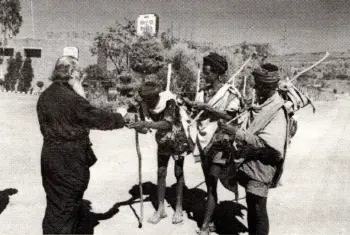
για τη βόμβα στο Πατριαρχείο
έτοιμο για την Τρίτη Χιλιετία

Πρωτοπρεσβύτερου, καθηγητή Πανεπιστημίου
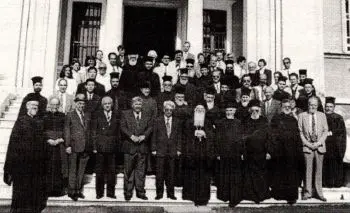
π. Εμμανουήλ Κλάψη
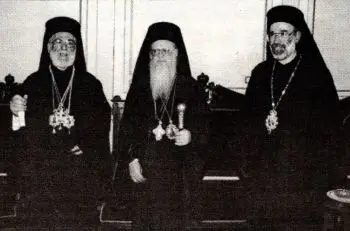
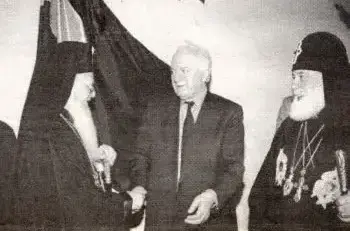

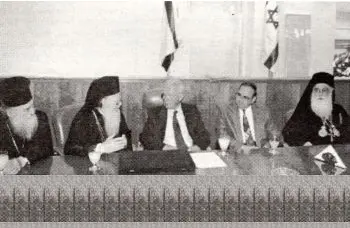
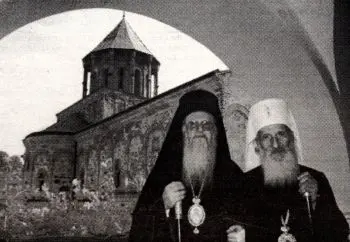
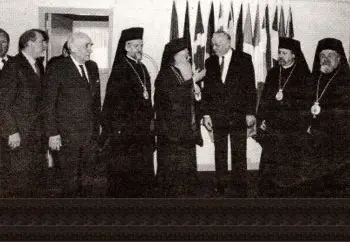


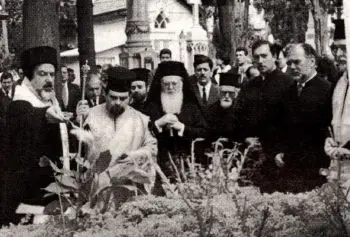
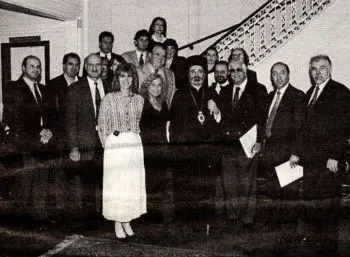



of the Holy Bible, 21st Century King James
Bible Publishers, Gary, S.D.
Rev. Dr. Athanasios Demos,
Holy Cross School of Theology
I shall not want.
He maketh me to lie down
in green pastures;
He leadeth me beside the still waters.
He restoreth my soul;
He leadeth me in the paths
of righteousness;
for His name's sake.
Yea, though I walk through
the valley of the shadow
of death, I will fear no evil;
for thou art with me;
Thy rod and Thy staff, they comfort me.
Thou preparest a table before me
in the presence of mine enemies;
Thou anointest my head with oil;
my cup runneth over.
Surely goodness and mercy shall follow me
all the days of my life;
and I will dwell in the house
of the Lord for ever."
St. Nicholas Greek Orthodox Church
Rev. George I. Paulsen (Holy Cross '44)
About 85 percent of members are converts






