
For thousands of faithful, the en- thronement of Archbishop Spyridon on a sundrenched Saturday on the last day of summer was the experience of a lifetime and an experience that will last a lifetime.
More than 1,200 persons packed the 650-seat Holy Trinity Archdiocesan Ca- thedral on Sept. 21 and at least that many more filled the basement hall and adjacent Cathedral Center to watch the service on large-screen TVs.
By Jim Golding
At 10:30 a.m., Archbishop Spyridon, accompanied by Metropolitan loakeim of Chalcedon, and numerous hierarchs and clergy of the Archdiocese and other Orthodox jurisdictions, Roman Catholic and Protestant churches, led the pro- cession into the Cathedral.
As he entered the nave, the entire congregation erupted into enthusiastic applause.
Stepping onto the solea on his way to the altar, His Eminence veered slightly to the left to make a grand gesture that solidified the past with the future and served as a visible reminder to the faithful that the Church is eternal — a brotherly embrace with his predecessor Archbishop Iakovos. A great cheer arose from the congregation.
Continuing into the altar, he donned the white litur- gical vestments — the epitrahelion and omophorion — that draped his shoulders, then proceeded to take his place on the throne, again to the warm applause of the faithful.
Meanwhile the cameras of the many TV crews present began to roll, some beaming the ceremony via satellite and the Faith and Values cable channel to millions of households around the world as the mellow voice of Rev. Emmanuel Gratsias provided the voice-over narration that kept the far-flung viewers attuned as the service progressed.
Attending the service were hundreds of clergy and presbyteres, lay leaders of the Archdiocesan Council, Ar- chons and other organizations, members of His Emi- nence's immediate family including his mother, sisters and brother, as well as numerous cousins and friends from the Tarpon Springs area and elsewhere, New York Mayor Rudolph Giuliani, other officials and presidential advisor George Stephanopoulos.
The 90-minute service consisting of a number of prayers and petitions included the reading of a message from Patriarch Bartholomew by patriarchal Deacon Tara- sios, and an address by Metropolitan Ioakeim.
"...With God's help, a new page is opened, a new period in the history of the Holy Archdiocese of America. A period for renewed spiritual struggle and common effort, which must be sealed and characterized by love, for above all other truth and virtue, this is what we have been taught by our Lord," the Metropolitan read in Greek.
Moments later, the Metropolitan presented His Emi- nence with the archpastoral staff of his office from the Ecumenical Patriarchate, signifying that he was officially enthroned.
Near the end of the service, Archbishop Spyridon gave his message to the faithful in both English and Greek that set the tone for the beginning of his ministry in America. He stressed that his concern is for our spiritual identity and that the Church should be inclusive to anyone wanting to embrace the faith. A top priority will be the youth.
The service ended amid shouts of "Axios" followed by a procession out of the cathedral.
As he started to leave, Archbishop Iakovos sto ped at the front pew where Clara Papageorgiou, Archbishop Spyridon's mother, and other relatives sat, and offered his congratulations and blessings.
Luncheon at the Waldorf
The weekend events continued at the Waldorf Astoria hotel as more than 2,000 luncheon guests filled the grand ballroom to overflowing.
As the dais guests took their places, the audience gazed at the large-screen TVs around the cavernous room to see a memorable sight — Archbishop Iakovos acknowledging the crowd followed by a shot of our new Archbishop.
Related coverage on pages
4, 5, 10, 11, 21, 27, 28
Among the many speakers were Archbishop Iakovos, New York Gov. George E. Pataki, Mayor Giuliani, New York Sen. Alfonse D'Amato, Maryland Sen. Paul Sar- banes, Metropolitan Philip of the Antiochian Orthodox Archdiocese, William Cardinal Keeler of Baltimore, Florida Congressman Michael Bilirakis, the ambassadors of Greece and Cyprus, U.S. Ambassador to the Vatican Raymond Flynn, Archdiocesan Council President Demitri Moschos and others.

His Eminence Archbishop Spyri- don with the newly appointed Chancellor of the Greek Orthodox Archdiocese of America, Rev. Fr. Alexander Leontis (D.Panagos photo)
Archbishop Iakovos praised Spyridon for his extensive education, long experience in inter-church relations and his "under- standing, love and willing- ness to help in every ef- fort."
He also exhorted the audience to "look forward, never backward. We must abolish suspicion, bias, ha- tred and the catastrophic spirit which has permeated the minds of young people in the world."
Gov. Pataki observed that "His Eminence has demonstrated a willingness to bridge the gap between different faiths as well as cul- tures. He understands that different religious institutions benefit from friendly dialogue, for without communica- tion, we will not achieve our common goals.
His Eminence's experience, open-mindedness and creativity make him will qualified to counsel the Christians in the Orthodox Diaspora."
Pataki also acknowledged the "im- mense role in American society of Archbishop Iakovos in the causes of social justice, civil rights and religious freedom.
Metropolitan Philip praised the "37 years of outstanding and brilliant lead- ership" of Archbishop Iakovos and the "outstanding efficiency of His All Holiness and the Holy Synod" for the swift election of Archbishop Spyridon.
The Metropolitan said he was "deeply moved by the humility and genuine love of the new Archbishop."
In a plea for unity, Metropolitan Philip, who also serves as chairman of the Standing Conference of Canonical Orthodox Bishops in the Americas, urged that "we must respond with one mind and one accord, otherwise we would continue to wander aimlessly through the wilderness of division."
Sen. Sarbanes read a congratulatory message from President Clinton (text on page 4). The senator also told His Eminence, "We stand ready to walk with you into the third millennium of Christianity. Our prayers and best wishes are with you."
Mayor Giuliani welcomed His Eminence to "the capital of the world" and presented him with a New York Yankees baseball cap, noting that he was unable to convert Archbishop Iakovos from his favorite Boston Red Sox.
On a serious note, Giuliani said that he looked forward to working with Archbishop Spyridon and that the enthronement "was a beautiful occasion that uplifted the city of New York.
Ambassador Loucas Tsilas of Greece said that "the Greek people rejoice at your enthronement as Archbish- op. Under your spiritual guidance, the community will be at the forefront of the faith and safeguarding of Hel- lenism."
Demitri Moschos noted that "We are deeply confident that your stewardship will see to it that the Church will not be a dinosaur, but an eagle which will continue to soar in the glory of God."
In his address, Archbishop Spyridon spoke of the importance of confronting the major problems facing A- merica such as crime, alcohol, tobacco, violence, a- bortion, civil rights abuses and racism. He said that, with the full support of the Ecumenical Patriarch, the Arch- diocese of America "stands ready to help address these problems." (full text on page 4)
As the luncheon concluded, another example of the harmony and love that has characterized His Eminence's approach manifested itself when he assisted Archbishop Iakovos down the steps leading to the dais.
First Vespers
That evening, His Eminence traveled to northeast Queens to the largest parish in the United States — St. Nicholas Shrine Church of Flushing — where he presided over his first Great Vespers service.
In his homily at the end, he talked of a new begin- ning, not only for his own service to the Archdiocese, but that which is represented by Christ's victory over the cross and death.
The Archbishop said that "we must pick up the cross together" and that "true love can only come by following the Lord and Savior Jesus Christ."
He continued, "I call upon all of you, especially the youth, to this new beginning for all of us."
The Archbishop told the faithful that "we need to spend time with our young people and children" and that the most important teaching they can impart is love for God's love., for one another and love for the Church." A major emphasis of his ministry will be to bring children closer to God, he told the congregation.
Following welcoming remarks by Fr. George Passias, head priest of St. Nicholas, he introduced several parish- ioners representing the various groups and organizations of his community — senior citizens, converts, young a- dults, and a newlywed couple with two infant children that a doctor had advised them to abort.
They each greeted Archbishop Spyridon and received his blessings.
A reception in the church's hall followed the vespers.
First Divine Liturgy
Sunday morning Archbishop Spyridon, along with sev- eral Orthodox bishops and clergy, celebrated his first Divine Liturgy at Holy Trinity Cathedral. A standing-room-only congregation filled the church. The Archbishop gave the homily focusing on the gospel lesson from Luke 5:1-11.
A reception took place afterward, concluding the of- ficial events of the enthronement weekend.
Among those attending was Archdiocesan Council President Moschos, who expressed his joy at the en- thronement of the new Archbishop. "As the Archbishop said, we have entered a new era, building on the legacy of the past to strengthen the Church as we approach the 21st century," Moschos said. "On behalf of the laity, we look forward to working with His Eminence to preserve our Faith for the future generations of Americans. He added that the Archdiocesan Council "expresses its appreciation to the Ecumenical Patriarch and Holy Synod for the election of Archbishop Spyridon."
Fordham University law professor Helen Bender, a member of the Archdiocesan Council Executive Commit- tee, commented that "I believe we're truly blessed to have received him."
Among the congregants during the weekend services were 10 Orthodox Christian cadets from West Point.
One of them, 19-year-old Cadet Pete Henderson, a sophomore, is Archbishop Spyridon's second cousin.
"This is overwhelming," Henderson told the Observer at the reception. "It's a great honor for the family."
He also expressed his confidence that Archbishop Spyridon would be "a great leader."
[ pp. 1, 11 ]
Enthronement Message of Archbishop Spyridon
Sisters and Brothers in Christ:
With love and joy in my heart, I humbly answer the call of our spiritual father, His All Holiness Bartholomew I, Ecumenical Patriarch, and the Holy Synod, to serve and minister to the Greek Orthodox faithful in America. I thank my beloved brother, Metropolitan loakeim of Chalcedon, for personally bringing to us the love of His All Holiness and the blessings of the Great Church of Christ in Constantinople.
It is only by the mercy of God that I stand before you today as your Archbishop, for only by His grace could so many worthy challenges be placed on so unworthy a soul.
Indeed, elevation to this sacred throne is an awesome commission entrusted to me by the Ecumenical Patriarchate On this most solemn day for our Church in America, I pray for strength from God to carry out this blessed task, and I ask all of you for our love, support and constant prayer.
As I accept this commission, I find myself as the in- heritor of an extraordinary legacy which has been given to us by my predecessors: Alexander, Athenagoras, Mi- chael and Iakovos. Their record shows what mere people can achieve when touched by a compassionate God who loves mankind. Today, the shepherd's staff is passed to a generation born in America. Let us pray together for God's continued blessings and grace, so that in our own day, we, too, may know what it is to achieve great things in His holy name.
Let us remember this day all that they accomplished would not have been possible without our committed clergy, our faithful presbyteres, and our loyal laity — and without people like my parish priest, Fr. Constantine Raptis of Tarpon Springs, Fla., who was a spiritual guide to me, and who honors me by his presence here today.
Like the sturdy columns that have sustained the Par- thenon for thousands of years, and like the powerful arches that have suspended the dome of Aghia Sophia for centuries, each and every one of you carries the Greek Orthodox Church in America on your shoulders. Indeed, so vital is your role in the future of our Arch- diocese that I will begin my tenure with a pilgrimage to parishes throughout the United States, in order to ex- perience the parish life of the Church in America, be close to you, and walk with you, and in so doing see how the Archdiocese can be of greater help.
I approach this throne today as a pulpit from which to preach the Faith; not so much as a lectern from which to instruct you, but as a seat from which to learn about your concerns, dreams and expectations; and not as a podium from which to dictate, but as a platform from which to define, with your help, a vision for our Church in America.
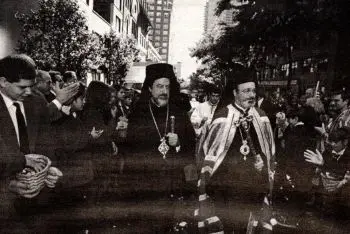
Two hierarchs (N. Maginas photo)
Archbishop Spyridon, escorted by Metropolitan Ioakeim of Chalcedon, makes his way past the crowd outside the Holy Trinity Archdiocese Cathedral.
I profoundly believe that, as great and glorious as our past, there is even greater glory in our future. But only if we take to heart the central message of our Church: that in the resurrected Christ, we are all born again, we are all reconciled, we are all renewed. Only by renewal do we grow, only by renewal do we improve, only by renewal do we become more worthy of our Father, in whose image we were made. And so St. Paul wisely counsels us, "Be renewed in the spirit of you mind and put on the new man who was created in the image of God."
Like His All Holiness, Patriarch Bartholomew, I believe that the Archdiocese of America can play a pivotal role in the renewal of the Holy Orthodox Church. The Greek Orthodox faithful in America are deeply engaged in all aspects of the life of this great nation. The rich spiritual, intellectual and material resources of the Church in America can provide us with the tools to better confront growing pastoral challenges and safeguard the rights of Orthodox Churches and communities throughout the world.
This Archdiocese stands at the forefront of an ex- traordinary history. Indeed, both the Church and her children have come a long way since we arrived on these shores more than a century ago, as "strangers in a strange land." The Church that we inherit was built with love, faith and great sacrifice by our parents and grandparents who emigrated to this land of hopes and dreams. Often uneducated, they worked from sunrise to sunset until they could save enough money to bring over a brother, a sister, a wife, a child or a cousin. The little they earned put bread on the table for themselves and for those still back in the homeland. But as good Christians, they also knew that "man does not live by bread alone." And so, hard-pressed though they were, they made sure to build a home for the Faith of their fathers and mothers — a Greek Orthodox Church that would protect and preserve that rich spiritual heritage and convey it to their children born in a new land.
Those early immigrants built 65 percent of the Or- thodox churches in America while they were among the poorest communities in the country. We have much to accomplish to match their achievement now that their children have been blessed with material resources.
Our archbishops have been faithful fathers, seeing us through the stages of our communal life. Alexander nurtured us through our childhood as a community, while Athenagoras guided us safely through the conflicts of adolescence. Under Michael, we achieved adulthood, and with His Eminence Archbishop Iakovos, our community finally became wedded to America.
Together we have created a new community that is partly Greek, partly American, and yet completely Or- thodox.
It is no betrayal to join ourselves to a new nation. But it would be a grave failing not to provide for the fruit of that union —the children of Orthodoxy in America. The time has come to think earnestly about our legacy to them.
What kind of church will we leave to our children, and to our children's children? If we take our faith seriously, we know that their salvation tomorrow depends on how well we answer that question today.
I see one of my primary roles to be an advocate for those children — after all, I am one of the children of America. My mother gave birth to me in Warren, Ohio. I feel truly blessed today to have her and my sisters and brother here.
Of all humanity, Jesus singled out children as special: "Whosoever shall receive one of such children in my name, receiveth me; and whosoever shall receive me, receiveth not me, but him that sent me." We need to cherish, love and spiritually nurture our children, keeping them close to the Church and teaching them the beauty of their Faith.
Our young people deserve a living tradition in which they can find spiritual sustenance. They deserve a refuge from the anxiety of modern, materialistic life. they deserve the comfort of belonging to a loving, spiritual family. And they deserve the strength that comes from enduring values. All that they seek is offered by the Greek Orthodox Church.
I take it as the special task of my tenure to prepare a strong legacy for our youth: a Church that will grow and endure, a Church that will serve the needs, not just of any one generation of Orthodox in America, but of all generations of Orthodox in America.
Brothers and sisters in Christ, the key to building such a Church is inclusion. Rome became great by opening up its citizenship to all people. Christianity became pre- dominant by welcoming all people into the Faith. The United States became the strongest nation in the world by opening its doors to all people — raising a huge Statue of Liberty in the middle of its greatest harbor, to let newcomers know that they were welcome. Each of these communities shared the belief that, by admitting new members, it would gain far more than it lost. Each of these communities was right.
The Greek Orthodox Church is no exception. I read in
a newspaper not too long ago that the greatest problem we face today is that the majority of our people in America marry persons not of the Orthodox faith. I was shocked, not that they are a majority, but that anyone would regard this solely as a problem.
It is not so much a problem as it is a promise of things that can be. It is an opportunity. Let us take advantage of it, for a church that is open to all people is a church that grows. Isn't this what happened when the Apostle Paul, the patron saint of the Archdiocese, took the message of Christ to the Gentiles, the Greeks, and the Romans of the eastern Mediterranean, despite the disapproval of some of his fellow disciples?
Let us inspire our young people with the Faith that inspired their mothers and fathers, so that when the time comes for the sacrament of marriage, the Church is their first thought, not their last resort. Let us welcome and embrace their non-Orthodox spouses with love, and let us tell them about our Faith with joy.
Today, we all gather in this cathedral as children of God. We are honored by the presence of political and civic leaders of many races and creeds, and by cardinals, bishops and clergy. They are our brothers and sisters, and we join hands with them to promote religious tol- erance and freedom. Together, we must fight the forces of bigotry and intolerance that burn African-American churches in the United States, and that forcibly close seminaries in other parts of the world.
There is a brotherhood of believers in America, and we must take care to build bridges to each of these communities of Faith, even as we nurture and develop our own community. The mosaics that adorn our churches bring together parts that are different and turn them into a vision of beauty. So it is with the American mosaic, and we must respect that. Yes, we have a unique gift in the Tradition of our Church — we have preserved something beautiful and fulfilling, something ancient and pure, and kept it safe so that others may share in it. As the Orthodox Patriarchs wrote in a joint letter in 1718, "we preserve the doctrine of the Lord uncorrupted, neither adding anything nor taking anything from it." That doctrine is called ORTHO-DOXIA, correct belief. but let us be sure to follow ORTHO-DOXIA with ORTHO-PRAXIA — to follow correct belief with correct action. We must love even those who are different from us.
And that includes our fellow Orthodox, such as Rus- sians, Georgians, Albanians, Romanians, Serbs, Bulgar- ians, Ukrainians, Arabs, as well as Hispanics, Asians, Afri- cans and countless others, those who were born Or- thodox and those who were not born Orthodox but yet have embraced the Orthodox Faith. We learn from our Creed that there is "one, holy, catholic, and apostolic church." but too often we see with our eyes a church divided, not only in Eastern Europe, but even here in the United States, with its parallel Orthodox jurisdictions.
We read in the Bible that "there is neither Jew nor Greek, there is neither slave nor free, there is neither male nor female: for ye are all one in Christ Jesus." But what we see all to often — not only among Orthodox, but throughout the world — is a destructive politics of identity, in which there is only Jew or Greek, only male or female, only black or white.
No one takes greater pride in Hellenic culture that I do, to which my Greek school teacher, Savvas Petrides, will readily attest. He came all the way from Steubenville, Ohio, to be with me today. I am deeply touched by his presence.
Western civilization arose within the womb of Hellenism. We would be foolish to squander that rich legacy, or to forget who we are and where we came from.
I believe that those newer arrivals who still feel strong ties to the country of their birth and to their mother tongue are a bulwark of our Church in America. I believe we need to do more to preserve the culture and the language to which they, and we, are bound. It will be one of my goals to expand the teaching of the Greek language, the language of the Gospels, and of Hellenic culture in our communities. And I intend to reach out to all philhellenes and friends of Orthodoxy who recognize the vast contributions that Hellenism has made to Christianity and the world. with the help and support of our Church schools, of the many academic programs devoted to Hellenic studies, of the great number of Greek cultural organizations in America, and of Hellenes and philhellenes everywhere, we will preserve our cultural identity.
But my concern is first and foremost with our spiritual identity. For the Orthodox Church serves no earthly power, but only Christ Jesus himself.
I spoke earlier of our Ecumenical Patriarch's special hopes for America as a source of renewal for Orthodoxy. When it comes to inclusion, America very much justifies those hopes. For every time Orthodoxy believers of dif- ferent ethnic backgrounds share the chalice of Holy Com- munion — as we do here in America — all of Orthodoxy takes a step forward. Every time bishops of different ju- risdictions meet in partnership to advance the common Faith — as American bishops do in SCOBA — all of Orthodoxy takes a step forward. I am pleased today to greet my brother hierarchs of SCOBA; I warmly thank you for your presence and participation here today; and I pledge myself to our common dream of growing together and ministering as one Orthodox family to all of our Faithful.
The inclusiveness of the American Church stands as a beacon for Orthodox Christians throughout the world. It justifies His All Holiness' high expectations for this Arch- diocese. I am thankful for the ministries of my brother Bishops of the Archdiocese, who for many years have served my predecessor as his co-shepherds to the flock in the Western Hemisphere. I look forward to working closely with them for the continued good welfare of this Holy Church.

Family pride (D. Panagos photo)
The Archbishop's mother, Clara Papageorgiou (r), and his three sisters rever- ently look on as he is elevated as the next archbishop of the American church.
The Greek Orthodox Church here is a natural exten- sion of the Ecumenical Patriarchate. Just as the Mother Church is the first See of world Orthodoxy — with in- creased responsibilities, a special ministry, and a primary role in the affairs of Orthodox Churches throughout the world — likewise the Daughter Church of America has a special ministry in the New World, a ministry of relevance to all of us.
Sisters and brothers, today we open a new chapter in that ministry. We approach the third millennium in a society where people are desperate to distract them- selves. they are weary of life and afraid of death. Political cynicism and personal disillusionment have robbed them of their ability to believe.
Yesterday, our forbears needed the hope offered by America. Today, America needs the hope offered by our Church.
We must recapture the daring spirit of the great Patriarchs of Constantinople — Chrysostom, Gregory, Photios, Athenagoras and Dimitrios — as well as the dreamers who left their homelands, the pioneers who established our Church in America. And we must share the Good News. Where others see death, we have a vision of life. Amid sorrow, we have reason to rejoice. In an untrusting world, we have something we can depend on, something that has remained true to us for the last 2,000 years, and will remain true to us for the next 2,000 and unto the ages of ages: the salvation of the cross and the promise of the empty tomb of our Lord and Savior Jesus Christ.
Brothers and sisters in Christ: may our Heavenly Father grant us the wisdom and strength to pursue our task, and the good fortune to succeed. And in so doing we on earth will become, like the angels in heaven, messengers who proclaim: "Glory to God in the highest, and on earth, peace and goodwill to all women and men."
[ pp. 1, 10, 11 ]
|
RELATING TO THE FAITH |
What the Church Fathers Say about ... Being Born Again-2
Part of an ongoing series
What is the goal (v.14) of the maturing Christian believer? For Paul it is that we be engaged in the struggle of faith, confident that Christ has made us His own, but fully cognizant we are not yet perfected. Therefore, we have to "press on" (v. 12) toward the realization and completion of our salvation. There is no room for "instant salvation" in the teachings of St. Paul.
Yes, it is possible to lose one's salvation. If we are arrogant and presumptuous enough to claim to know our eternal future then we must take enormous care never to place that salvation in jeopardy. The truth is, however, that we should never become so complacent, so sure, as to say that we can force the hand of Almighty God. This truth is laid out clearly in several places:
In John 3:4-10
"Whoever commits sin also commits lawlessness, and sin is lawlessness. And you know that He was manifested to take away our sins, and in Him there is no sin. Whoever abides in Him does not sin. Whoever sins has neither seen Him nor known Him. Little children, let no one deceive you. He who practices righteousness (being good, just and blameless) is righteous, just as He is righteous. He who sins is of the devil, for the devil has sinned from the beginning... Whoever is born (again) of God does not sin, for Christ's seed remains in Him, and He cannot sin. Because He has been born again of God."
In 2 Peter 2:20-22
"For if, after a person has escaped the pollutions of the world through the knowledge of the Lord and Saviour Jesus Christ, they are again entangled in them and overcome, the latter end is worse for them than the beginning.
For it would have been better for them not to have known the way of righteousness, than having known it, turn from the holy commandment delivered to them.
But it has happened to them according to the true proverb: 'A dog returns to its own vomit.'''
Of course, a man can lose the gift of being "born again." Look at his or her life. Do they manifest the gifts of the Spirit, i.e., truthfulness, honesty, purity and all forms of righteousness? Or are they like dogs, who return to the vomit from which they came?
Look also at Hebrews 6:4-6:
For it is impossible to restore again to repentance those who have once been enlightened who have tasted the heavenly gift, and have become partakers of the Holy Spirit, and have tasted the goodness of the word of God and the powers of the age to come, if they then commit apostasy, since they crucify the Son of God on their own account and hold Him up to contempt.
So, you see, it is possible to lose the gift of being born again and it is impossible to renew them again to repentance.
How Can We Be Saved?
We are continually being saved. Our Savior asks us to "abide (continue) in My word, (then) you are My disciples indeed" (John 8:31). "Everyone who loves is born of God" (1 John 4:7). And one who loves "keeps the commandments." This is a hard word indeed! No instant, emotional salvation here! Salvation is a continual process because I was saved by Christ's death on the cross, when He paid the penalty for my sins. Read Romans 5:6-11:
"In that while we were still sinners, Christ died for us." (v.8)
"Much more then, having now been justified by His blood, we shall be saved from wrath through Him." (v.9)
"We shall be saved by His life." (v.10)
I am saved because I know Christ is the only path to heaven and eternal life "Jesus said, I am the way, the truth and the life. No one comes to the Father except through me" (John 14:6).
I am being saved each day of my life, by trying to become as much like Jesus Christ as is humanly possible.
"For to this you were called, because Christ also suffered for us, leaving us an example that you should follow His steps." (1 Peter 2:21)
Christ Himself, commanded us to strive for perfection. "Therefore you shall be perfect, just as your Father in heaven is perfect" (Matthew 5:48)
I will be saved when my life, lived in God's love, and following the example of Christ Our Savior, is over and I am judged whether I really believed and lived what I claimed to believe. For what is the purpose of a judgment if I am sure, beyond a shadow of a doubt, as our "born again" friends say, that I am saved and my name is in the Lamb's Book of Life. Judgment is unnecessary for the saved! Salvation as noted in Holy Scripture, is not mere words. Jesus was adamant when He said, "Not everyone who says to Me, Lord, Lord, shall enter the kingdom of heaven but he who does the will of My Father in heaven" (Matthew 7:21).
St. Paul expands on this profound truth in 1 Corinthians 3:14-15:
"If anyone's work which he has built endures, he will receive a reward. If anyone's work is burned, he will suffer loss, but he himself will be saved, yet so as through fire."
Obviously, if salvation was assured in an instant there would be no need for St. Paul to urge us to "endure."
Eternal salvation can take a lifetime and requires ef-
fort, not mere testimony:
"My little children, let us not love in word or in tongue, but in deed and in truth." (1 John 3:18)
No one can work their way to heaven
We can never work our way into heaven! We can never "earn" our salvation by the quantity or quality of the good works we perform. However, because we were saved by Christ's redemptive death we must expend effort and be obedient to the example Christ set for us.
"And do not present your members (body) as instruments of unrighteousness to sin, but present yourselves to God as being alive from the dead, and your members as instruments of righteousness to God. For sin shall not now have dominion over you...(because of Christ's sacrifice) for you are not under the Law but under grace." (Romans 6:13-14)
Add to this James' words:
James 2:14: "What does it profit a man, my brethren if someone says he has faith but does not have works? Can faith save him?"
James 2:17: "Thus also faith by itself, if it does not have works is dead."
James 2:18: "But someone will say; "You have faith, I have works." Show me your faith without your works, and I will show my faith by my works."
However, when we believe in Christ as Lord, good works will naturally flow from our belief, if they are done in the name of our belief of Jesus, as Savior and Redeemer.
St. Paul, in Hebrews 11:6 says:
"For without faith it is impossible to please Him, for he who comes to God must believe that He is, and that He is a rewarder of those who diligently seek to do His will."
We recall the story of Zacchaeus related in Luke-19:8-10. Zacchaeus was wiling to give one half of all he owned to the poor and pay back four times over to anyone whom he may have defrauded. These were both good works, and followed Zacchaeus' acceptance of Jesus, for Whom he had an open heart. Jesus proclaimed, for all to hear, that because Zacchaeus was willing to do what the rich young man could not, salvation had come to his house.
Your salvation is dependent on your faith in Christ as Your Savior. But this faith cannot be just mouthed - it must be active and alive. Unlike Zacchaeus, the rich young man was unable to sell his belongings and give to the poor (clearly good works). Had he done so Jesus promised him treasure (salvation) in heaven. (Matthew 19-21)
In the seventh century, St. Gregory the Great said this:
"For many come to faith, but few are brought into the heavenly Kingdom. And many serve God with their tongue, but turn from Him in their lives. From this we should reflect on two things. The first is that no one should presume concerning his own salvation: for though he is called to the faith, he knows not whether he will be chosen to enter the Kingdom of Heaven. The second is that no one should take it upon himself to despair of his neighbor, whom he sees steeped in vice, because no one knows that rightness of Divine mercy."
A Spiritual Elite?
Keeping in mind the preceding words of Gregory the Great, we must refrain from becoming either arrogant or presumptuous about our salvation, or the salvation of others. Some "born again" Christians enjoy being members of a spiritual elite. They believe only they have true salvation and, as such, are favored in the eyes of Almighty God. They also will not accept any interpretation of salvation except their own narrow version. They conveniently forget that the idea of "re-birth," being "born from above" (which is actually the proper translation of "born again") has been, and now is, common to many religions. To be "born-again." to be renewed or made whole once more, is actually at the heart of beliefs such as Shamanism, nature religions, New Age, and almost every mystic faith known to man. Dying to old life and being re-born is not a new phenomenon. It has been around since the earliest days of the Christian Church where it was borrowed from pagan belief systems St. John Chrysostom tried to fight a perverted interpretation of being born from above as did Gregory.
Many tried to twist Christ's teaching about being born of water and the spirit, "Unless one is born of water and the Spirit, he cannot enter the Kingdom of God (John 3:5).
To these early Christians, Gregory responded:
"Perhaps each of you will say to himself. I have believed, therefore I shall be saved. He speaks what is true if to his faith he joins good works. That is indeed true faith which does not deny in work what it professes in word.
"For this St. Paul says of certain false faithful: "They profess that they know God, but by their lack of works they deny Him." (Titus 1:16) For this John also says: "he who says that he knows God, and keeps not His Commandments, is a liar, and the truth is not in him." (1 John 2:4)
Excerpted from the book "What the Church Fathers say about ..." edited by George W. Grube, Light & Life Publishing Co., Minneapolis, 1996.
[ pp. 2, 25 ]
A Thank You
from His Eminence
His Eminence Archbishop Spyridon takes this opportunity to express his gratitude to all who have so graciously offered their prayers and congratulations on the occasion of his enthronement as Archbishop of America.
His Eminence was also moved by the outpouring of love that was expressed through the many congratulatory wishes, gifts and, particularly, flower arrangements which he received on the occasion of his birthday, and extends a heartfelt thank you for all these acts of kindness and welcome.
The Archbishop, realizing the great and many needs of the ministries of this holy Archdiocese, desires that we all, as a family united in Christ, support the Archdiocesan ministries. With much love, His Eminence requests that we contribute our time, talents, and material resources to comforting and assisting the most tender and precious members of our community.
With these thoughts in heart and mind, all the Faithful of the Archdiocese are asked, in the future, to please, in lieu of flowers, to express your love and good wishes to His Eminence by offering a donation to either St. Michael's Home for the Aged or St. Basil's Academy. We need to be mindful of our aging fathers and mothers and our beautiful children, pledging ourselves to their safety, well-being education and spiritual nourishment.
As you contribute to these most worthy Archdiocesan Institutions, know in your heart that you honor your Archbishop most by extending your love and concern to those for whom we are all responsible.
[ p. 2 ]
|
|

President Clinton's Message to His Eminence
Dear Archbishop Spyridon:
I am pleased to join with Greek Orthodox Christians and people of faith across America and around the world in extending heartfelt congratulations on your enthrone- ment as Archbishop of America.
Your commitment to serving the spiritual needs of others has been invaluable in fostering an atmosphere of compassion and fellowship. By embracing this new chal- lenge, you are helping to shape a part of our world for generations to come.
While the responsibilities of spiritual leadership are great, the knowledge of a mission fulfilled can be among
life's most meaningful rewards. As you begin to address the tasks of leading the church in the Western Hemi- sphere, you have my prayers and good wishes for every success in this special a role to which God has called you.
Sincerely,

Bill Clinton
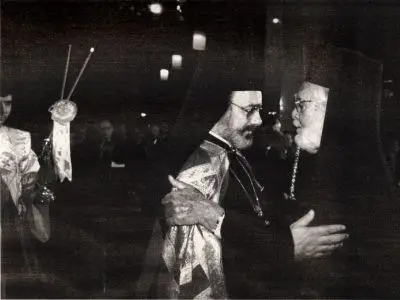
NEW ERA BEGINS
Archbishop Spyridon pauses briefly after entering the church on his way to the altar, to embrace Archbishop
Iakovos in a gesture of love that served to uplift the congregation.
(D. Panagos photo)
Archbishop Makes Staff Appointments
NEW YORK — Archbishop Spyridon recently appointed three clergymen to key positions at the Archdiocese.
The Very Rev. Alexander G. Leondis is chancellor; the Very Rev. Archimandrite John A. Heropoulos is director of the Office of the Archbishop and the Rev. Alexander Karloutsos is vicar for public affairs.
Fr. Leondis has served as pastor of Holy Trinity Church, Westfield, N.J., since 1974. He is a past presi- dent of the Archdiocesan Presbyters Council.
Father Heropoulos most recently was pastor of St. Paraskevi Church, Greenlawn, N.Y., and served as deacon to Archbishop Iakovos from 1989 to 1993.
Since 1992, Fr. Karloutsos has served as an assistant to the Ecumenical Patriarch and was vicar for public affairs for the Archdiocese from 1984-92.
The three officials assumed their duties on Sept. 20.
A Dream Come True
http://www.goarch.org/observer
Responding to the demands of the new generation of computer literate Greek Orthodox faithful, the Orthodox Observer's "page" on the Internet is already in place and will be continuously upgraded. It was made possible by knowledgeable volunteers, and through direct and interactive links with the Arch- diocese's web site (http://www.goarch. org) it offers a wide selection -and soon a library- of its articles, commentaries and news items, as well as links to other selected mirror sites, to a plethora of electronic "surfers".
His Eminence Protests Demonstrations Against the Phanar
Archbishop Spyridon has sent the following letter to Prime Minister of Turkey Necnettin Erbakan and Foreign Minister Tansu Ciller protesting a recent demonstration by extremist groups directed against the Ecumenical Patriarchate of Constantinople.
The letter also protests threats made against the life of His All Holiness Ecumenical Patriarch Bartholomew in an article appearing recently in a Turkish periodical, "Middle East," in which His Eminence alludes to the hanging of Patriarch Gregory V in 1821.
His Eminence wrote: "It is with deep concern that I write this letter regarding the demonstration recently di- rected at the Ecumenical Patriarchate by various extrem- ist elements who protest unrelated events which have taken place in a foreign country.
"The Orthodox Church in the United States is most sensitive every time our Mother Church, the Ecumenical Patriarchate at the Phanar, is unjustly connected to un- related political matters and used as a target for violent protest. These unjust actions, directed at the Ecumenical Patriarchate, cause international concern and distress for millions of Orthodox faithful who look upon the Patri- archate as the Center of world Orthodoxy.
"I must also bring to your attention that the personal threats against Ecumenical Patriarch Bartholomew's life which were expressed at the same time by the Turkish periodical "Middle East" can only be a matter of further profound concern to the Orthodox Church worldwide. Appealing in this case to the sad example of the violent death of Patriarch Gregory V, who in 1821 was hanged at the center gates of the Patriarchate at the Phanar, can only be perceived as a direct threat to the freedom and peaceful existence of the Patriarchate, a sacred place which has for centuries prayed for peace and under- standing between all people and until this day humbly serves millions of Orthodox faithful throughout the world.
I am confident that you, Madame Foreign Minister, known for being guided by religious principles and for the desire to protect the rights of all revered religious institutions in Turkey, will use the good influence of your office to bring these latest unjustifiable protests to a peaceful end.
Encyclical
His Eminence Expresses Sorrow for Cyprus Tragedy
September 12, 1996
To the Reverend Clergy and the Faithful
of the Greek Orthodox Archdiocese of America:
I address this encyclical to all the faithful of the Holy Archdiocese of America with a heart which yearns for peace in the world and understanding between all people.
As you know, there has been continuing bloodshed and violence on the island nation of Cyprus. Cyprus, which is the home of countless churches, monasteries and holy places, a country which has produced saints throughout the ages who continually prayed for peace, continues to be tormented by the abuse of human rights and the killing of precious young people.
On August 11, Tassos Isaak and Solomos Solomou were killed by the brutal action of Turkish-Cypriot citizens and members of the military. These two young people who were expressing their desire for justice, and were bringing attention to the 22-year occupation of a con- siderable portion of Cyprus by foreign troops were, one, ruthlessly beaten to death, and the other shot to death. Violence and hate are reaching into yet another gen- eration of our young people because of the blatant dis- regard for international law, and the constant call of all civilized nations to peacefully settle the Cyprus question once and for all time.
With a spirit of fatherly love for these two young men, and for the youth of the world who desire for goodness and freedom everywhere, I ask that a memorial service be chanted in all of the churches of the Greek Orthodox Archdiocese of America on Sunday, September 22, 1996. Let us come together in love, as a united Greek Orthodox community, to pray for the blessed repose of the souls of these two young men, and also pray to Christ, the Prince of Peace, to inspire all people of good will to work for peace in Cyprus and throughout the world.
By the coming together of tens of thousands of prayers from every part of this Archdiocese, may the unity of the Greek Orthodox Church in America be most perfectly realized once again.
Praying for the grace and mercy of the Lord to be with you all, I remain,
With paternal blessings,
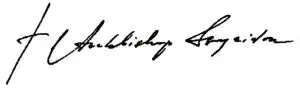
Archbishop of the Greek Orthodox
Archdiocese of America
[ p. 3 ]
|
|

Luncheon Address of Archbishop Spyridon
This morning I was enthroned as the Archbishop of A- merica. For those of you who were at that service, and for those of you who are here this afternoon, I am very honored and grateful that you have come to lend your voices to my prayer that I may rightly pastor this flock that God has given to me this day.

First entrance (D. Panagos photo)
His Eminence enters Archdiocese headquarters shortly after 6 p.m. following his arrival at Kennedy Airport on Thursday, Sept. 19.
It is an awesome responsibility to be given charge of this particular Church. I my homily this morning, I spoke of America as a source of renewal for Orthodoxy. I spoke of an America whose very essence is the inclusion of all peoples, as a place where the Greek Orthodox Church can flourish as a beacon for Orthodox Christians through- out the world. Indeed, as I look around this room, I see the uniqueness of this Church, and of this country. Even this luncheon, with so many distinguished guests, with so many people who have traveled from afar, even with all the glorious flowers that adorn these tables, and the fine food, and this magnificent setting: all of this say to an Orthodox churchman who has spent most of his ministry in another country that this is a unique and wonderful place.
But of course, I come to you as an American, too. And I must say, it is good to be home.
Someone once told me that the only place you can truly be an American is outside of America. In other words, while we are in America we are merely our- selves amongst ourselves, and only when we are in an environment and circumstances foreign to us do we see ourselves as particularly American.
The thought that goes along with this axiom is that, in order to understand who we are, we must see ourselves in relationship to everyone else. This holds true for us as Americans; this holds true for the many of us in this room of Greek heritage; this holds true for those of us who are Orthodox Christians. And this holds true for me as an Orthodox churchman. I remind you of this truth because, as leaders and servants and citizens of such a great country, our vision must encompass more of our world than our own relatively narrow circumstances sometimes tempt us to allow. Otherwise, we Greek Orthodox Christians in the United States of America would end up living our Faith in the sectarian isolation of an ethnic ghetto. And I don't think -looking around this room- that is something any of us want.
The full integration of our Orthodox community into the mainstream of American society is perhaps the most profound legacy left to us by my direct predecessor, His Eminence Archbishop Iakovos. Indeed, the many Ortho- dox civic leaders sitting in this room are a testimony to that legacy.
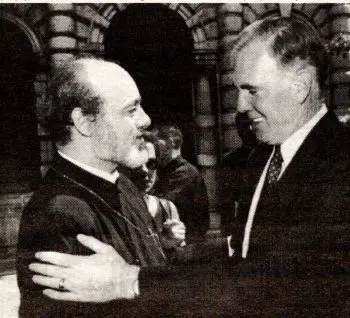
A FEW weeks before coming to the United States, Archbishop Spyridon received the American ambassador to the Vatican, Raymond Flynn, at the headquarters of the Greek Orthodox Archdiocese of Italy In Venice. Flynn, a former mayor of Boston, conveyed President Clinton's congratulations on Archbishop Spyridon's election as primate of the Greek Orthodox Church in America.
However, a legacy is not an inheritance to merely hold onto; it is a foundation on which to build. It is, therefore, our obligation to build on this legacy and not be content with merely being part of the American mainstream. Rather, our aim should be to witness in our American community to our Faith, and the best way to do that is to live our Faith. It is, then, our moment in history to take our witness of faith among our neighbors and join it to that of St. Paul, who advanced Christianity throughout the Greek-speaking world of his time; to join it to that of Ss. Cyril and Methodios, who brought Orthodox Chris- tianity to the Slavs; and to join it to that of the mission- aries who sacrifice even today their well-being in order to preach the Gospel in all the corners of the earth.
This is not a call to be arrogant about our Faith. It is, however, a call to simply live our faith. This is what the true evangelistic spirit has always meant. This morning I spoke of intermarriage, not as a problem, but as a bless- ing and an opportunity for our community to grow. But for the opportunity to truly be a blessing, it would be good to remember the admonition of an American Prot- estant theologian, who once wrote that it is not an indict- ment against others if they see the Church as it is and choose not to be Christians; if others see the Church and do not want to be Christians, it is an indictment against the Church. In other words, if we do not live out our Faith with love and humility, why should anyone-including our children's spouses-want to join it?
This morning I also spoke of the future realization of one Orthodox Church here in America, and here I echoed the thoughts of His All Holiness Patriarch Bartholomew. We must now move forward toward that bright new day when all the Orthodox in this country-Greeks. Russians, Ukrainians, Serbs, Arabs, and all the many others-must be united, for it is only as one Church that we will fulfill the prayer of our Lord Jesus Christ when, as it is told to us in the 17th chapter of John, he prayed that his entire flock be one. Indeed, we can even extend our hopes for this unity to our partners in the ecumenical movement, although to achieve it will be a long and complicated process, as the history of ecumenical relations in this century has shown. Still, it is a hope and a goal to which I, and Ecumenical Patriarch Bartholomew, are deeply committed indeed, if the 20th century has been called the "ecumenical century," why can't we dream of our great-grandchildren one day looking back on the next century as the "century of unity"?
On that long march, our Church has the potential to play an important role. The Greek Orthodox Church in this country is unique among the other Orthodox Churches. Where else are Orthodox laymen and lay- women so deeply involved in the workings of the Church, not just at the parish level, but at the diocesan and Archdiocesan levels? Where else in the world is there a body resembling the Archdiocesan Council, with mem- bers who lend their time and talent to ensure fiscal and legal soundness in the administration of the Church? Where else are Orthodox laywomen so well-organized as in the National Philoptochos, with its great works of charity on the local and national levels? Where else are young people so actively involved in the Church's life, in such organizations as JOY, YAL, and the various Scouting troops affiliated with church communities? Where else have Orthodox men and women donated their money with such foresight as to provide the Church with a perpetual source of funds for its national ministries, in the form of an endowment fund known as Leadership 100? Where else have Orthodox laymen been asked to give their talents and resources with one accord to de- fend and build up the Patriarchate as in the Order of St. Andrew, or the Archons?
Yes, the Greek Orthodox Archdiocese of America is unique in the Orthodox world. But it is also part of the Orthodox world. And here I most specifically refer to its intimate connection with the Orthodoxy's Mother Church; the Ecumenical Patriarchate of Constantinople.
As we all know, the Ecumenical Patriarchate has had a glorious history. And, more than any of us know, it has a glorious future. From the 4th century to the 15th cen- tury, it's existence, or rather its worldview, defined that of the Byzantine Empire, which was the greatest Empire known to the history of the world. As the head of the Church, the Ecumenical Patriarch of Constantinople was the symbol of Orthodoxy throughout the Empire, or since the Empire was defined by its borders, throughout the Christian world, the Oikoumene. In 1453, the Byzantine Empire came to an end. But the Ecumenical Patriarchate remained. What remained as well as the worldview of the oikoumene. And it continues to exist today. For those of us in the room who are Greek, one of the most puzzling developments in the 20th century -and this has been written about by the great English historian Steven Run- ciman- is that we Greeks, in our search for an identity have perhaps skipped over the largest portion of our history and have chosen the legacy of ancient Greece as that which only defines us rather than proudly looking also to the Byzantine legacy that has formed us for over 1,500 years. Only by balancing both legacies do we hon- or our true cultural heritage.
The Ecumenical Patriarch is well conversant with this problem, and he seeks to address it. He sees it as a matter of our Faith. Therefore, let us reiterate the reality that we have known for 2,000 years-that at the Ecumen- ical Patriarchate, the Great Church of Christ, the Phanar, is still the unwaning candle that illuminates that world- view that defines the Orthodox soul, whether it be the soul of a Greek, a Russian, an Arab, an Asian, an African, or an American.
The Ecumenical Patriarch His All Holiness Bartholo- mew I, is cognizant of his role as the guardian of that candle's light. And for all of world Orthodoxy he desires to brighten the flame. The Greek Orthodox Archdiocese will continue to play a great part in spreading the light that emanates from the sacred flame in the Phanar. And we Orthodox believers, if we truly are agents of renewal as His All Holiness believes must recognize our obligation to be united with him in this effort. This is the perspec- tive we need to maintain if we want to steer a clear course as an Archdiocese in the years to come. This per- spective will guide our internal Church life; this per- spective will guide our ecumenical life; and this per- spective will guide our relations with the larger communi- ty in which we live.
We recognize the reality in America of the problems of crime, alcohol, tobacco, violence, and abortion. As Arch- bishop, and with the full support of His All Holiness, I assure our civic leaders -Governor Pataki, Senator Sar- banes, Michael Bilirakis, and others present, as well as those not present this afternoon- that the Greek Ortho- dox Archdiocese of America stands ready to help address these problems.
We also recognize the reality in America of civil rights abuses and racism -we see it, for example, in the burning of black Churches- and we deplore it. As Archbishop, I assure you that our Archdiocese stands ready to meet this hatred head-on, with both the love of Christ and the active participation of our people. These evils do harm against holy and well-meaning people around the world, especially the crimes of violence and hatred and racism, which in other countries take the form of ethnic divisions and nationalistic aberrations and religious wars. As Arch- bishop, I assure you that we join the peacemakers of the world in the flight against these horrible forms of hatred. Enabling us to do battle against such evils is, of course, the Holy Spirit. but also assisting us is knowledge of the fact that we live in a country founded on tolerance, reli- gious freedom, and human rights.
These principles are the core of our values as Ameri- cans. And they are what we, as Orthodox believers, yearn to pass on to our children along with the tenets particular to the Christian faith.
Next year, our Archdiocese celebrates many anniver- saries. It is the 75th anniversary of the founding of the Archdiocese. It is the 75th anniversary, too, of the AHE- PA, which has always supported our Archdiocese. It is the 60th anniversary-of Hellenic College/Holy Cross School of Theology. I look forward to celebrating these events with you, and I look forward to welcoming Ecumenical Patri- arch Bartholomew, who will honor us with his presence at these celebrations.
His visit to America, in the fall of next year, will kick off our countdown to the new millennium. And this fit- ting. In the face of the next 1,000 years of Christian Faith, a visit from His All Holiness, whose unique histor- ical and theological vantage point gives him the clearest of vision, will help us to reaffirm what we believe in, and help us to see what a the future can hold for us.
And it will be a bright future. All of us in this room have a share in that future, all of the parishioners back home in your communities have a share in that future. And I feel blessed to be walking toward that future with each and every one of you, guiding you as the appointed shepherd of this Church.
And as we walk toward the future, we must not forget our past. And the great debt we owe to our forebears. As one writer put it:
We owe a great debt to the Great Church. Where would we be without the liturgies of St. John Chrysostom and St. Basil the Great? ...the glorious Nicene Creed? ...the definitions of Christ and the Trinity as formulated by the Ecumenical Councils? the sublime icons? How many others have labored in our behalf that we could come to this hour as Orthodox Christians? All that we have, all that we are, the great treasure of our faith has been bought with enormous price. We are not our own. We were bought with a price none can repay. We are debtors living on great gifts from the past.
Thank you for your dedication as Greek Orthodox believers. Thank you for your participation in Church life, at the local, diocesan and national levels. Thank you for your presence today.
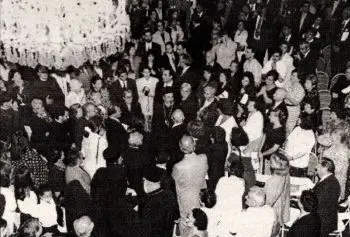
Scores of faithful surround His Eminence at Cathedral Center
(D.Panagos photo)
I would be remiss if I did not also thank the members of the Enthronement Committee, who worked diligently to make this a momentous occasion for you, especially His Grace Bishop Sotirios, who served as General Chair- man of this luncheon, and who also commendably served as Archiepiscopal Vicar during the transition, as well as our Chairman and Co-Chairman. Mr. Alex G. Spanos and Mr. John A. Catsimatidis. And I would be equally remiss if I did not thank my staff as well, for all the work they have done for our Archdiocese, and for all of the services they will continue to provide in the years to come.
My thanks to all of you. Thank you, our distinguished guests, church and civic leaders who honor me with your presence. Thank you, Your Eminence Archbishop Iakovos, for your words, and for the Church you have left in my care. I know I speak for everyone when I say that in your 37 years as Archbishop, you have been a faithful steward of the Church here in America. and Thank you, Your Eminence Metropolitan Ioakeim, my good friend and beloved brother in the Lord, for bringing the blessing of our spiritual father, His All Holiness, to us today.
This is a blessed day. Let us go forward, as God has commanded us to multiply these blessings.
[ pp. 4, 21, 27 ]
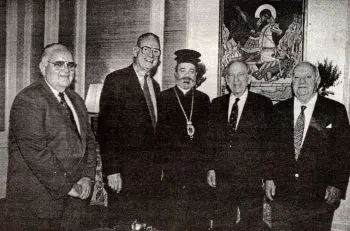
The minority leader of the House Foreign Affairs Committee, Congressman Lee Hamilton visited His Eminence Archbishop Spyridon of America for a discussion which included John Brademas, president emeritus of New York University, John Koumoulides profesor of History at Indiana's Ball State University, and Andrew A. Athens former president of the Archdiocesan Council. (N.Maginas photo)
[ p. 4 ]
|
|

Biennial Assembly of Hierarchs of the Ecumenical Patriarchate
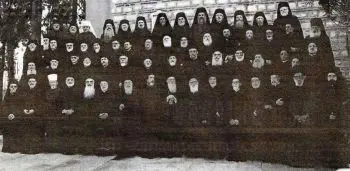
HIERARCHS from Orthodox Churches around the world gathered for the biennial meeting at the Phanar at the beginning of September.
(D. Panagos photo)
CONSTANTINOPLE — Nearly 70 hierarchs representing Orthodox jurisdictions from around the world gathered at the Ecumenical Patriarchate Sept. 1-3, for the third regular biennial assembly (Synaxis), upon the invitation and under the presidency of His All Holiness Ecumenical Patriarch. Bartholomew.
In addition, a special meeting of all European hier- archs of the Ecumenical Throne took place on Sept. 4.
On Sunday, Sept. 1, members of the Sacred Assembly concelebrated at the Divine Liturgy with His All-Holiness the Ecumenical Patriarch, at the Most Venerable Patriar- chal Church of St. George, at the Phanar. Following His All-Holiness, the entire Hierarchy, in turn, signed the Act of the New Indiction (Ecclesiastical New Year).
The day marks the official beginning of the new ecclesiastical year. In addition, the day also has been set aside by the Ecumenical Patriarchate as one of prayers for the preservation and protection of the natural environment which was observed by all sister Orthodox Churches in the world.
The main work of the Sacred Assembly commenced on Sunday afternoon with an address by His All Holiness the Patriarch, followed by a response on behalf of the Hierarchy by His Eminence Metropolitan Joachim, of the Senior See of Chalcedon.
On the morning of Sept. 2, began the discussion of the main theme of the Assembly: "The Position of The Orthodox Church in Facing the Challenges of Contempo- rary Western Culture."
The following reports were presented on this subject.:
1. Basic characteristics of contemporary Western Cul- ture.
2. The preaching of the Church and the challenges of contemporary culture.
3. The Orthodox Church and Information and Com- munication Media.
4. The Orthodox Church and the problems of Con- temporary Youth.
5. The role of the post-graduate Institute of Orthodox Theology in Switzerland at the service of the Church as
she faces the challenges of contemporary Western Cul- ture which confront it.
From the above addresses and the lengthy discus- sions which followed, the following was ascertained:
What is commonly referred to as Western Culture constitutes the framework within which the Orthodox Church functions today. This culture tends to be domi- nant in almost all countries of the world. Given the fact that the characteristics of this culture were formed under the influence of Western Christianity, Orthodoxy finds itself in a dialectical relationship with this culture on ma- ny issues.
As a consequence, it is the duty of Orthodoxy not to become marginalized within Western countries, but rath- er to take care to influence the course of history from within these countries. Orthodoxy possesses the spiritual powers by which it will be enabled to confront the im- passes which Western culture, despite its great progress in all fields, has created for contemporary humankind. Orthodoxy will accomplish this, primarily, if it reinforces the institution of the local parish and relates its preaching and entire pastoral ministry to the existential problems of contemporary humanity.
For this reason, it was decided that at the next, Fourth Assembly of Hierarchs of the Ecumenical Throne, we shall examine the issue of the local parish, in both theory and practice.
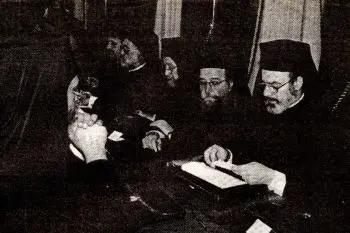
ARCHBISHOP SPYRIDON with other hierarchs in the synodical meeting room of the Ecumenical Patriarchate.
(Nicholas Maginas photo)
Aside from the discussions of the main theme of the Assembly, the Presiding Hierarchs of the Inter-Orthodox Committees reported to the Assembly on the course of bilateral theological dialogues between the Orthodox Church, on the one hand and, on the other, the Roman Catholic, Non-Chalcedonian, Anglican, Lutheran, Old Cath- olic and Reformed Churches.
The hierarchs also attended a concert in their honor by singer Demis Roussos on Sept. 1.
With No Seminary, Concerns about the Future
CONSTANTINOPLE — A number of articles have appeared recently about human rights issues in Turkey. The plight of the Kurds and even of Turkish dissidents has been discussed in the media.
Even the Turkish press has reported on the status of the theological school of Halki, closed by the Turks in 1971. A Turkish journalist, Yalman Onaran, writing for the Associated Press, reports in the following story about the concerns of orthodox church officials for the seminary's future:
Although shut down by the Turks 25 years ago, Yorgo Kara still carries out a daily ritual of dusting the books in the library of what was the country's only Orthodox Christian seminary.
"What if one day the school reopens?" Kara, of Greek origin, says as he cleans a theological book from 1864 published in French and Greek. "We have to be ready for the students."
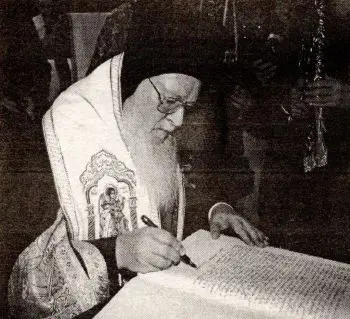
ECUMENICAL PATRIARCH Bartholomew signs the Indiction for the new church year on Sept. 1.
(Nicholas Maginas photo)
But there is no sign of that happening soon, and Or- thodox officials now worry about where future patriarchs will come from. There is even serious talk of moving the Patriarchate from Istanbul, the historic seat of the Or- thodox Church, to another country.
In 1971, the Turkish government shut the seminary college under a law requiring that higher education in religious and military training be controlled by the state. The high school remained open until 1985, when the last five students graduated.
The Halki college was the training ground for many Greek Orthodox leaders, especially the ecumenical pa- triarchs, to whom the majority of the world's 300 million Orthodox Christians look for leadership.
The current patriarch, Bartholomew I, is a product of
the seminary on this small island an hour's boat ride from Istanbul.
The Orthodox leadership elected a young ecumenical patriarch intentionally in 1992. Bartholomew, who was only 51 at the time, is considered the "first among equals" of the five Eastern church leaders.
"We are getting old, we shall be gone soon. We need to train the people who will replace us," said Metropolitan Abbot Apostolos, in charge of the Holy Trinity Monastery, where the seminary was based.
Under a 1923 treaty with Greece, the ecumenical patriarch must be a Turkish citizen. That was the condition set by Turkey for allowing the Patriarchate to remain in Istanbul.
The patriarch's spiritual position stems from the historical role played by his see in Istanbul, which was known as Constantinople when it was capital of the great Byzantine Empire.
There are 30 priests serving the 4,000 Greek Orthodox still in Turkey, remnants of a once-thriving community in Istanbul. Almost all are graduates of the Halki seminary.
But the seminary's most important role was in preparing the top leaders of the Greek Orthodox Church. The patriarch of Alexandria, Egypt, the Australian archbishop and many others are Halki graduates.
Turkey's closing of the seminary was seen as part of its centuries-old rivalry with its western neighbor Greece.
Turkey has been accused of using its control over the Patriarchate in Istanbul as a weapon against Greek moves on the Muslim minority in Greece.
Turkish officials deny this, but their anger toward Greece comes to the surface when discussing the issue.
"They...don't allow Muslim clergy from here to visit the minority there, and then complain about us not allowing an Orthodox priest school to operate freely," claimed Duray Polat, head of the Foreign Ministry's Greek desk.
The rise of an Islamic-inspired party to power in June may also pose a threat. Although Prime Minister Nechmettin Erbakan has not taken a stand on the Patriarchate, the radical Islamic press has attacked the patriarch and denounced efforts to re-open the seminary.
After the college closed, the Patriarchate tried to train future leaders of the church by sending them to theological schools abroad after they finished the high school here.
But it didn't work.
"Most students we sent to Greece or to the United States for higher education never returned," Father Apostolos said.
Patmos island in Greece has been mentioned as a possible future location of the Patriarchate. The island's monastery already is under the authority of the patriarch.
The Turkish government has offered to open a theological school as part of Istanbul University, but the Patriarchate refuses, saying a religious school cannot be under the mandate of a secular government.
[ pp. 5, 27 ]
|
OF SPECIAL INTEREST |
The Making of an Archbishop
Profile of Spyridon: Commitment, Calling and Desire
(Editor's Note: Religion News Service interviewed Archbishop Spyridon in late August at his Venice office for the fol- lowing story which is printed in its en- tirety).
VENICE — He has spent most of his 51 years in Europe, studying, preaching and building his church. He rarely travels to the United States, has never lived in New York City and speaks Italian and Greek more often than English. Like many Italians, he eats lunch at 2 p.m.
Yet, when Archbishop Spyridon is enthroned on Sept. 21 in New York as the fifth leader of the Greek Orthodox Church in America, the Ohio-born prelate will be celebrated as the first American-born chief of an institution that has largely completed the transition from an immigrant church to a fully American church.
By Steven Heilbronner
©1996 Religion News Service
In fact, few American Orthodox leaders know Spyridon's style or his intentions. He was a surprise choice of the 12-member Holy Synod of the Ecumenical Patriarchate that elected him unanimously last July in Constantinople, the ancient name of Istanbul used by the church.
"I was surprised because I was not among the candidates," he said in an interview. "I wasn't looking for another solution to my service or my life." Moreover, he said, "others might know more about the American church than me."
Notwithstanding that admission, none of the other candidates had the American birthright and vast European experience that Patriarch Bartholomew I, leader of some 250 million Orthodox Christians worldwide, seemed to be looking for.
"Having been born in the United States will appeal to an overwhelming number of people who were born on this continent," said Metropolitan Philip, leader of the Antiochian Orthodox Christian Archdiocese of North America, which has 205 parishes and half a million members. Philip, born in Lebanon, added, "It will also enable him to understand the unique problems which the church in this hemisphere is facing in 1996."
Wearing a plain black robe, Spyridon gives a visitor a tour of the 400-year-old Church of St. George of the Greeks that has been his home for the past four-and-a-half years. The church sits on the San Lorenzo canal, about a five-minute walk from St. Mark's Square.
Small groups of tourists filter through the partly shaded courtyard. A Japanese man, unfamiliar with Greek, points to a plaque on the church and asks Spyridon, "Is this Jewish?"
A rare smile crosses his pale face. "No," he says, "it's Greek."
Though unrelated to his new assignment, the question is an emblem of some of the basic and challenging work that lies ahead as Orthodox Christianity attempts to communicate its message beyond old boundaries of nationalism and ethnicity.
"We are on our way towards the construction of an American Orthodox Church that is acquiring American characteristics, slowly but surely, and abandoning its ethnic elements," Spyridon said.
His 85-year-old predecessor, Archbishop Iakovos, held the reins of the Greek Orthodox Archdiocese of North and South America for 37 years. Iakovos ruled with a firm hand and a loyal coterie of supporters. Some critics said he inflamed ethnic divisions within the Orthodox churches, which include Lebanese, Armenians, Ukrainians and others.
Spyridon said he will employ "teamwork," "listening" and "cooperation" to lead the Greek Orthodox Archdiocese, which has been downsized to include only the United States. New metropolitans will be named to head separate jurisdictions for Canada, South America and Mexico, all part of a restructuring announced by the Ecumenical Patriarchate intended to simplify administrative functions.
"We're not talking of imposing unity, we're talking of constructing unity," Spyridon said, and "I think the American people are for such a unity."
In a reference to the Greek-born Iakovos, he added, "Of course, somebody that comes from Greece doesn't have this concern, and doesn't have a feel for this, not because he is basically against such a thing but because he has no experience on what the lack of unity means."
George Papageorgiou is a first-generation Greek-American, born Sept. 24, 1944, in Warren, Ohio, to devout Orthodox parents whose links to the mother country were passed on to their six children. Clara and Constantine, a physician, raised their children in Ohio, Florida and on the Greek island of Rhodes, where they learned the language, customs and religion of their forbears.
In a family from which each of the four previous generations had produced priests, it would come as no surprise that among the immigrant clan one of the six Papageorgiou children would inherit the family duty.
For Spyridon, the path of the priesthood was a combination of commitment, calling and desire.
"Somehow it's been a tradition of the family," he said, speaking slowly in hushed tones from behind his desk in his wood-paneled office above the courtyard. "Each family has one only that has to deal with the church. I was the one that was chosen. I had this inclination more
than the others. I discovered that this was one way I could go to feel happier, better about my life."
He graduated from the Theological School of Halki, Turkey, in 1966 and furthered his religious education in Switzerland and Germany. From there, Papageorgiou served the Ecumenical Patriarchate at the World Council of Churches in Geneva.
He was ordained a priest in 1976, and was named dean of the Greek Orthodox Community of St. Andrew in Rome. In 1984, he was appointed to head the church's theological commission between the Orthodox and Roman Catholic Churches.
In 1991, he became the first metropolitan of Venice, and assumed the name Spyridon, after the 4th century Cypriot saint who was a skilled shepherd.
Spyridon said he relishes his success in the Orthodox community in Italy, which has 120,000 members. He increased the number of parishes to 25 from seven, created two monasteries and established an Orthodox youth movement.
Last December he expanded his reach, setting up a homepage on the World Wide Web, where he posted his biweekly church bulletin in English and Italian. The newsletter features articles on church affairs in Italy, news from the patriarch in Constantinople and reflections on theological issues.
The effort, he said, paid off, because many Orthodox, including some in the United States and Canada, wrote to him, seeking his counsel or expressing their ideas. He receives about 30 messages a day on the Web site, which he hopes his successor will continue.
Over the past two years, the Orthodox Church in the United States has posted church information on an electronic bulletin board accessible on the Internet. But Spyridon said he will likely upgrade that system to mirror the home page in Italy.
"It is the easiest, and perhaps the cheapest way, to get yourself known," he said.
"I'm leaving with part of my heart here because what was ever done here was done with great sacrifice," said Spyridon who typically works from nine in the morning to midnight, with a one-hour lunch at 2 p.m. The work has left little time for him to read Camus or Dostoevsky, or watch old movies on television, a favorite past-time.
In Italy, Spyridon has been surrounded by the richness of a city in perpetual motion. He seems cloistered, weighted down by official duties. Yet, he does not feel deprived.
"It was a wonderful time I had here. It was exciting. It was a challenge. I hope I can do something useful in America, too."
Spyridon said his chief aims in the years ahead will be to expand the church, which has already gained new members from a growing number of disenchanted Episcopalians, Evangelicals and others. He also intends to increase reconciliation efforts between the Orthodox and Roman Catholic Churches, which remain divided.
But his top priority will be to seek unity among the 6 million Orthodox Christians in the United States, most of whom are of Greek and Russian descent, but also include Albanian, Bulgarian, Romanian, Serb and Ukrainian Christians. while the American Orthodox churches share the same dogma and a common religious ancestry as the original Apostolic churches, they differ on matters of ethnicity, style, management and leadership.
Unity is an old issue and it's certainly one of the major issues he will have to confront," said Ron Roberson, assistant director of the secretariat for economic and interreligious affairs at the U.S. National Conference of Catholic Bishops.
Roberson, who knew of Spyridon from his dozen years of service in Rome, added, "I think virtually all of the (Orthodox) churches in the West want unity. The problem is administrative. Each of them is autonomous. It's a very complicated situation."
"We're spending money, we're expending efforts in different directions," Philip said. "We have too much duplication. Instead of numerous educational facilities, we could have one strong Christian education department, better materials, more researchers and create more impact on the spiritual and moral life in this country."
Ironically, a meeting of 10 of the 13 Orthodox denominations in the United States nearly brought about what I called "administrative ecclesial unity in North America," in 1994. But the declaration alarmed Bartholomew, who saw it as an effort by Iakovos to centralize his power.
In many respects, Spyridon uses the same language in seeking unity among Americans. But with a twist.
"I have a feeling that (the churches) are developing in their very American way, which means more isolated," said Spyridon, who intends to increase contacts between European and American seminary students and pastors.
"I think an exchange would be good for both. We know very little about America in Europe. And I suppose that in America they know very little about Europe."
Ultimately, he said, "we have to feel part of the world Orthodox family. When you speak of American unity you risk creating the impression that Orthodoxy is on its own in the states. I really do think that the church of America should be brought closer to world-wide Orthodox reality. And I think that in that sense I could offer a good service."
[ p. 6 ]
|
CLERGY-LAITY CONGRESS |
Report of the Strategic Planning Committee
Bishop Methodios, presiding bishop
George Kaludis, chairman
The Strategic Planning Committee of the Archdiocesan Council was established for the first time during the present term of the Council reflecting a felt need to begin to embrace the Church as a whole in a plan. We are in the crawling stage of thinking about the proper approach to planning for the Church. A very active and vibrant Congress Strategic Planning Committee pushed this thinking extensively in the last two days. One particular piece of wisdom that came from the committee is that concern for planning should emphasize the parish and diocese as well as the national ministries.
Inspired by the Archbishop's keynote address and his admonition to us with St. Paul's letter to the Phillipians to "Only let us hold true to what we have attained; let us walk by the same rule, let us be of the same mind," and the Archbishop's call for a new collaborative spirit:
"Let us carve out for ourselves in our time the same path in ways which will exclude facile diversions. We usu-ally go astray either by false and subjective human cal- culations or by vain ambitions to make our own new course. It is time for all — the Archdiocesan Council, the National Board of the Philoptochos, the Parish Councils, the Diocesan Councils, as well as the leaders major organizations and federations and of other local societies and associations — to set aside self-imposed blinders and false perceptions that they can do all things in isolation. It is to their benefit to ascertain that they must leave aside obstinate fancies and be joined to the ecclesial community which invites and serves all. Indeed, it is only within the ecclesial community these can survive and become more serviceable units and productive entities on behalf of the Omogenia."
The first step in working together is planning together, and taking the long view.
There are two major points to be made about plan- ning for the Church;
1. There is no doubt about the vision for any plan for the Church, in terms of what our principal objective is, the Kingdom of God. Therefore, any change toward the Kingdom, and not away from it;
2. There is good planning going on in the Church now at places in all levels of the Church; for example, the Stewardship Commission is very visible in its plan for developing stewardship and leadership in the Church at large; the Finance Committee is building the infrastruc- ture necessary for the managing the finances of the con- temporary Church; some dioceses, organizations, institu- tions and parishes have adopted effective planning proc- esses. The issue is that the plans do not come together effectively, nor are they guided by a general sense of pri- orities.
The label "strategic planning' may not be appropriate for planning in the Church, but the concept is valid. Put simply, strategic planning is looking to the future, establishing a vision of what we want the future to be and planning back from the future. In contrast, long-range planning is working out from the present condi- tions. We may be in a condition that is even less than long-range planning. Bound by a very difficult financial situation (which is of our own making), we are facing a paralysis of thinking and action, freezing us into the present, that could be very damaging to the Church. The budget and the constraints of the budget are the plan. Further, the lack of a plan for the Church has the con- sequence of setting us against ourselves as we try to optimize our own corner. The worst possible fund-raising situation to be in is raising money to cover a shortfall. A Church plan could offset that issue.
The Church needs a planning process that will provide constructive tension to the budget process with a focus on needs and priorities and bring together the entities that the Archbishop included in his call of togetherness for us.
The Committee also discussed at length the issue of information about the Church, how and what is collected and what standards are used for date definition. Our premise was and is that we have to know the Church in order to plan. As the institutions, organizations and groups become more active, they develop a voracious appetite for data and go after it, on their own, unco- ordinated. The Archdiocesan Council Strategic Planning Committee started down the road of developing parish profiles and learned first hand some of the problems in developing date bases. We are spending and will spend time, energy and money in developing date. It is time for us to adopt a data plan and discipline so that we get the best return for our investment in data.
The Committee did some preliminary work in review- ing the Archbishop's Theological Agenda and his keynote address to this Congress to identify vision statements and goals for the Church. The Committee commends this list to those who will do this work in the future. These statements are included in the full minutes of the Com- mittee.
The Committee considered and unanimously passed the following resolution:
Resolved, the Strategic Planning Committee respect- fully recommends that the Archbishop appoint a perma- nent Church Planning Commission, representing constit- uencies throughout the Church to do the following;
A. Establish a Church planning process to support the Archbishop and the Holy Synod, the Clergy-Laity Con- gress, the Archdiocesan Council, the parishes and the in- stitutions and organizations of the Church;
B. Develop Church priorities to guide the program and financial implementation planning of all aspects of the Church;
C. Oversee the development of data and information about the Church through the adoption of data standards and through the coordination of data requests to the Church from all Church organizations and activities;
D. Within the realities of the financial situation; con- sider providing professional support for planning proc- esses.
The Church Planning
Committee Members
Inter-Church Report
The Inter-Church Committee was unable to complete its deliberations due to the lack of proper scheduling and arrangements for meeting space.
Important matters relating to the Archdiocese's relations to other churches, ecumenical activities and in- ter-Orthodox matters require immediate and important study.
The Ecumenical Department and the Church and So- ciety Departments of Archdiocese have been combined and their budgets amalgamated. The Committee was un- able to make a proper analysis of these important admin- istrative decisions.
It is suggested that the Inter-Church Committee of the Archdiocesan Council meet as soon as possible in order to give proper direction. It will be very important for the new archbishop to establish his position in ecu- menical affairs. Equally important will be the position of SCOBA.
Presiding Hierarch, Bishop Maximos
Chairman, Paul G. Manolis
[ p. 7 ]
|
OPINIONS |
|
_____ |
EDITORIAL |
____________________________________________________________________________________________ |
|
Our New Archbishop To use an oft-quoted phrase from President Kennedy's inaugural address, the torch has been passed to a new generation. The election and subsequent enthronement of the 52-year-old American-born Spyridon opens a new era for the Church in America. Already, the response of thousands of Orthodox faithful witnessing the events of the enthronement weekend as summer ended and autumn began has been one of enthusiasm. His Eminence set the tone for his ministry on several occasions over the past few days as he exhorted his listeners to follow Christ's command to love one another. A recurring theme he has em- phasized is the need to emulate Christ and to set aside past differences and rivalries and work for the betterment of the Church under the guidance and direction of our Mother Church, the Ecumen- ical Patriarchate. He has stressed, particularly to his staff, the importance of hard, honest work, of teamwork in a joint and common effort to further the mission of the Church. Our new Archbishop is the answer to the prayers of many Greek Orthodox faithful. Over the past few months, there was a certain amount of uncertainty of what the future would hold; first, about who the Ecumenical Patriarch would select to head the church, then, after Spyridon's election, what sort of leader will he be? Lay leaders and clergy from across the nation hoped for an archbishop sensitive to the needs of the faithful, able to relate to the American expe- rience, and with the ability to articulate the Orthodox Christian faith to a varied and complex flock — second-, third- and fourth-generation Greek Americans, non-Greek spouses, converts, a secularized youth, and to the nation and world at large. In his enthronement speech, Archbishop Spyri- don expounded a vision for the Church that meets these expectations. Acknowledging with gratitude the sacrifices and contributions made by our immigrant forbears to plant the faith in America, the Archbishop sees himself as one of the children of that legacy who intends to make the Church a strong presence in the lives of future generations of young people. In the contemporary setting of modern society, His Eminence frowns on exclusionary attitudes and calls upon the faithful to reach out to those who want to embrace the faith -- converts, non-Or- thodox spouses, and the vast numbers of un- churched. This may not be what some wanted to hear, but the Archbishop has served notice that this is what is expected of us if we are to take our faith seriously. He has made it quite clear that his concern is with our spiritual identity, that we can only serve Jesus Christ and that Orthodox Christianity must present a united front in advancing that faith. As our new spiritual father, Archbishop Spyridon clearly has the qualities that merit the exclamation of "Axios" heard during the enthrone- ment service. But he also challenges us, his spiritual children, to strive to be worthy of being called Orthodox Christians. |
[ p 8 ]
|
COMMENTARY |
Prime Time Follies
Aaron Spelling has been creating and producing television shows for three decades. He is best known for such dramas as Charlie's Angels, Dynasty, Beverly Hills 90210, Melrose Place and Savannah.
By Fr. Angelo Artemas
This season he adds 7th Heaven to his resume. Airing Mondays at 8 p.m. on the WB network, 7th Heaven is a light-hearted and humorous program about a Christian minister and his family. In its premier episode, the minister is eager to capture some intimate moments with his wife, his wife is quick to make home-repairs, his eld- est son is reluctant to go to church, his eldest daughter is anxious about her first kiss, his second daughter is going through puberty, and the younger brother and sister al- ternate between amusing and annoying the rest of the family.
The program was cleverly emotional and realistic, though slightly contrived. When asked in an interview on PBS about what motivated him to produce a program with such a different theme than his usual offerings, Spelling responded "We owe this to America."
After three decades of sex, violence, farfetched plots and increasingly vulgar language, television owes Amer- ica much more that a cute family show. The television beast has swallowed America and spit it back out.
Besides its obsession with sex and violence, network television has given rise to two generations of Americans who have neglected the art of reading, and who lack the motivation to mature.
Seinfeld and Friends, the blueprint for most of today's sit-corns that are shows about adults who won't grow up. Cybil is about two divorced women acting like teenagers. Family sit-corns such as Married With Children, Rose- anne, Grace Under Fire and The Simpsons prefer to mock
family life than to take it seriously.
New sitcoms such as Clueless, Party Girl, and Men Behaving Badly are actually cruder than their titles imply.
The funniest thing about today's sitcoms is that most of their writers have graduated with honors from some of America's most prestigious universities. Seinfeld's head writer is a Harvard graduate. Many writers of NBC shows are graduates of Yale.
America has become a nation of adolescents. Twice as many adults watch Letterman or Leno over Ted Koppel. College students schedule their courses at times that won't interfere with their soap operas. Daytime talk shows long ago reached their lowest point and adolescent morning shows such as Rosie and After Breakfast are the latest trend. By the time children are old enough to read TV Guide or to bypass the V-chip, the TV beast will have already have done its damage.
While politicians and educators place great emphasis on educational programming for children, young people will not likely be convinced that growing up is worthwhile when adult role models behave like adolescents. With or without ratings, if a program is not suitable for younger viewers, it is not suitable for adults.
Certainly, there are some good programs on the five networks, cable and public TV. 7th Heaven is one of them. But viewers would be well-advised to turn off the "beast" for most of the day.
An eighth-grader can read 40-pages in half an hour. Idle time spent watching many programs would be better spent feeding the mind by reading.
While television is running out of ideas and scram- bling to bring back veterans from successful programs of the past such as Bill Cosby, Michael J. Fox and Ted Dan- son.
Americans should tune out, grow up and recapture their lost creativity and intelligence.
[ p 8 ]
LETTERS
A wise decision
Editor,
Our Patriarch Bartholomew wisely divided North and South America into four parishes. It is difficult for one Archbishop to visit Canada and especially South America.
We need an Archbishop that will visit large and es- pecially small parishes.
Looking forward for Archbishop Spyridon to visit our Church St. Barbara in Sarasota. I wish him "chronia polla despota."
Stanley Demos
Sarasota, Fla.
Consequences of secularism
Editor,
For many years I have been reading letters for and against English in the services. Also over the years, as I talk to fellow Orthodox that are church-going, I find a far more disturbing trend: many Orthodox do not accept and believe the basics of our faith. They challenge the Church on subjects such as whether Jesus existed, the virgin birth, the ever-virginity of Mary, the resurrection, fasting, premarital sex, abortion, foul language, astrology, homo- sexuality, and the existence of heaven and hell, etc. Im- parting our 2,000-year-old faith intact is our greatest challenge. The most beautiful Liturgy in Greek or English, is an empty noise if the people in the pews no longer believe the words being prayed.
Harry Katopodis
Novi, Mich.
About instant salvation
Editor,
Your recent column criticizing the idea of "instant sal- vation,"(Sept. 96) while perfectly accurate, was unduly harsh in tone. This idea of "instant salvation" has some biblical basis (Jesus's forgiving the robber on the Cross (Luke 23:40), it is a key idea of modern Protestant evan- gelists and common in churches in many rural American communities.
It is a message of hope and must be useful, based on its widespread use throughout rural America, in pros- elytizing to individuals who have very little structure in their lives. If any church is to expand in this country, I believe it must come to terms with these curious, but still useful American customs.
Based on my limited knowledge, there may be some rational basis for this idea historically. Many early Amer- icans started in Calvinist churches; when they rebelled against the strictures of Calvinism they migrated to churches that stressed "free will' as opposed to Calvinist doctrines of predestination; therefore, the doctrine of "instant salvation" would represent the logical extreme of the idea of "free will" as the sole determinant of faith.
Additionally, in the constantly changing social world of the American frontier, it is likely that church member- ships were highly unstable and some rule was needed that would legitimize the newcomers.
Personally, I believe the doctrine a very attractive one
for bringing people into contact with the Christian com- munity thereby creating the possibility of a spiritual growth which may continue; such converts are unlikely to be satisfied for long with such a simple doctrine.
F. Andrew Morfesis, M.D.
Harlan, Ky.
Prayer is a beginning
Dear Editor,
We as Greek Orthodox have been blessed with the most beautiful of all churches. We have the privilege and honor of our Divine Liturgy and are able to partake in the excellence of all spiritual experiences through the Holy Eucharist....yet that for two thousand years has so fully endowed our church.
The article "Relating to the Faith" in your September edition, mentions simplistic religions that have people believing they are saved through a simple prayer. Yet a heartfelt simple prayer of an acceptance of Jesus as one Saviour is a recognition of oneself as a sinner having need of redemption, and by this awareness they conse- quently become receptive to our Lord's Grace. This a- wareness and receptiveness is what is known to the Protestants as "born again.
Of course every prayer should be a beginning not an end and one should never arrogantly assume that they have attained full spiritual growth... for true growth is a continuous humbling process. Therefore for anyone to embrace a "holier than thou attitude" would certainly make them anything but.
But we should also never forget, that although the outpouring of the Holy Spirit has produced within our church the most beautiful and profound prayers in all Christendom, that it was the very simplistic, yet heartfelt and continuous prayer of "Dear Lord, forgive me for I am a sinner," that has confounded the world's greatest minds by producing our most blessed saints.
Jeannette Kotsonis
West Milford, N.J.
Reach out to interfaith couples
Editor,
Our Church must be more ecumenical and less ethnic. At times we can be too clannish. The term "mixed mar- riages" has a negative connotation. It is distasteful. In- stead, we should use the terms interfaith or interchurch marriages. Such marriages are now the majority.
Interfaith couples can be considered as little mission- aries for Orthodoxy. The immigration rate from Greece is low and will continue to decline. One-hundred years from now all our parishioners will be non-Greeks. Our parishes should have mentor couples who can serve as role models, guide, and integrate interfaith couples into Or- thodox worship. We should have outreach programs to our local neighborhoods and surrounding communities such as the Latino and Asian communities.
We must show the love of Christ to people around us and this is the best way to attract them to Orthodoxy - the true church of Christ.
William S. Andrews
Chicago
[ p. 8 ]

A Faith That Moves Hearts and Causes Healing
Dear "Tell Me Father" Readers:
I met Dr. Roman Alexandroff Hitchev and his wife, Elli, for the first time this past summer at Bethesda Naval Hospital. A social worker had called me to solicit my help. "A young Bulgarian couple have brought their five-year-old son who is afflicted with cancer. They have no friends, no relatives, no place to stay; can you please come and visit them and do whatever you can to help?"
By Fr. George Papaioannou
I did go and visit with them, and my parishioners helped, and young Nicky is doing just fine. Dr. Hitchev, a very gentle man, made several attempts to talk to me but every time he came to see me we were interrupted. Finally Dr. Hitchev decided to write his thoughts and feelings. One morning I found his letter on my desk. I started reading it, and before long I was overtaken by spontaneous emotion. His letter is a marvelous testimony of faith. The following Sunday, I asked him to share his moving experience with the congregation and there was not a dry eye in the church. Dr. Hitchev's testimony deals with the most important business in one's life: faith. This testimony had such a great impact on my congregation and myself that I thought it would help this column's readers also to feel the exaltation of faith.
Fr. George Papaioannou
Dear Father George,
It was just one year ago when I was studying at the Academy of Health Sciences, "Ft. Sam Houston," in San Antonio, Texas. On Sundays I used to go to St. Sophia Greek Orthodox Church on St. Mary Street where I found the spiritual comfort that I needed. I had been separated from my family for almost a year, and was having a hard time living and studying alone. I prayed for my two little boys and for my wife, asking the Lord to protect them as they were also alone, and to give me strength to overcome homesickness. At that time I could not foresee that only three months after my return to my country I would fly to the United States again and my family would once more be separated under very unhappy circumstances.
I graduated from the Academy of Health Sciences just before Christmas and returned home. We thanked God that we were all together again, and I promised God that next Sunday we would mark my return from the United States with prayers of gratitude in church.
But the next Sunday I was called into the naval hospital where I was employed as a surgeon. I thought we could go to church any time. But the next several months were very hectic at the hospital. I was constantly busy and kept putting off going to church week after week.
I put off going until March 10, 1995, when my five-year-old son Nicky, otherwise a pretty healthy and playful child, complained of abdominal pain and was examined in the hospital. A tumor was found in his abdomen, and he underwent surgery. The tumor turned out be lymphoma - a highly malignant cancer of the lymphatic system.
I began making desperate attempts to arrange for chemotherapy to take place in the United States, the only country in the world where this particular type of cancer can be cured.
I was pretty self-confident, believing that my con- nections in the medical field would help me. But to all of my appeals for assistance I received only negative replies. The cost of the treatment was very high - it was a matter of $150,000; but it was also a matter of life and death for my child.
We went to a small monastery in the central Balkan mountains famous for the miraculous power of an icon of the Mother of God. When we stepped up to the icon we felt something unexplainable radiating from the eyes of the Virgin and Infant. We cried and prayed from the bottom of our hearts that the Lord might take mercy on our child.
There was an old blind man in the monastery who called us and told us to cry no more, but to go back home with faith in our hearts and everything would improve, because our prayers and repentance were coming straight from the bottom of our hearts. "But mother," I said, "how can I stop crying when I am so weak and could never get over the loss of my child?"
"You are not going to lose your child," was her answer, "because the Lord's Mother has heard your prayers and is going to help you and your child. She knows the pain of a suffering child. Your child has undergone surgery recently and a serious disease was found. Your child has suffered through a major operation and is facing a long and painful treatment, but finally will be cured with the help of the Mother of God.
And the blind nun told us in detail about the disease and about the future treatment. As a physician I was astonished to see how informed she was in every single detail. She also told us that she could see us flying overseas to a distant country, to a land which is protected by the Mother of God, and to a place in whose name much biblical wisdom is hidden. The treatment would be five months long and very painful and the blood of our child would be changed, and something would be implanted in his chest; but finally he would be healed through the protection of the Lord's Mother. She also told us that she could see a woman with oriental features and short black hair who would care for our child. We would meet many pious people in that blessed land.
Upon our return to Varna there were several messages on the answering machine. The first one said that our son had been granted medevac status for treatment at Bethesda Naval Hospital. The second said that a specially designated medical military aircraft would pick us up within three days. Information was requested as to whether the child's condition would allow landing in Germany or direct flight to the United States. As I listened to these messages shivers ran down my spine. We could not believe our ears. We sat down and began to cry.
Three days later a special designated medically equipped airplane touched down at Varna Airport. One hour before the landing neither the U.S. ambassador in Sofia, nor the Flight Control Center at the Varna Airport had any information about such an airplane or about any request for air traffic clearance regarding an extraordinary flight.
Our passports and visas were issued in only two hours, exceeding all of our expectations. In two days we had sold everything we had in order to scrape together the money for the forthcoming trip. On leaving we said a prayer and set out for the unknown.
After an eleven-hour flight we landed at Andrews Air Force Base in Maryland and were taken to Bethesda Naval Hospital. A couple of weeks later I realized that we were in Maryland, and that our child was being treated in Bethesda - the biblical place of healing. Our first attending nurse was from the Philippines, with oriental features and short black hair. A central line was implanted in my son's chest and he underwent many blood transfusions during the dramatic five-month course of chemotherapy. We still carry everywhere with us the wooden icon of the Mother of God and the Savior. Two weeks ago you, Father, brought us sacred pieces of wood from the Holy Sepulcher the Holy Cross made of wood.
And so here we are in Maryland, hoping, and praying, and thanking God that our child survived the chemotherapy and the two major operations, thanking God for helping us through your help, Father, and through the generosity and compassion of the people of the St. George community. Our older son, Alexander, has just arrived from Bulgaria and now we are all together.
This is my testimony of how God's benevolence and mercy worked a miracle for us, through our repentance, faith, and prayers in a most desperate situation. Having lost almost everything which makes life normal - health of our child, the presence of our other child who was separated from the family for more than seven months, the presence of our old and infirm parents whom we may never see again, our jobs, our house, our friends, the place where we were born and raised, and the confidence to make plans for the future - we found our miracle through the benevolence of God and the Mother of God. We found people who cared for us like parents. We found friends who were as loving as brothers and sisters. We found a home in the church, and now, having received all these things, we have been strengthened in our faith and have found confidence to make plans for the future.
Today God is helping my family through the assistance and compassion of many pious people. I believe that one day it will be my turn to help other people in need for the glory and in the name of the Father, the Son, and the Holy Spirit. Amen.
May the Lord bless you as you continue.
Living in His-Story
Roman Alexandroff Hitchev
[ pp 9, 25 ]

Church Takes Root in Hong Kong
"Go ye therefore and make disciples of all nations..." (Matt.28:29)

ust two weeks before Easter I had prepared my Holy Week schedule and was informing the parishes under my pastoral care accordingly.
The Wednesday before Palm Sunday, however, I was called to go to the Archdiocese.
Archbishop Iakovos had received a request from His All Holiness Patriarch Bartholomew. A year earlier, the Orthodox community of Hong Kong had petitioned the Ecumenical Throne seeking a more permanent presence for Orthodoxy in that region of the World.
By Bishop Athenagoras of Dorylaion
Upon serious consideration and aware of the impend- ing change of government in Hong Kong, which returns to Chinese rule in July 1997, the Mother Church realized that something should be done.
I was asked by His All Holiness and the Holy Synod of Constantinople to travel to Hong Kong and visit the com- munity there. My task was to encourage the Orthodox faithful, who against serious odds had kept the light of faith, shining.
I was further directed to determine the feasibility of establishing an Archdiocese to be seated in Hong Kong and include all of Southeast Asia. Once determined, I was to pursue any and all efforts necessary to obtain this goal.
I arrived on Holy Wednesday not knowing what to expect. My expectation was that I would be in Hong Kong for Holy Week and two to three weeks thereafter. Little did I know that I was to remain for about two months.
The St. Luke Orthodox Church in Hong Kong is com- prised mostly of Orthodox faithful primarily from the U- nited States, Australia, Greece, Serbia and Russia as well as a few indigenous Chinese.
It was started in 1986 when a Chinese gentleman named Luke Chow, along with his Greek wife, Dora, pe- titioned the Patriarchate to establish a parish in Hong Kong. The first Divine Liturgy was performed in their home by Bishop Sotirios of Zelon, then serving the Orthodox Church in Seoul, South Korea.
Subsequently, and throughout the years, upon the di- rective of the Metropolitan of New Zealand who is the Exarch for Asia, Bishop Sotirios would send priests to Hong Kong to offer religious services as often as feasible. With one exception, when a priest was sent from Greece for a six-month period, the community never had the services of a permanent priest.
Recently they would gather on Sundays for matins services performed by Deacon Peter Danilchick, a clergy- man from the OCA employed by Exxon in Hong Kong. But they persisted. They never let up. They would continue to write to His All Holiness for help. Last year they traveled to Korea and were given an audience with His All Holi- ness while he was on a pastoral visit there.
From that moment, His All Holiness tried to find a so- lution. He was deeply concerned for the Orthodox com- munity in Hong Kong. But he also had a broader vision for Asia. With the impending re-integration of Hong Kong with China, now was the time to establish an Archdiocese there. A separate Archdiocese which would serve the al- ready established mission communities of Hong Kong, the Philippines, Indonesia, India, but which would also reach out to the broader Asian population.
These are new and challenging times for the world, and His Holiness is intent on making sure that Orthodoxy prepares to witness the Gospel to an otherwise anxious humanity.
Having never visited Hong Kong, I was surprised to see a city much like Manhattan. I was even more sur- prised however to realize how expensive it is for one to live there.
More importantly, though, what should we expect from the communist government of China once they take control of Hong Kong?
Are we establishing an Archdiocese which could be under persecution in the future? Conceivably! Possibly! But this was never the barometer used by the Church in spreading the Gospel.
If anything I was encouraged by the local population. As I walked through the streets in my cassock, I was continually stopped by local Chinese who asked for my blessing. I came to realize that these are a deeply spir- itual people, void however of any faith or religious con- viction.
Buddhism had been systematically and effectively e- radicated by the communists. There are few Buddhist temples left standing in China.
The vast majority of the Chinese people have a sense of spirituality, but are faithless. This is why I was told time and again in Hong Kong, the people have turned so intensely to making money and giving their children the best education possible. They trust no one but them- selves. Money and a good education alone they thus be- lieve, can secure their only chance for happiness.
Even so, they feel the void. No one and nothing could squelch their basic need for faith in God. I saw it in their eyes. As I walked through the streets they would stare at me, only hoping that I would notice them so that they could bow towards my person.
Two young ladies at the subway stop asked to speak with me and then kept me for over 20 minutes asking about the church, about confession, about the Eucharist. They had no faith, they told me, but nevertheless asked for my blessing upon leaving.
During my visit to Hong Kong, I have come to realize that while establishing an Archdiocese in Hong Kong would be a difficult task, this was God's will. The Holy Spirit was moving through the expressed concern of His All Holiness.
What is impossible with man, is surely possible with God. I thus placed my mission in His hands and prayed unceasingly. He would guide me and open the doors.
Thus, with the help of all the members of the Ortho- dox community, the gracious assistance of preeminent members of the broader society of Hong Kong and the kind graces of numerous Chinese, the task is well under way.
A new constitution establishing the Archdiocese is now in the hands of appropriate attorneys and will be presented before the Legislative Council of Hong Kong (their equivalent of our Congress) hopefully to be passed into law before the end of the year.
In the meantime the St. Luke community of Hong Kong does not have a permanent home. Church services are presently performed in an Anglican chapel used in the past by the British armed forces, and which is to be handed over to the Chinese army next July.
Hence, we are feverishly pursuing efforts to purchase land and build a chapel with Archdiocese residence and office facilities. In the meantime, His All Holiness has asked me to continue as the emissary to Hong Kong until the task is brought to fruition.
I now anticipate returning in September and as often as is necessary until July of next year.
By the Grace of God, Orthodoxy will have its proper role in China and Southeast Asia. We may not see the fruits of these labors in our life time.
But Patriarch Bartholomew has planted the seed. And by his vision and from these labors, the tree can and must and will bear much fruit. The time for Orthodoxy to witness to the world has arrived. To Christ our Lord, belongs all glory, honor and worship.
[ pp 12, 25 ]

ΕΤΟΣ 61ΟΚΤΩΒΡΙΟΣ, 1996ΑΡΙΘΜΟΣ 1119
ΑΝΑΦΩΝΗΣΕ Η ΟΜΟΓΕΝΕΙΑ
ΝΕΑ ΥΟΡΚΗ.- Με επικεφαλής το νέο της ποιμένα, η Ελληνική Ορθόδοξη Εκκλησία στην Αμερική ξεκινά και πάλι το έργο που της εμπιστεύθηκε ο Θεός, με πλήρεις και ακμαίες τις δυνάμεις της.
Την πραγματικότητα αυτή τόνισε ο Σεβ. Αρχιεπίσκοπος Αμερικής κ. Σπυρίδων κατά τον ενθρονιστήριο λόγο του -που δημοσιεύεται παραπλεύρως- το Σάββατο, 21 Σεπ- τεμβρίου 1996, στον αρχιεπισκοπικό καθεδρικό ναό της Αγίας Τριάδας, στη Νέα Υόρκη.
Πάνω από τρεις χιλιάδες πιστοί παρακολούθησαν με κατάνυξη αλλά και ενθουσιασμό την ενθρόνισή του, γε- μίζοντας ασφυκτικά κάθε διαθέσιμο χώρο, μέσα και έξω από τον Καθεδρικό, καθώς και στο παραπλεύρως κοινο- τικό κέντρο, όπου είχαν τοποθετηθεί μεγάλες οθόνες τη- λεοράσεως.
Η τελετή της ενθρόνισης ακολούθησε πομπή, στην οποία συμμετείχαν τετρακόσιοι και πλέον ιεράρχες και κληρικοί, τους οποίους έραναν με ροδοπέταλα μαθητές των κοινοτικών σχολείων της αρχιεπισκοπικής περιφέ- ρειας. Ανάμεσά τους, ο νέος Αρχιεπίσκοπος Αμερικής, μαζί με τον Σεβ. Μητροπολίτη Γέροντα Χαλκηδόνος κ. Ιωα- κείμ, ο οποίος και τον ενθρόνισε, εκπροσωπώντας την Α.Θ.Π. τον Οικουμενικό Πατριάρχη κ. Βαρθολομαίο.
Μέσα στον Καθεδρικό, ο πρώην Αρχιεπίσκοπος Αμερι- κής, Σεβασμιότατος κ. Ιάκωβος τον υποδέχθηκε με θερμό εναγκαλισμό, ενώ δεκάδες ιεράρχες και άλλοι κληρικοί φόρτιζαν με μεγαλοπρέπεια την τελετή. Εκατοντάδες πι- στοί, εκκλησιαστικοί και πολιτικοί ηγέτες, σπουδαστές της Θεολογικής Σχολής, ευέλπιδες της στρατιωτικής σχολής West Ροint, άγημα ελληνορθοδόξων προσκόπων, μέλη της Νεολαίας και εκπρόσωποι ιδρυμάτων της Ι. Αρχιεπι- σκοπής και οργανώσεων της Ομογένειας παρακολούθη- σαν τις ιστορικές για την Εκκλησία μας στιγμές και φώνα- ξαν «Άξιος!» στον νέο μας Ποιμενάρχη.
Την τελετή της ενθρόνισης ακολούθησε επίσημο γεύ- μα, στο ξενοδοχείο Waldorf Astoria, όπου συμμετείχαν πάνω από δύο χιλιάδες άτομα.
Ο Σεβ. Αρχιεπίσκοπος Αμερικής κ. Σπυρίδων έφτασε στη Νέα Υόρκη το απόγευμα της Πέμπτης, 19 Σεπτεμ- βρίου, με πτήση της Ολυμπιακής Αεροπορίας. Τον συνό- δευαν ο Μητροπολίτης Χαλκηδόνος, η μητέρα του, ο α- δελφός και αδελφές του, κ.ά. Στο αεροδρόμιο, τους υπο- δέχθηκε επίσημη αντιπροσωπεία της Ι. Αρχιεπισκοπής, με επικεφαλής τον Γενικό Αρχιερατικό Επίτροπο, Θεοφ. Επί- σκοπο Τορόντο κ. Σωτήριο και τα μέλη της Ιεράς Επαρ- χιακής Συνόδου. Οδηγήθηκε στην έδρα της Ι. Αρχιεπι- σκοπής, όπου τον υποδέχθηκε το προσωπικό σε μια πρώ- τη γνωριμία.
Την επομένη, Παρασκευή 20 Σεπτεμβρίου, ο Γενικός Αρχιερατικός Επίτροπος κ. Σωτήριος τέλεσε πανηγυρικό Εσπερινό, στον ι. ναό της Αγίας Τριάδος στο New Rochelle και στη συνέχεια ο Σεβ. Αρχιεπίσκοπος παρέθεσε δείπνο στους κληρικούς της Ι. Αρχιεπισκοπής και τις πρεσβυτέρες τους.
Την εσπέρα του Σαββάτου, ο Σεβασμιότατος χοροστά- τησε στον Μεγάλο Εσπερινό, στον ι. ναό του Αγίου Νικο- λάου, στο Φλάσινγκ Νέας Υόρκης, όπου έγινε αντικείμενο Θερμότατων εκδηλώσεων από το εκκλησίασμα.
Ασπασμός αγάπης του Ιεράρχη, στη Μάνα που δίκαια τον καμαρώνει...
(Φωτ. Δημ. Πανάγος)
Το πρωί της Κυριακής 22 Σεπτεμβρίου, ο Σεβασμιό- τατος τέλεσε την πρώτη του Θεία Λειτουργία ως Αρχιεπί- σκοπος Αμερικής, στον αρχιεπισκοπικό καθεδρικό ναό της Αγίας Τριάδας, στο Μανχάταν. Στην αρχιερατική αυτή Θεία Λειτουργία συμμετείχαν τα μέλη της Ιεράς Επαρχια- κής Συνόδου και οι Βοηθοί Επίσκοποι, καθώς και κληρικοί από κάθε Επισκοπή της Ι. Αρχιεπισκοπής Αμερικής. Ακο- λούθησε δεξίωση προς τιμή του στην αίθουσα του Καθε- δρικού, στην οποία πήρε μέρος ολόκληρο το εκκλησία- σμα.
[ p 13 ]
Ενθρονιστήριος λόγος του Αρχιεπισκόπου
Στο άπειρό του έλεος, ο εν Τριάδι Πανάγαθος Θεός μας ευδόκησε και πάλι να ευλογήσει δαψιλώς την ελλη- νική ορθόδοξη Εκκλησία της Αμερικής. Με την πρόνοια και οφειλετική μέριμνα του Οικουμενικού Πατριαρχείου, της Μητρός μας Εκκλησίας, πληρώθηκε ο Θρόνος της Ιεράς Αρχιεπισκοπής Αμερικής. Ιδού, σήμερα, ενθρονίζε- ται ενώπιόν σας, στη γεραρά και ιστορική αυτή επισκοπική καθέδρα, ο νέος σας κανονικός ποιμένας.
Και ήδη η Εκκλησία μας ξεκινά και πάλι, με επικεφα- λής το νέο της ποιμένα και με πλήρεις και ακμαίες τις δυνάμεις, το έργο που της εμπιστεύθηκε ο Θεός και που είναι απαράλλακτα το ίδιο μ’ εκείνο του Χριστού: το έργο της σωτηρίας του ανθρώπου. Οι εποχές και οι καιροί αλλάζουν, οι ποιμενάρχες διαδέχονται αλλήλους και μαζί τους αλλάζουν ίσως και οι μέθοδοι, οι τρόποι και τα μέσα που μετέρχεται η Εκκλησία κατά την επιτέλεση του θείου έργου της, όμως ο σκοπός της είναι και παραμένει, σταθε- ρά κι αμετακίνητα διά των αιώνων, πάντοτε ο ίδιος: η σωτηρία του ανθρώπου, η εξασφάλιση δηλαδή και η πα- ροχή της δυνατότητας να πραγματωθεί η ανθρώπινη ύ- παρξη, ως γεγονός κοινωνίας και σχέσεως με το Θεό, κι όχι να πραγματωθεί από μόνη της, καθ’ εαυτή, αντλώντας υπαρξιακές δυνάμεις από τον εαυτό της, από την κτιστή της φύση και μόνο – βραχυλογίς, η δυνατότητα της πραγ- μάτωσης της ζωής ως αγάπης και κοινωνίας.
Το συγκεκριμένο πρόγραμμα, επομένως, που κατά το προσεχές μέλλον θα εφαρμόσει η Αρχιεπισκοπή μας για την επίτευξη του σκοπού της, δεν μπορεί να είναι άλλο παρά εκείνο που κατά το πολυετές παρελθόν εφάρμοσαν οι μεγάλοι προκάτοχοί μου, διότι για τους ποιμένες που διαδέχονται αλλήλους ένα και μόνο πρόγραμμα υπάρχει, το αιώνιο πρόγραμμα της Εκκλησίας για τη σωτηρία του ανθρώπου.
Μη χάνοντας ποτέ από το στόχο της τη σωτηρία της κάθε «εικόνας» του Θεού –του κάθε μοναδικού, ανόμοιου κι ανεπανάληπτου ανθρώπινου προσώπου- η Εκκλησία μας σήμερα καλείται, χρησιμοποιώντας τους τρόπους και τα μέσα της σύγχρονης εποχής, να παγιώσει και να αξιο- ποιήσει όσα αξιόλογα και θαυμαστά θεμελιώθηκαν κατά την εβδομηκονταετή ύπαρξη της Ιεράς αυτής Αρχιεπι- σκοπής και να κύψει συγχρόνως με μητρικό ενδιαφέρον πάνω από πολλά και ποικίλα προβλήματα, παλιά και νέα.
Το κύτταρο της μεγάλης ελληνορθόδοξής μας κοινότη- τας, η ελληνορθόδοξη οικογένεια, δεν μπορεί παρά να α- ποτελέσει κατά τα επόμενα χρόνια αντικείμενο ιδιαίτερης ποιμαντικής μέριμνας, ενώ η σύμφωνα με τις πατρώες πα- ραδόσεις εκπαίδευση της νεολαίας μας –θέμα κεφαλαιώ- δους σημασίας, απ’ το οποίο θα εξαρτηθεί σε μεγάλο βαθ- μό και το μέλλον της Εκκλησίας μας σ’ αυτήν τη χώρα- δεν μπορεί παρά να τύχει της μεγαλύτερης ακόμη προ- σοχής μας. Παράλληλα, δεν μπορούμε να μην καταστή- σουμε ακόμη πιο ακουστή και σεβαστή τη φωνή της Εκκλησίας μας πάνω στα μεγάλα κοινωνικά προβλήματα που απασχολούν τους πιστούς στην καθημερινή τους ζωή.
Συγχρόνως, όλο και πιο εμφανής καθίσταται η ανάγκη να αναθεωρήσουμε την όλη τοποθέτησή μας πάνω στο φλέγον πρόβλημα των μικτών γάμων, εγκαταλείποντας τη σχετικά αμυντική μας στάση και μη αποκλείοντας καθόλου τη θεώρηση των γάμων αυτών ως προκλήσεων και αφορ- μών προς εμπλουτισμό της ζωής της Εκκλησίας.
Από την άλλη πλευρά, τόσο ως χριστιανοί όσο και ως άνθρωποι υπερήφανοι για την καταγωγή μας, δεν μπορεί παρά να ευαισθητοποιούμαστε ολοένα και
περισσότερο μπροστά στις διαρκώς αυξανόμενες άμεσες ή έμμεσες δι- αμφισβητήσεις των απαραχάρακτων δικαίων του Γένους. Μήπως δεν εξακολουθεί να ισχύει και για μας ο ευαγγε- λικός λόγος: «εἴτε πάσχει ἓν μέλος, συμπάσχει πάντα τὰ
μέλη»; (Α΄ Κορ. 12, 26)
Είναι όμως δυνατόν, ως άνθρωποι που θέλουμε να εί- μαστε έστω και κατ’ ελάχιστον συνεπείς στις αρχές του Ευαγγελίου, να αδιαφορούμε για τη συνεχή και κατάφωρη καταπάτηση των ανθρώπινων δικαιωμάτων ή θρησκευ- τικών ελευθεριών σε οποιαδήποτε γωνιά της γης;
Ασφαλώς δεν μπορούμε να ολιγωρήσουμε στην προώ- θηση της μεγάλης και ιεράς υποθέσεως της ενότητας των ορθοδόξων στη χώρα αυτή, εντείνοντας και
επεκτείνον- τας, υπό την πολύτιμη και αναντικατάστατη καθοδήγηση του Οικουμενικού Πατριαρχείου, το ήδη αξιόλογο έργο της Μόνιμης Επιτροπής των Κανονικών Ορθόδοξων Επι- σκόπων.
Παράλειψη όχι μικρά θα ’ταν αν, στην προσπάθεια πα- γιώσεως της Ορθοδοξίας στη μεγάλη και φιλελεύθερη αυ- τή χώρα, δεν αναφέραμε τη θετικότατη συμβολή όσων καθ’ οδόν ασπάσθηκαν την ορθόδοξη πίστη, οι οποίοι και καλούνται τώρα να μεταφέρουν το μήνυμα της οικουμενι- κότητας της Ορθοδοξίας προς κάθε τάξη και στρώμα της
αμερικανικής κοινωνίας.
Δεν μπορούμε επίσης να υστερήσουμε στο έργο του διαλόγου της καταλλαγής με τις λοιπές χριστιανικές Εκ- κλησίες και Ομολογίες, το οποίο κατά την κατ' εξοχήν αυτή εποχή του διαλόγου, καλούμαστε με τα κριτήρια της ορθόδοξής μας παράδοσης να προαγάγουμε περαιτέρω, μη λησμονώντας ποτέ την αγωνιώδη προσευχή του Κυ- ρίου της Εκκλησίας: «ἵνα πάντες ἓν ὦσιν». Αναφέροντας μερικά από τα πολλά προβλήματα που καλείται να αντι- μετωπίσει η Εκκλησία κατά τους δύσκολους και ταραγμέ- νους αυτούς καιρούς, η σκέψη μου στρέφεται αυτόματα προς τον ιερό κλήρο της Αρχιεπισκοπής μας, τους επισκό- πους και πρεσβυτέρους και διακόνους, τους άμεσους συν- εργάτες μου, οι οποίοι με υπευθυνότητα και αυταπάρνηση αίρουν το βάρος του γιγαντιαίου λειτουργικού και γενικά πνευματικού και κοινωνικού έργου της Εκκλησίας και οι οποίοι στην τίμια αυτή προσπάθειά τους θα έχουν πάντο- τε την ευεργετική προστασία και αμέριστη συμπαράσταση της Ιεράς Αρχιεπισκοπής.
Η σκέψη μου τη στιγμή αυτή στρέφεται επίσης προς όλα τα διοικητικά σώματα και τους οργανισμούς της Ιεράς Αρχιεπισκοπής, που με ζηλευτή αποδοτικότητα επιτελούν το έργο τους και που καλούνται τώρα σε ακόμη μείζονα συμβολή, αν θέλουμε να αντιμετωπίσουμε αποτελεσματι- κά τις μεγάλες προκλήσεις των καιρών μας.
Μεγάλα και σπουδαία επιτέλεσε η Αρχιεπισκοπή αυτή υπό την εμπνευσμένη καθοδήγηση επιφανών ποιμεναρ- χών και υπό την ευεργετική σκιά της εν Κωνσταντινουπό- λει Μητρός Εκκλησίας. Εξίσου μεγάλα και σπουδαία, αν όχι μεγαλύτερα και σπουδαιότερα, περιμένουν να επιτελε- σθούν τώρα σε απόλυτη συμπόρευση με το Οικουμενικό Πατριαρχείο, το οποίο –ας είμαστε βέβαιοι, αδελφοί– δεν θα φεισθεί των σοφών του συμβουλών και οδηγιών για τη στερέωση και παγίωση της Ορθοδοξίας στη μεγάλη αυτή χώρα. Για τη συνεχή αυτή εκδήλωση της πολλής στοργής της Μητρός Εκκλησίας και κατά το παρελθόν και το παρόν και το μέλλον, εκφράζω τη βαθιά και ανεξίτηλη ευγνωμο- σύνη της Ιεράς Αρχιεπισκοπής μας.
Στους εκπροσώπους των Ηνωμένων Πολιτειών, της Ελλάδος και της Κύπρου, στους πολιτικούς παράγοντες και δημοτικούς προύχοντες, στους αντιπροσώπους
των άλλων χριστιανικών Eκκλησιών και Oμολογιών, στους υπ- ευθύνους των αρχιεπισκοπικών σωμάτων και οργανώ- σεων και ιδίως της ελληνορθόδοξής μας νεολαίας, απευ- θύνω λόγο ευχαριστήριο για την τιμητική τους παρουσία κατά την επίσημη αυτή εκκλησιαστική στιγμή. Ευχαριστώ απ’ τα μύχια της καρδιάς τούς οικείους και φίλους, κληρι- κούς και λαϊκούς, οι οποίοι υποβλήθηκαν στον όχι μικρό κόπο του υπερατλαντικού ταξιδιού για να συμμετάσχουν στη σημερινή χαρά της Αρχιεπισκοπής μας.
Ιδιαίτερη όλως και θερμή εκφράζω ευχαριστία προς το σεβασμιότατο αρχιεπίσκοπο πρώην Αμερικής, κ. Ιάκωβο, ο οποίος, σε εκδήλωση της μεγάλης του αγάπης για την Αρχιεπισκοπή αυτή, βρίσκεται σήμερα μαζί μας και για του οποίου την εν υγεία και ειρήνη μακροημέρευση δεόμασθε όλοι ταπεινώς.
Προπάντων, αποτίω φόρο ευγνωμοσύνης στην Α.Θ.Π. τον Οικουμενικό Πατριάρχη Βαρθολομαίο και στην Αγία και Ιερά Σύνοδο του Οικουμενικού Πατριαρχείου, που δια- δηλώνοντας με τρόπο πασιφανή την ανεκτίμητη μέριμνα και αγάπη της Μητρός Εκκλησίας για την Αρχιεπισκοπή μας, απέστειλε τον πεφιλημένο αδελφό, σεβασμιότατο μη- τροπολίτη γέροντα Χαλκηδόνος, κ. Ιωακείμ, να λαμπρύνει την ιστορική αυτή ημέρα.
Αδελφοί προσφιλείς, μας περιμένει έργο σοβαρό και μεγάλο. Προσευχή μου διάπυρη είναι η αγάπη του Χρι- στού να εμπνέει πάντα τις σκέψεις, τους λόγους και τις πράξεις μας, για να μπορέσουμε να επιτελέσουμε όσο το δυνατόν ανεμπόδιστα και πληρέστερα το επίπονο και δυ- σχερέστατο έργο που μας περιμένει. Ο αλληλοσεβασμός και η αγάπη είναι εκείνα που οδηγούν στην ενότητα, απα- ραίτητη προϋπόθεση, όπως όλοι γνωρίζουν, για την επιτέ- λεση κάθε συλλογικού
έργου, όπως είναι το έργο της Εκ- κλησίας.
Έχοντας λοιπόν ως μόνιμο εμπνευστή μας την ευαγγε- λική αγάπη που «μακροθυμεῖ, οὐκ ἀσχημονεῖ, οὐ ζητεῖ τὰ ἑαυτῆς» και που «πάντα στέγει», θα βαδίσουμε με βήμα σταθερό προς την τρίτη χιλιετία της χριστιανικής Εκκλη- σίας, επιτελώντας από κοινού και στο ακέραιο το χρέος μας προς τη Μητέρα μας Εκκλησία, εργαζόμενοι πάντα για τη σωτηρία των ανθρώπων. Τότε, με χαρά πεπληρωμένη, θα μπορώ να αναφωνώ καυχώμενος ότι είστε «ἡ χαρὰ καὶ ὁ στέφανός» μου (πρβλ. Φιλ. 4, 7), εσείς δε να υπερηφα- νεύεστε λέγοντας ότι όντως «τοιοῦτος
ἔπρεπεν ἡμῖν ἀρχιε- ρεύς» (πρβλ. Εβρ. 7, 26).
Αμήν.
[ p 13, 18 ]
Άξιος διάδοχος μεγάλων ανδρών
ΤΟΝΙΖΕΙ Ο ΕΚΠΡΟΣΩΠΟΣ ΤΟΥ ΟΙΚΟΥΜΕΝΙΚΟΥ ΠΑΤΡΙΑΡΧΗ
ΝΕΑ ΥΟΡΚΗ.- Μήνυμα πίστεως, ελπίδος, αγάπης, εμπι- στοσύνης και αισιοδοξίας διά το μέλλον από τη Μητέρα Εκκλησία κόμισε ο Σεβ. Μητροπολίτης Γέρων Χαλκηδόνος κ. Ιωακείμ στους Ελληνορθόδοξους πιστούς των Ηνωμέ- νων Πολιτειών, με την ομιλία του κατά την ενθρόνιση του νέου Αρχιεπισκόπου μας, του από Ιταλίας Σεβασμιοτάτου κ. Σπυρίδωνος.
Ευχόμενος ο νέος Αρχιεπίσκοπος Αμερικής να αποδει- χθεί μεγάλος και άξιος συνεχιστής του έργου και της πνευματικής κληρονομιάς των προκατόχων του, ο Μητρο- πολίτης Χαλκηδόνος, δεύτερος τη τάξει εκ των Ιεραρχών του Οικουμενικού Πατριαρχείου, υπογράμμισε τα προσόν- τα του κ. Σπυρίδωνος και εξέφρασε τη βεβαιότητα ότι θα αναδειχθεί και εκ των πραγμάτων κατάλληλος για την υψηλή και τιμητική θέση, που του εμπιστεύθηκε ο Προκα- θήμενος της Ορθοδοξίας και η περί αυτόν Αγία και Ιερά Σύνοδος.
Ενα κερί, εισερχόμενος στον καθεδρικό για τη μεγάλη στιγμή της εν- θρονίσεως.
(Φωτ. Δημ. Πανάγος)
Εμπόδια θα υπάρξουν, τόνισε, και θα απαιτηθεί επίμο- νη και επίπονη προσπάθεια απ' όλους για την αντιμετώ- πισή τους. Από σήμερα, ολοκλήρωσε, επιστρατεύεστε όλοι να συστρατευτείτε με τον νέο Αρχιεπίσκοπο και Ποιμενάρ- χη σας, «για νέες εξορμήσεις, νέες προσπάθειες, νέες ανατάσεις, νέα επιτεύγματα, νέες δόξες, νέους στεφά- νους, που θα δοξάζουν το όνομα του Θεού των πατέρων μας, που θα στερεώνουν περαιτέρω την Εκκλησία μας εδώ και που θα κάνουν το Οικουμενικό μας Πατριαρχείο να εξακολουθήσει να είναι υπερήφανο για όλους σας».
Το κείμενο της ομιλίας του Σεβ. Μητροπολίτη Χαλκη- δόνος έχει ως εξής:
«Κομιστής της μητρικής στοργής και των ευχών του ιερού μας Κέντρου, του Οικουμενικού Πατριαρχείου και της αγίας Πατριαρχικής ευλογίας του σεπτού Προκαθήμε- νου αυτού, του Οικουμενικού μας Πατριάρχου κ.κ. Βαρ- θολομαίου, ευρίσκομαι σήμερον εν τω μέσω υμών, διά να εκπληρώσω μίαν τιμητικήν και ευχάριστον εκκλησιαστικήν αποστολήν, ήτοι να ενθρονίσω τον νέον Αρχιεπίσκοπον και ποιμενάρχην σας Σεβασμιώτατον κύριον Σπυρίδωνα τον από Ιταλίας.
»Και είναι τούτο τιμή δι' εμέ, διότι αφ' ενός μεν έρχο- μαι εκ προσώπου του Παναγιωτάτου Πατριάρχου μας και της περί Αυτόν Αγίας και Ιεράς Συνόδου, αφ' ετέρου δε απευθύνομαι προς υμάς, τους κληρικούς και λαϊκούς εκ- προσώπους της προσφιλούς Ομογένειας της Αμερικής και σύμπαντα τον λαόν του Θεού, ο οποίος μεγαλουργεί εδώ επί δεκαετίας τώρα, ερριζωμένος εις την Ορθόδοξον πί- στιν των πατέρων μας και εις τας ευγενείς και ωραίας πα- ραδόσεις του Γένους μας και όχι μόνον μένει ερριζωμένος εις αυτάς αλλά και τας συνεχίζει, και τας ενσαρκώνει εις την καθημερινήν ζωήν του, και τας προβάλλει με υπερη- φάνειαν προς τα έξω, και δημιουργεί πολιτισμόν.
»Αλλά είναι και ευχαρίστησις και χαρά δια την ελαχι- στότητά μου η ενθρόνισις του αδελφού αγίου Αμερικής, διότι μετ' αυτού συνδεόμεθα φιλικώς από της δεκαετίας του '60, από των μαθητικών θρανίων της Ιεράς Θεολογι- κής Σχολής Χάλκης, εκ της οποίας απεφοίτησαν και οι τρείς προκάτοχοι αυτού όντως μεγάλοι Αρχιεπίσκοποι Α- μερικής και επιφανείς εκκλησιαστικοί άνδρες Αθηναγόρας, Μιχαήλ και Ιάκωβος.
»Ευχόμεθα να αναδειχθή μεγάλος και ο άρτι εκλεγείς διάδοχος και συνεχιστής του έργου των και της πνευ- ματικής κληρονομίας των, Αρχιεπίσκοπος κύριος Σπυρί- δων, να αναδειχθή άξιος της αγάπης, με την οποία τον υ- ποδέχεσθε σήμερον, να αναδειχθή άξιος του ενθουσια- σμού, με τον οποίον ηκούσατε το άγγελμα της εκλογής του, και άξιος της αγάπης, με την οποίαν τον υποδέχεσθε σήμερον, να αναδειχθή άξιος της παρακαταθήκης των προκατόχων του και να κρατήσει με υπευθυνότητα και ι- κανότητα την σκυτάλην, την οποίαν παραλαμβάνει από των χειρών του αμέσου προκατόχου του δια να την παρα- δώσει και αυτόν με την σειράν του όταν θα επιστή η στιγμή εις τον ιδικόν του διάδοχον.
»Και υπάρχουν όλαι οι προϋποθέσεις δια να αναδειχθεί άξιος και μεγάλος: Ο Αρχιεπίσκοπος Σπυρίδων είναι νέος, είναι ακμαίος, είναι ενθουσιώδης, είναι ευπαίδευτος, είναι γλωσσομαθής, είναι Αμερικανογεννημένος αλλά και κο- σμοπολίτης. Είναι εργατικώτατος -θα έλεγα χαλκέντερος- είναι σύγχρονος και πεφωτισμένος Ιεράρχης και με την βοήθεια του Αρχιποιμένος Χριστού και την συμπαράστασιν και υποστήρηξιν και βοήθειαν του ποιμνίου του, όλων υ- μών, αγαπητοί Ελληνοαμερικανοί, είμεθα βέβαιοι ότι θα αναδειχθεί και εκ των πραγμάτων κατάλληλος δια την υψηλήν και τιμητικήν θέσιν, την οποίαν του ενεπιστεύθη η Μήτηρ Εκκλησία, το Οικουμενικόν μας Πατριαρχείον, εν τη αγάπη και τη στοργή του ακριβώς προς την μεγάλην αυτήν και δυναμικήν επαρχίαν του.
»Εμπόδια θα υπάρξουν, όπως και προβλήματα προς αντιμετώπισιν και λύσιν. Θα χρειασθεί επίμονος και επίπο- νος προσπάθεια από μέρους όλων όσοι ειλικρινώς αγα- πούν και πονούν την Εκκλησίαν μας. Οπως είπεν ο Πα- τριάρχης μας προς τον νέον Αρχιεπίσκοπον, θα χρειασθεί νυχθήμερος αγών, αγών ημέραν και νύκτα, εις όλους τους τομείς του εκκλησιαστικού και κοινοτικού βίου προς συντήρησιν και συνέχισιν και επαύξησιν των πολλών επι- τευχθέντων μέχρι σήμερον, αλλά και προς διάνοιξιν νέων προοπτικών και ευρέων οριζόντων, καθώς βαδίζομεν γορ- γώ τω πόδι προς έναν νέον αιώνα, προς μίαν νέαν χιλιετία εν Χριστώ.
»Ολα αυτά σημαίνουν ότι αρχίζει, συν Θεώ, μια νέα σελίς, μια νέα περίοδος εις την ιστορίαν της Ιεράς Αρχι- επισκοπής Αμερικής, περίοδος νέων πνευματικών αγώνων και κοινών προσπαθειών, η οποία πρέπει να έχει ως σφραγίδα και γνώρισμα την αγάπην. Διότι αυτήν μας εδί- δαξεν, υπέρ πάσαν άλλην αλήθειαν και αρετήν, ο Κύριός μας. Αυτή και μόνον -η αγάπη- είναι ισχυροτέρα και αυ- τού του θανάτου και ημπορεί να νικήση και να υπερβή την φθοράν, την οποίαν εκείνος φέρει εις τα ανθρώπινα. Η αγάπη του Χριστού διά την Εκκλησίαν Του, «ην περι- εποιήσατο διά του ιδίου αίματος» (Πραξ. 20,28), την καθιστά απρόσβλητον, άτρωτον, αιωνίαν, τόσον ισχυράν, ώστε και πύλαι άδου να μη δύνανται να κατισχύσουν αυτής (Ματθ.16,18). Δι' αυτό έλεγεν επιγραμματικώς ο Πατριάρχης Αθηναγόρας: «Δύνανται τα πάντα να ανα- τραπώσιν, εκτός της Εκκλησίας». Αυτή μένει εις τον αι- ώνα ως μοναδική κιβωτός σωτηρίας, διότι είναι ο ίδιος ο Χριστός, ο παρατεινόμενος εις τους αιώνας.
»Αυτό το μήνυμα πίστεως, ελπίδος και αγάπης και εμπιστοσύνης και αισιοδοξίας διά το μέλλον σάς μεταφέ- ρω από το αείφωτον Φανάριον, από την Μητέρα όλων μας Εκκλησίαν, τον μετά της οποίας σύνδεσμόν σας εχαρα- κτήριζεν ως «αναλλοίωτον» ο αοίδιμος Πατριάρχης Αθη- ναγόρας και προσέθετεν εις μίαν εγκύκλιόν του προς τας Κοινότητας της Αρχιεπισκοπής προ εξήκοντα και τεσσά- ρων ετών: «Και πόσα δεν οφείλομεν, αγαπητοί, εις το Οικουμενικόν Πατριαρχείον, εις την Μεγάλην αυτήν Μητέ- ρα Εκκλησίαν! Αν είμεθα Ορθόδοξοι Χριστιανοί, αν λαλώ- μεν την γλώσσαν των αθανάτων προγόνων, αν διατηρώ- μεν όλην την κληρονομίαν του παρελθόντος, αν τόσας ελπίδας μέλλοντος ανωτέρου τρέφωμεν, όλα αυτά οφεί- λομεν εις το Οικουμενικόν Πατριαρχείον Κωνσταντινου- πόλεως... Με τον οβολόν σας κρατείτε αναμμένην την πνευματικήν εκείνην εστίαν, η οποία λέγεται Μεγάλη Εκ- κλησία και από την οποίαν και θερμαινόμεθα και φωτι- σμόν λαμβάνομεν και δύναμιν αντλούμεν διά την ζωήν».
»Οντως, αγαπητοί αδελφοί και πατέρες, το Οικουμε- νικόν Πατριαρχείον είναι πάντοτε η βακτηρία και η
ασφά- λειά σας, είναι ο εύδιος λιμήν, εις τον οποίον ημπορείτε να εύρετε νηνεμίαν και καταφύγιον εις όλας τα τρικυμίας του βίου σας ως Εκκλησίας και ως Ομογένειας. Και μόνον το γεγονός ότι το Φανάριον εφρόντισε να σας αποστείλη εκάστοτε εκλεκτούς ποιμένας και εν Χριστώ ποδηγέτας, οι οποίοι ετίμησαν και ανέδειξαν το ορθόδοξον ράσον καιτο όνομα του ευσεβούς Γένους μας εις την μεγάλην, ένδοξον και ισχυράν Αμερικανικήν Συμπολιτείαν, και μόνον αυτό το γεγονός αρκεί να μαρτυρήση ότι εκ Φαναρίου εκπέμ- πεται φως και περισσότερον φως, το οποίον φωτίζει τον δρόμον σας και καταυγάζει τη ζωήν και τα έργα σας.
Ο Αμερικής Σπυρίδων ευλογεί τόυς συνεργάτες του στο παρεκκλήσιο της Ι. Αρχιεπισκοπής, το βράδυ της άφιξής του.
(Φωτ. Δημ. Πανάγος)
»Τέκνα φωτόμορφα της Εκκλησίας, επιστρατεύεσθε ό- λοι από της σήμερον και καλείσθε υπό της Μητρός Εκκλη- σίας να συστρατευθήτε με τον νέον Αρχιεπίσκοπον και Ποιμενάρχην σας διά νέας εξορμήσεις, νέας προσπαθείας, νέας ανατάσεις, νέα επιτεύγματα, νέας δόξας, νέους στε- φάνους που θα δοξάζουν το όνομα του Θεού των πατέ- ρων ημών, θα στερεώνουν περαιτέρω την Εκκλησίαν μας εδώ και θα κάμουν το Οικουμενικόν μας Πατριαρχείον να
εξακολουθήση να είναι υπερήφανον δι' όλους υμάς.
»Λοιπόν, αδελφοί, χαίρετε, καταρτίζεσθε, παρακαλεί- σθε, τό αυτό φρονείτε, ειρηνεύετε, καί ο Θεός της αγάπης καί ειρήνης έσται μεθ' υμών... Η χάρις του Κυρίου Ιησού Χριστού καί η αγάπη του Θεού και η κοινωνία του Αγίου Πνεύματος μετά πάντων υμών. Αμήν» (Β' Κορ. 13, 11-13).
[ pp. 14, 17 ]
Μνημόσυνα για τους νεκρούς ήρωες
ΝΕΑ ΥΟΡΚΗ.- Σε εγκύκλιο του προς το πλήρωμα της Ελληνικής Ορθοδόξου Αρχιεπισκοπής Αμερικής, ο Σεβα- σμιότατος Αρχιεπίσκοπος Αμερικής κ. Σπυρίδων παρό- τρυνε τον περασμένο μήνα, κλήρο και λαό να συμμετά- σχουν σε επιμνημόσυνες δεήσεις σε όλους τους ναούς της Ελληνικής Ορθοδόξου Αρχιεπισκοπής, εις μνήμη των δυό Κυπρίων νέων, Τάσου Ισαάκ και Σολωμού Σολωμού.
Σημειώνεται ότι ο ιδιος τέλεσε μνημόσυνο για τους δυο αδικοσκοτωμένους νέους, την επομένη της ενθρονί- σεώς του στον Αρχιεπισκοπικό Καθεδρικό Ναό της Αγίας Τριάδας, στη Νέα Υόρκη.
Στην εγκύκλιό του ο Σεβασμιότατος εκφράζει την εκ βαθέων επιθυμία του για ειρήνη και κατανόηση μεταξύ όλων των ανθρώπων και ιδιαίτερα στην Κύπρο, την χώρα «των αμέτρητων μοναστηριών και εκκλησιών... τη χώρα που ανάθρεψε Αγίους ανά τους αιώνες...» και που συνεχίζει να υποφέρει από τη βία, την αιματοχυσία και την συνεχή παραβίαση των ανθρωπίνων δικαιωμάτων.
Ειδικότερα, καταδικάζει τις βάναυσες δολοφονίες των Τάσου Ισαάκ και Σολωμού Σολωμού, οι οποίοι, όπως το- νίζει, προσπαθούσαν να διαμαρτυρηθούν για την 22χρονη παράνομη κατοχή του βορείου τμήματος της Κύπρου και να εκφράσουν την επιθυμία τους για την επικράτηση της δικαιοσύνης. Ετσι, διαπιστώνει ο Σεβασμιότατος, η βία και το μίσος άγγιξαν ακόμη μιά γενιά νέων ανθρώπων.
Ας προσευχηθούμε όλοι μαζί ενωμένοι, προτρέπει ο Αρχιεπίσκοπος Αμερικής κ. Σπυρίδων, για την ανάπαυση των ψυχών των δυό αυτών νέων. Ας προσευχηθούμε ό- πως ο Κύριος ημών Ιησούς Χριστός, ο Βασιλιάς της Ει- ρήνης, οδηγεί και κατευθύνει όλους τους ανθρώπους να εργαστούν για την ειρήνη στην Κύπρο και σ' όλο τον κό- σμο.
Με τη συλλογική προσευχή μας, καταλήγει ο Σεβα- σμιότατος, η ενότητα των Ελληνορθοδόξων σε όλη την Α- μερική θα γίνει πράξη για μια ακόμη φορά.
[ p 14 ]
Στο πλευρό της Μητρός Εκκλησίας
ΝΕΑ ΥΟΡΚΗ.- Με επιστολές προς τον Πρωθυπουργό και την Υπουργό Εξωτερικών της Τουρκίας, ο Σεβασμιώ- τατος Αρχιεπίσκοπος Αμερικής κ. Σπυρίδων εξέφρασε στις 12 Σεπτεμβρίου τη βαθιά του ανησυχία για τις διαδηλώ- σεις που σημειώθηκαν εναντίον του Οικουμενικού Πατρι- αρχείου εκ μέρους διαφόρων στοιχείων, τα οποία έδειχ- ναν να εξυπηρετούν πολιτικοθρησκευτικές σκοπιμότητες, τονίζοντας ότι η Μητέρα Εκκλησία αδίκως συσχετίζεται με γεγονότα άσχετα προς αυτήν.
Στις επιστολές του, ο Σεβασμιώτατος χαρακτηρίζει την αναφορά στον απαγχονισμό του Πατριάρχου Γρηγορίου του Ε' (1821) και τις απειλές κατά της ίδιας της ζωής του Οικουμενικού Πατριάρχου Βαρθολομαίου εκ μέρους του τουρκικού περιοδικού "Μέση Ανατολή" ως αφορμή για α- κόμη μεγαλύτερη ανησυχία για όλο τον ορθόδοξο κόσμο.
Ο Αρχιεπίσκοπος δεν παρέλειψε εξ άλλου να επισημά- νει τον ειρηνόφιλο και πνευματικό ρόλο που από αιώνες διαδραματίζει το Οικουμενικά Πατριαρχείο επ' ωφελεία ε- κατομμυρίων ορθοδόξων πιστών σ' όλο τον κόσμο, υπο- γραμμίζοντας συγχρόνως την ανάγκη επεμβάσεως των Τουρκικών Αρχών, ώστε να αποφευχθεί η επανάληψη πα- ρόμοιων αδικαιολόγητων επεισοδίων.
Αξίζει να σημειωθεί, ότι την δημοσιοποίηση των επι- στολών ακολούθησε σφοδρή επίθεση εκ μέρους του τουρκικού Τύπου κατά του Σεβ. Αρχιεπισκόπου Αμερικής κ. Σπυρίδωνος.
Το πλήρες κείμενο των επιστολών πρός τον κ. Ερμπα- κάν και την κα Τσιλέρ έχει ως εξής:
«Με μεγάλη ανησυχία σας απευθύνω αυτή την επι- στολή για τις πρόσφατες διαδηλώσεις εναντίον του Οικου- μενικού Πατριαρχείου εκ μέρους διαφόρων στοιχείων που, ενώ διαμαρτύρονται για γεγονότα άσχετα που έλα- βαν χώρα σε ξένη χώρα, φαίνονται να εξυπηρετούν πολι- τικο-θρησκευτικές σκοπιμότητες.
»Η Ορθόδοξη Εκκλησία στις Ηνωμένες Πολιτείες είναι ιδιαίτερα ευαίσθητη οσάκις η Μητέρα Εκκλησία, το Οικου- μενικό Πατριαρχείο, αδίκως συσχετίζεται με άσχετες πολι- τικές υποθέσεις και γίνεται στόχος βίαιων διαμαρτυριών. Οι άδικες αυτές ενέργειες κατά του Οικουμενικού Πατρι- αρχείου προκαλούν διεθνώς την ανησυχία και αγωνία εκατομμυρίων ορθοδόξων πιστών, για τους οποίους το Πατριαρχείο είναι το Κέντρο της ανά τον κόσμο Ορθοδο- ξίας.
»Πρέπει επίσης να θέσω υπ' όψη σας, ότι οι προσω- πικές απειλές εναντίον της ζωής του Οικουμενικού Πατρι- άρχου Βαρθολομαίου, τις οποίες ταυτόχρονα εξέφρασε το τουρκικό περιοδικό «Μέση Ανατολή», δεν μπορούν παρά να αποτελέσουν αφορμή περαιτέρω ανησυχιών για την Ορθόδοξη Εκκλησία ανά τον κόσμο. Η αναφορά, ως πα- ραδείγματος, του θλιβερού επεισοδίου του βιαίου θανάτου του Πατριάρχου Γρηγορίου Ε', ο οποίος το 1821 απηγ- χονίσθη στην κεντρική πύλη του Πατριαρχείου στο Φα- νάρι, δεν μπορεί παρά να εκληφθή ως άμεση απειλή κατά της ελευθερίας και της εν ειρήνη λειτουργίας του Πατρι- αρχείου, τόπου ιερού στον οποίο επί αιώνες αναπέμ- φθηκαν προσευχές για την ειρήνη και κατανόηση μεταξύ των ανθρώπων και ο οποίος μέχρι σήμερα υπηρετεί ταπει- νά εκατομμύρια ορθοδόξων πιστών σε όλο τον κόσμο.
»Ευελπιστώ ότι εσείς, κύριε Πρωθυπουργέ, γνωστός για τον σεβασμό που τρέφετε για τις θρησκευτικές αρχές και για την επιθυμία σας να προστατεύσετε τα δικαιώματα όλων των σεβασμίων θρησκευτικών ιδρυμάτων στην Τουρκία, θα κάμετε χρήση των καλών υπηρεσιών του Πρωθυπουργικού σας Γραφείου, ώστε να αποφευχθή η επανάληψη παρομοίων αδικαιολογήτων διαμαρτυριών».
[ p 14 ]
Συγχαρητήρια Κλίντον
ΝΕΑ ΥΟΡΚΗ. — Αμέσως μετά την εκλογή του, ο Σεβ. Αρχιεπίσκοπος Αμερικής κ. Σπυρίδων εδέχθη την επίσκε- ψη του αμερικανού πρέσβη στο Βατικανό κ. Ρέϋμοντ Φλυν, στην έδρα της Ελληνικής Ορθοδόξου Μητροπόλεως Ιταλίας στη Βενετία. Τον κ. Φλυν συνόδευαν η σύζυγός του καθώς και ο εκκλησιαστικός του σύμβουλος Διάκονος Mario.
Ο αμερικανός πρέσβης, μετά από συνομιλία που είχε με τον Λευκό Οίκο, μετέφερε τα συγχαρητήρια του Προ- έδρου των ΗΠΑ Μπιλ Κλίντον για την εκλογή του Αρχιεπι- σκόπου Σπυρίδωνος ως Πρωθιεράρχη της Ελληνορθο- δόξου Εκκλησίας στην Αμερική. Ο πρέσβης κ. Φλυν εξέ- φρασε επίσης τις δικές του προσωπικές ευχές.
Ο Σεβασμιότατος είχε μακράς διαρκείας συζήτηση με τον κ. Πρέσβη για την θρησκευτική και πολιτιστική κατά- σταση στις Ηνωμένες Πολιτείες, καθώς επίσης και για ειδι- κά θρησκευτικού και ηθικού χαρακτήρος προβλήματα που αντιμετωπίζει η σημερινή αμερικανική κοινωνία. Εθίγησαν επίσης και άλλα θέματα που αφορούν την Ελληνική Ορθό- δοξη Εκκλησία και Ομογένεια της Αμερικής.
Ο Αρχιεπίσκοπος Σπυρίδων και ο πρέσβης κ. Φλυν εί- χαν συναντηθεί επανειλλημένα κατά το παρελθόν στο πλαίσιο διαφόρων επισήμων εκδηλώσεων, γεγονός που συνέβαλε στην εγκάρδια ατμόσφαιρα της συνάντησης τους στη Βενετία.
[ p 14 ]
ΝΕΑ ΥΟΡΚΗ. - Ο Σεβ. Αρχιεπίσκοπος Αμερικής κ. Σπυρί- δων ανακοίνωσε τους εξής τρεις διορισμούς στην Ελλη- νική Ορθόδοξη Αρχιεπισκοπή Αμερικής, με ισχύ από 20 Σεπτεμβρίου 1996.
Ο Αιδεσιμολογιότατος Πρωτοπρεσβύτερος Αλέξανδρος Γ. Λεοντής διορίσθηκε ώς Πρωτοσυγκελεύων της Ι. Αρχιε- πισκοπής, ο Πανοσιολογιότατος Αρχιμανδρίτης Ιωάννης Χαιρόπουλος ως Διευθυντής του Αρχιεπισκοπικού Γραφεί- ου και ο Αιδεσιμολογιότατος Πρωτοπρεσβύτερος Αλέξαν- δρος Καρλούτσος ως Επίτροπος Δημοσίων Σχέσεων.
Ο Π. Λεοντής υπηρέτησε από το 1974 στην κοινότητα της Αγ. Τριάδας, στο Westfield, ΝJ και στο παρελθόν ήταν πρόεδρος του Αρχιεπισκοπικού Συμβουλίου Πρεσβυτέρων.
Ο π. Χαιρόπουλος υπηρέτησε στην κοινότητα Αγ. Πα- ρασκευής Greenlawn, ΝΥ και προηγουμένως ως διάκονος κοντά στον Σεβ. Αρχιεπίσκοπο πρώην Αμερικής κ. Ιάκωβο.
Ο π. Καρλούτσος υπηρέτησε από το 1992 μέχρι σήμε- ρα ως στέλεχος του Οικουμενικού Πατριαρχείου και στο διάστημα 1984-92 είχε διατελέσει Επίτροπος Δημοσίων Σχέσεων της Ι. Αρχιεπισκοπής.
✣ ✣ ✣ ✣ ✣
Ο ΣΕΒΑΣΜΙΟΤΑΤΟΣ Αρχιεπίσκοπος Αμερικής κ. Σπυρίδων έστειλε στις 20 Αυγούστου συγχαρητήρια επιστολή προς τον αμερικανό Πρόεδρο Μπιλ Κλίντον επ' ευκαρία των γενεθλίων του, στην οποία μαζί με τις προσωπικές του ευ- χές για 50 χρόνια του, του μεταφέρει τον χαιρετισμό ο- λόκληρης της ελληνοαμερικανικής κοινότητας. Προσεύ- χομαι, γράφει, «ο Κύριος να σας εμπνέει σοφία κατά την εκπλήρωση της βαρειάς ηγετικής σας ευθύνης, προς επι- κράτηση της δικαιοσύνης και των ανθρωπίνων δικαιω- μάτων σ' όλο τον κόσμο».
✣ ✣ ✣ ✣ ✣
ΔΗΜΟΣΙΕΥΜΑΤΑ ότι δήθεν δόθηκε εντολή από το Οικου- μενικό Πατριαρχείο να μη γίνουν μνημόσυνα για τα δύο θύματα των βιαιοτήτων τον Αύγουστο στην Κύπρο, δια- ψεύθηκαν κατηγορηματικά τόσο από τον Σεβ. Αρχιεπί- σκοπο κ. Σπυρίδωνα, όσο και από τον τότε Γενικό Αρχιε- ρατικό Επίτροπο της Ι. Αρχιεπισκοπής Αμερικής, Θεοφ. Επίσκοπο Τορόντο κ. Σωτήριο. Ο Σεβασμιότατος, ο οποίος μάλιστα τέλεσε ο ίδιος το 40ήμερο μνημόσυνο στον Αρχιεπισκοπικό Καθεδρικό Ναό της Αγίας Τριάδας στις 22 Σεπτεμβρίου, εξέφρασε και τη λύπη του για το ότι σε εκ- κλησιαστικά και μη θέματα, σχετιζόμενα με το Οικουμενι- κό Πατριαρχείο, παρατηρείται σε μερίδα του ομογενειακού τύπου «περίεργη και κακόβουλη τάση διαστροφής της πραγματικότητας, τάση που εξυπηρετεί αδιαφανείς σκοπι- μότητες».
✣ ✣ ✣ ✣ ✣
ΕΝΑ ΟΝΕΙΡΟ έγινε πραγματικότητα. Ο Ορθόδοξος Παρα- τηρητής απέκτεισε τη δική του «σελίδα» στο ηλεκτρονικό δίκτυο INTERNET. Οι χρήστες του δικτύου, που συνεχώς αυξάνουν, βρήκαν άμεση ανταπόκριση στα αιτήματά τους και ήδη μπορούν -με ένα κλικ- να διαβάσουν ολόκληρη σχεδόν την ύλη του στις οθόνες τους. Σε πρώτη φάση τα Αγγλικά κείμενα υπάρχουν ήδη στη διεύθυνση "http:// www.goarch.org/observer" και πολύ σύντομα, και στα Ελ- ληνικά, με πλήρεις οδηγίες και... εφόδια, για να κάνετε τα κομπιούτερ σας δίγλωσσα, όποιο σύστημα κι αν χρησιμο- ποιείτε. Φυσικά, από την κεντρική «σελίδα» της Ελληνι- κής Ορθόδοξης Αρχιεπισκοπής Αμερικής, μπορείτε επίσης να «ταξιδεύσετε» στο Οικουμενικό Πατριαρχείο, στο χώρο της Νεολαίας και άλλους μαγικούς και σίγουρα ενδιαφέ- ροντες τόπους.
ΕΓΙΝΕ ΑΠΟΔΕΚΤΗ από τον Πρωθυπουργό και τον υπουρ- γό Εξωτερικών η παραίτηση του Γενικού Γραμματέα Από- δημου Ελληνισμού Γιάννη Πανούση, στις αρχές Αυγού- στου. Σύμφωνα με γνωμοδότηση του Νομικού Συμβου- λίου του Κράτους, ο κ. Πανούσης δεν μπορούσε να κατέ- χει ταυτοχρόνως τις θέσεις του Γενικού Γραμματέα Από- δημου Ελληνισμού και του Πρύτανη του Δημοκρίτειου Πανεπιστημίου Θράκης. Κατόπιν αυτού, ο κ. Γ. Πανούσης επέλεξε να διατηρήσει τη θέση του Πρύτανη του Δημοκρί- τειου Πανεπιστημίου Θράκης.
✣ ✣ ✣ ✣ ✣
ΑΓΝΩΣΤΕΣ ΠΡΟΣΩΠΟΓΡΑΦΙΕΣ της αρχαίας ελληνικής και βυζαντινής περιόδου έφερε στο φως της δημοσιότητας η έρευνα του καθηγητή Γ. Σ. Μάρκου, που πραγματοποιή- θηκε στα πλάισια της UNESCO. Η ανακάλυψή τους υπήρ- ξε αποκύημα έρευνας σε χειρόγραφους κώδικες, δημόσια αρχεία, μοναστήρια, εκκλησίες και κτίρια της Ιταλίας, Γαλλίας, Ελβετίας, Γερμανίας και Αγγλίας, με χρονικό επίκεντρο τα χρόνια από τον 120 έως και τον 17ο αιώνα. Μεταξύ άλλων, αναπαριστούν τους Ιπποκράτη, Μεγάλο Αλέξανδρο, Αριστοτέλη, Σωκράτη, Γαληνό, Ιουστινιανό και άλλους. Είναι όλες άριστα διατηρημένες και άγνωστες στη διεθνή βιβλιογραφία.
✣ ✣ ✣ ✣ ✣
ΑΥΞΗΘΗΚΕ κατά 400 εκατομμύρια ο αριθμός των ανθρώ- πων που γνωρίζουν γραφή και ανάγνωση από το 1990 μέχρι σήμερα, σύμφωνά με στοιχεία της UNESCO. Τέσσε- ρις στους 5 ενήλικες θα μπορούν μέχρι το 2000 να διαβά- ζουν και να γράφουν, δήλωσε χαρακτηριστικά ο κ. Φεντε- ρίκο Μαγιόρ, Γενικός Γραμματέας της UΝΕSCΟ, αλλά ωσ- τόσο, ο αναλφαβητισμός παραμένει ένα πολύ σημαντικό πρόβλημα, καθώς στα πρόθυρα του 21ου αιώνα ο αριθ- μός των αναλφάβητων ανέρχεται στα 880 εκατομμύρια ενήλικες στις υπό ανάπτυξη χώρες και στα 200 εκατομ- μύρια στις βιομηχανοποιημένες.
✣ ✣ ✣ ✣ ✣
ΤΗΝ ΕΛΛΑΔΑ επισκεύθηκαν τον περασμένο μήνα, προσκε- κλημένοι του υπουργείου Εξωτερικών, 30 ομογενείς υπ- ουργοί, γερουσιαστές και βουλευτές καθώς και ο τέως κυ- βερνήτης και διεκδικητής της Προεδρίας των ΗΠΑ, Μάϊκλ Δουκάκης. Συναντήθηκαν και με τον πρόεδρο της Ελληνι- κής Δημοκρατίας Κωστή Στεφανόπουλο, καθώς και με τον Πρωθυπουργό Κώστα Σημίτη. Προέρχονται από 16 περιο- χές, πλην των ΗΠΑ -λόγω εκλογικής περιόδου- μεταξύ των οποίων η Αφρική, η Σουηδία, το Καμερούν, η Αυ- στραλία, κ.ά. και θα επισκεφτούν για πρώτη φορά και το Αγιο Όρος.
✣ ✣ ✣ ✣ ✣
ΥΠΕΡΒΟΛΙΚΑ συντηρητικοί είναι οι Τούρκοι, καθώς σύμ- φωνα με έρευνα της τουρκικής Οργάνωσης Κρατικού Σχεδιασμού μεγάλο ποσοστό τους δεν επιτρέπει στις γυ- ναίκες και τις κόρες τους να φορούν παντελόνια, μίνι φούστες και ρούχα χωρίς μανίκια, καθώς και να βάφον- ται. Συγκεκριμένα, το 81% των αντρών τάσσεται κατά της μίνι φούστας, όταν πρόκεται για τις γυναίκες ή τις κό- ρες τους, το 76% κατά των παντελονιών, το 73% κατά των αμάνικων ρούχων και το 70% κατά του μακιγιάζ, ενώ μόνο το 20% των αντρών δηλώνουν ότι μπορούν οι γυ- ναίκες τους να κυκλοφορήσουν στο δρόμο με ακάλυπτα μαλλιά. Εξάλλου ένα ποσοστό αντρών που φτάνει το 42% υποστηρίζει ότι στη διάρκεια κοινωνικών εκδηλώσεων, όπως οι γάμοι και οι αρραβώνες, θα πρέπει να κάθονται σε άλλο χώρο οι γυναίκες και σε άλλο οι άντρες.

ΓΙΑ ΤΟ ΝΕΟ ΠΟΙΜΕΝΑΡΧΗ ΜΑΣ

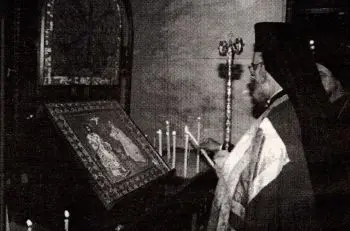



|
Ε ρ ώ τ η σ η: Πρόκειται να νυμφευθώ με μια καθολική κοπέλα, που θέλει ομως να γίνει ορθόδοξη. Ο ιερέας της κοινότητάς μου μας είπε οτι πρέπει πρώτα να γίνει Ορθόδοξη Κατήχηση και μετά νά βαπτισθεί, οπως και τα παιδιά. Διαμαρτυρήθηκα, ότι δεν είναι ούτε μουσουλ- μάνα ούτε άθεη, αλλά χριστιανή. Αφού είναι καθολική, μας απάντησε, το ίδιο είναι. Μπορείτε να μας διαφωτί- σετε; Οι καθολικοί δέν είναι χριστιανοί; Με ποιό τρόπο γίνονται δεκτοί στήν Ορθοδοξία; Λ.Β.Κ. Νέα Υόρκη ✧ ✧ ✧ Απάντηση: Δεν είναι δυνατόν οι Καθολικοί νά το- ποθετηθούν στό ίδια «καλούπια» με τους άθεους και μέ τούς μουσουλμάνους. Οι Καθολικοί είναι Χριστιανοί, οπως και εμείς. Ωστόσο, τα πράγματα δεν είναι τόσο απλά όσο μερικοί νομίζουν, γιατί έχουμε μεγάλες Θεολογικές δια- φορές με την Καθολική Εκκλησία. Αλλά οι Καθολικοί είναι Χριστιανοί και πρέπει να γνωρίζετε οτι η Ορθόδοξος Εκ- κλησία εχει λάβει επίσημη Κανονική θέση και δέχεται τους Καθολικούς μόνον δια του Χρίσματος. Η Εκκλησία μας λοιπόν, βασιζομένη στόν 7ο Κανόνα της Β' Οικουμενικής Συνόδου και στον 85ο Κανόνα της Στ' Οικουμενικής Συνόδου, συνέταξε και συμπεριέλαβε στο Μικρό Ευχολόγιο ειδική ακολουθία με τον τίτλο «Ακο- λουθία επιστροφής εις την Ορθοδοξίαν από της Λατινικής Εκκλησίας» (σελ. 87, έκδοση 1987). Η Ιερά Αρχιεπισκοπή Αμερικής, ακολουθώντας τήν Κα- νονική και Λειτουργική Τάξη του Οικουμενικού Πατριαρ- χείου, στον «Οδηγό του Ιερέως» (έκδοση 1987), σελ. 27 (στο αγγλικό κείμενο σελ.85), παράγραφος 2α, περιλαμ- βάνει και την «Ακολουθία προσελεύσεως Ετεροδόξων εις την Ορθοδοξίαν δια του Χρίσματος». Ορισμένες φορές, οι ευλαβέστατοι ιερείς μας, ίσως να μή συμβουλεύονται επαρκώς τις υποδείξεις του «Οδηγού του Ιερέως» και προβαίνουν σε αυθαιρεσίες. Από αδικαιο- λόγητη άγνοια, ή ακόμη καί από υπερβάλλοντα ζήλο, γί- νονται μερικές φορές «βασιλικότεροι του βασιλέως». Το Βάπτισμα των Καθολικών, εν μέρει, είναι αναγνω- ρισμένο από την Εκκλησία μας. Στη Βάπτισή τους επικα- λούνται μεν το Όνομα του Πατρός και του Υιού και του Α- γίου Πνεύματος, αλλά υστερεί στή δική μας τριττή κατά- δυση, που αντ' αυτής γίνεται δια ραντισμού. Γι αυτό, στην περίπτωση αυτή, όταν Καθολικός γίνεται Ορθόδοξος του δίνουμε μόνο το Αγιο Μύρο, δηλ. το Χρίσμα. Συνεπώς, η αναβάπτιση Καθολικού απαγορεύεται ρη- τώς από τους Ιερούς Κανόνες της Εκκλησίας μας και οι κυρώσεις είναι αυστηρές. Αλλωστε αυτό τονίζεται και στον 57ο Κανόνα των Αγίων Αποστόλων. Σας συνιστώ να δώσετε ιδιοχείρως στον ιερέα σας την ανωτέρω απάντηση και άν επιμείνει στην αναβάπτιση της μνηστής σας, τότε να ειδοποιήσετε αμέσως τον Σεβ. Αρχι- επίσκοπο. |
[ p 15 ]
Η Γ' Σύναξη των Ιεραρχών
ΣΤΟ ΟΙΚΟΥΜΕΝΙΚΟ ΠΑΤΡΙΑΡΧΕΙΟ
H Ορθοδοξία διαθέτει τις πνευματικές δυνάμεις, με τις οποίες θα συμβάλλει στην αντιμετώπιση των αδιεξόδων που έχει δημιουργήσει ο Δυτικός πολιτισμός για τον σύγ- χρονο άνθρωπο, παρά την μεγάλη τεχνολογική πρόοδο που ο πολιτισμός αυτός έχει σημειώσει σε όλους τους το- μείς.
του Νικολάου Μαγγίνα
Αυτό αποτέλεσε ένα από τα βασικά συμπεράσματα των εργασιών της Γ' Ιεράς Συνάξεως των Ιεραρχών του Οι- κουμενικού Πατριαρχείου, που συνήλθε απο τις 1 έως 3 Σεπτεμβρίου 1996, στην Κωνσταντινούπολη.
Οι εργασίες της Συνάξεως άρχισαν με προσφώνηση του Πατριάρχου κ. Βαρθολομαίου στην οποία απάντησε εκ μέρους της Ιεραρχίας ο Μητροπολίτης Χαλκηδόνος Γέρων κ. Ιωακείμ.
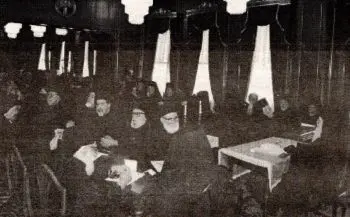
Υπό την προεδρία της Α.Θ.Π. του Οικουμενικού Πατριάρχη κ. Βαρθολομαίου, 62 ιεράρχες του Θρόνου πήραν μέρος στη φετινή Σύναξη. (Φωτ. Ν. Μαγγίνας)
Στην Σύναξη των Ιεραρχών υπό την προεδρία του Οικουμενικού Πατριάρχου κ. Βαρθολομαίου, έλαβαν μέ- ρος 62 Ιεράρχες, μεταξύ των οποίων ο Αρχιεπίσκοπος Α- μερικής κ. Σπυρίδων και οι Ιεράρχες της Αμερικανικής η- πείρου.
Κεντρικό θέμα της Συνάξεως ήταν: «Το Οικουμενικό Πατριαρχείο προ των προκλήσεων του Δυτικού πολιτι- σμού». Εγιναν εισηγήσεις από Ιεράρχες και ακολούθησαν μακρές συζητήσεις και παρεμβάσεις των μελών της Συνά- ξεως με τον ομολογουμένως άψογο συντονισμό και τις εύστοχες παρεμβάσεις του Προέδρου της Συνάξεως κ. Βαρθολομαίου.
Εισηγήσεις παρουσίασαν ο Μητροπολίτης Περγάμου κ. Ιωάννης με θέμα: «Βασικά χαρακτηριστικά του Δυτικού Πολιτισμού», ο Αρχιεπίσκοπος Αμερικής κ. Σπυρίδων με θέμα: «Η Ορθόδοξος Εκκλησία και τα μέσα ενημερώσεως και επικοινωνίας», ο Επίσκοπος Σκοπέλου κ. Σβεβολόντ με θέμα: «Η Ορθόδοξος Εκκλησία και τα προβλήματα των σημερινών νέων», ο Μητροπολίτης Κισάμου και Σελίνου κ. Ειρηναίος με θέμα: «Το κήρυγμα της Εκκλησίας και οι προκλήσεις του συγχρόνου πολιτισμού», και ο Μητροπο- λίτης Ελβετίας κ. Δαμασκηνός με θέμα: «Το μεταπτυχιακό Ινστιτούτο Ορθοδόξου Θεολογίας εις την διακονία της Εκκλησίας εν σχέσει προς τας ενώπιον αυτής προκλήσεις του Δυτικού πολιτισμού».
Η νέα Ινδικτιώνα
Της Συνάξεως προηγήθηκε Θεία Λειτουργία στον Πα- τριαρχικό Ναό Αγίου Γεωργίου στο Φανάρι με Χοροστασία του Πατριάρχου κ. Βαρθολομαίου και τη συγχοροστασία των Ιεραρχών του Οικουμενικού Θρόνου, στα πλαίσια της οποίας εορτάσθηκε και η νέα Ινδικτιώνα, η έναρξη του νέου Εκκλησιαστικού έτους. Επίσης συμπροσευχήθηκαν για τη διάσωση του περιβάλλοντος, στου οποίου την προ- στασία έχει αφιερωθεί η 1 η Σεπτεμβρίου κάθε Εκκλησια- στικού έτους, μετά από πρωτοβουλία του Οικουμενικού Πατριαρχείου.
Η θεματολογία της Συνάξεως, εντάσσεται στη γενικό- τερη προσπάθεια του Οικουμενικού Πατριαρχείου για πνευματική και πολιτιστική επικοινωνία μεταξύ Ανατολι- κού και Δυτικού πολιτισμού, στο πλαίσιο του ευρύτερου στόχου για ουσιαστική παρέμβαση της Ορθοδοξίας στον σύγχρονο κόσμο.
Πατριαρχικές Επισημάνσεις
Για να υπάρξει όμως ελπιδοφόρο μέλλον για τον άν- θρωπο του 21 ου αιώνα, καθίσταται επιτακτική η ανάγκη διάσωσης του περιβάλλοντος στο οποίο ζει. Και προς αυτή την κατεύθυνση κινείται και το εφετεινό μήνυμα του κ. Βαρθολομαίου για την «Ημέρα προστασίας του περιβάλ- λοντος». Συγκεκριμένα ο Προκαθήμενος της Ορθοδοξίας επισημαίνει μεταξύ άλλων: «Το οικολογικά πρόβλημα πε- ριπλέκεται στις μέρες μας λόγω των συμφερόντων των ο- λίγων και αγνοίας των πολλών, με αποτέλεσμα να επι- κρατεί η οικολογική αναλήθεια υπό την μορφή σκοπίμου αποκρύψεως της αληθείας. Παράλληλα, καλλιεργείται με πολλούς τρόπους η οικολογική τρομοκρατία, παραβιάζον- ται διεθνείς συμβάσεις και επικρατεί οικολογική αναρχία. Ετσι ελάχιστα αποτελεσματικά βήματα έχουν γίνει. Η εμ- μονή του μεγαλυτέρου μέρους της ανθρωπότητος να πιστεύει, εσφαλμένα, πως το οικολογικό πρόβλημα μπορεί να αντιμετωπισθεί διά της πολιτικής της οικονομίας υπεν- θυμίζει ότι η οικολογική καταστροφή αποτελεί παραβίαση των θείων ρυθμίσεων της ζωής. Επιβάλλεται, λοιπόν, η ά- μεση συμφιλίωση του ανθρώπου με αυτές τις μίσεις. Εάν δεν συμφιλιωθούν -καταλήγει ο Πατριάρχης- όλα τα δη- μιουργήματα του Θεού μέσα σε μία κοινωνία αγάπης και στο πλαίσιο αυτών των θείων κανόνων που προκαθόρισε ο Δημιουργός, τότε κινδυνεύει το ανθρώπινο και φυσικό κάλλος που αποτελούν υψίστη δωρεά του Θεού. Γι' αυτό και η Ορθοδοξία αγωνίζεται σήμερα για να ενημερώσει γι' αυτή την αλήθεια τον άνθρωπο, ώστε να αναζητήσει στις πραγματικές πηγές της ζωής τη λύση γιά διάσωση του πε- ριβάλλοντος».
Στη Σύναξη υπογραμμίσθηκε ομοφώνως, ότι το κυριό- τερο μέσο συμβολής και μαρτυρίας της Ορθοδοξίας, είναι οι ζωντανές οπουδήποτε Ενορίες μας που, ως το συνεκ- τικό κύτταρο της Εκκλησίας, μεταφέρουν την εναλλακτική και σωτήρια διέξοδο στα αδιέξοδα του Δυτικού Πολιτισμού.
Επίσης διαπιστώθηκε ότι ο καλούμενος Δυτικός πολιτι- σμός αποτελεί το κυρίαρχο πολιτισμικό πλαίσιο, μέσα στό οποίο κινείται στις ημέρες μας η Ορθόδοξη Εκκλησία, σε Δύση και Ανατολή. Είναι δε γεγονός ότι σε όλες σχεδόν τις χώρες του κόσμου τείνει σήμερα να κυριαρχήσει ο πο- λιτισμός αυτός. Ακόμη ότι η Ορθοδοξία βρίσκεται σε μεγά- λο βαθμό σε διαλεκτική σχέση προς τον Δυτικό πολιτισμό, λαμβάνοντας υπ' όψη ότι τα χαρακτηριστικά του πολιτι- σμού αυτού διαμορφώθηκαν κάτω από την επίδραση του Δυτικού Χριστιανισμού. Τονίσθηκε επίσης ότι χρέος της Ορθοδοξίας είναι να μη καταστεί ένα «γκέτο» ή ένα απο- λιθωμένο δάσος μέσα στις δυτικές κοινωνίες, αλλά να φροντίσει να επηρεάσει εκ των έσω την πορεία της ιστορίας.
Αντιμετώπιση των αδιεξόδων
Η επιτυχής αντιμετώπιση των αδιεξόδων θα επιτύχει κυρίως εάν η Ορθοδοξία ενισχύσει τον θεσμό της Ενορίας και συνδέσει το κήρυγμα και την όλη ποιμαντική διακονία της προς τα υπαρξιακά προβλήματα του συγχρόνου αν- θρώπου. Για το λόγο αυτό αποφασίσθηκε όπως κατά την προσεχή Δ' Σύναξη της Ιεραρχίας του Θρόνου το 1998, εξετασθεί θεωρητικά και πρακτικά το θέμα της Ενορίας.
Εκτός από την συζήτηση του κυρίου θέματος «Η στά- σις της Ορθοδόξου Εκκλησίας έναντι των προκλήσεων του δυτικού πολιτισμού», ενημέρωσαν το Σώμα της Ιεραρχίας και οι Πρόεδροι των Διορθοδόξων Επιτροπών γιά την πο- ρεία των διμερών Θεολογικών Διαλόγων μεταξύ Ορθοδο- ξίας και των άλλων Χριστιανικών Εκκλησιών και Ομολο- γιών, όπως της Ρωμαιοκαθολικής, Παλαιοκαθολικής, Αγ- γλικανής Λουθηρανής, Αντιχαλκηδονίου κ.ά. Την πορεία του Διαλόγου της Ορθοδοξίας με τους Λουθηρανούς ανέ- πτυξε ο Αρχιεπίσκοπος Αμερικής κ. Σπυρίδων, ο οποίος εί- ναι και ο Πρόεδρος της Διορθοδόξου Επιτροπής.
Ο Οικουμενικός Πατριάρχης κ. Βαρθολομαίος κατά τη λήξη των εργασιών προσφώνησε τα μέλη της Συνάξεως της Ιεραρχίας του Οικουμενικού Θρόνου τονίζοντας μετα- ξύ άλλων τα εξής:
«Θα επανέλθετε μετά διετίαν εις τον ιερόν τούτον χώ- ρον, τη χάριτι του Κυρίου, άπαντες οι παρόντες και ενδε- χομένως και νεώτεροι μέχρι τότε αδελφοί, και θα εύρετε την Μητέρα Εκκλησίαν να αγωνίζεται πιστώς και ευσυν- ειδήτως επί των πνευματικών επάλξεων της Εκκλησίας και του Γένους, όπως το πράττει επί αιώνες ήδη τώρα, όπως θα συνεχίσει να το πράττει και μέχρι της συντελείας των αιώνων. Εις τούτο ενισχύεται από τον ιδικόν σας κόπον καί ιδρώτα, από την καύχησιν αυτής εν Κυρίω διά πάντας υμάς, από την αγάπην των τέκνων της και υπέρ πάντα από την χάριν και την προστασίαν του Θεού. Χαλυβδώ- νεται η θέλησίς μας διά την δράσιν και προσφοράν και α- πό τας αδίκους εναντίον αυτής επιθέσεις εξ οικείων συχ- νάκις, τας οποίας αντιπαρέρχεται εν μεγαλοψυχία καί εν προσευχή να φωτίζει ο Κύριος τους κινούντας την πτέρ- ναν κατά του ευεργέτου. Αληθώς, ποίος άλλος θεσμός, θρησκευτικός ή θύραθεν, ποία άλλη Εκκλησία, ευεργέ- τησε πλέον του Οικουμενικού Πατριαρχείου όχι απλώς το Γένος των Ελλήνων, αλλά το Γένος των Ορθοδόξων όλων και την ανθρωπότητα ολόκληρον διά της δημιουργίας τοιούτου υπερόχου πολιτισμού ως ο ημέτερος».
[ p 16 ]
|
|

ΤΟΝΙΖΕΙ 0 ΣΕΒ. ΑΡΧΙΕΠΙΣΚΟΠΟΣ ΑΜΕΡΙΚΗΣ κ. ΣΠΥΡΙΔΩΝ
Η διατήρηση της ελληνικής γλώσσας, η προώθηση των ελληνικών αξιών στη ζωή της Ομογένειας, η σύσ- φιγξη των σχέσεων μεταξύ της Αρχιεπισκοπής Αμερικής και του Οικουμενικού Πατριαρχείου, είναι μεταξύ των προβλημάτων που πρέπει να αντιμετωπίσει η Εκκλησία της Αμερικής, όπως τα διατύπωσε ο νέος Αρχιεπίσκοπος Αμερικής, Σεβασμιότατος κ. Σπυρίδων.
Σε συνέντευξή του, ο Αρχιεπίσκοπος τόνισε πως το Φανάρι αποτελεί σήμερα «τη μεγαλύτερη ελπίδα της Ορ- θοδοξίας, την εγγύηση για ένα λαμπρό μέλλον της Εκκλη- σίας μας».
«Η Ιερά Αρχιεπισκοπή θα καταβάλει» δήλωσε, «κάθε δυνατή προσπάθεια και θα χρησιμοποιήσει όλα τα μέσα που έχει στη διάθεσή της για να κρατήσει ζωντανούς και μάλιστα να ενισχύσει τους ιερούς αυτούς δεσμούς της Ομογένειας της Αμερικής με το Οικουμενικό Πατριαρχείο στην Κωνσταντινούπολη».
Υπογραμμίζοντας τη σπουδαιότητα που έχει η ελλη- νική γλώσσα για την Ορθόδοξη Εκκλησία, ο Σεβα- σμιότατος είπε ότι «δεν μπορεί παρά να είναι σημαν- τικότατη η θέση της ελληνικής γλώσσας και στον χώρο της Ελληνικής Ορθόδοξης Εκκλησίας και της Ομογένειάς μας στην Αμερική». Πρόσθεσε ωστόσο ότι «παρά τις σο- βαρές προσπάθειες που κατεβλήθησαν μέχρι τώρα, υπάρ- χει ακόμη ένα τεράστιο έργο που πρέπει να επιτελεστεί στον χώρο αυτό» και συνέστησε όπως «με ταπεινοφρο- σύνη να διδαχθούμε από τις εμπειρίες του παρελθόντος».
«Η Ομογένειά μας στην Αμερική είναι ένας Ελληνισμός που τείνει να θεωρεί τις ελληνικές αξίες στα πλαίσια της Ορθοδοξίας του, πράγμα που συνέβαλε αποφασιστικά στη διάσωση και διατήρηση, μέχρι σήμερα, των αξιών αυτών σε όλα τα στρώματα της μεγάλης μας Ομογένειας και, μέ- σω αυτής, στην προβολή τους στο ευρύτερο αμερικανικό κοινό», τόνισε ο Αρχιεπίσκοπος Αμερικής, σημειώνοντας ότι «ασφαλώς υπάρχει ακόμη χώρος πολύς για ακόμη με- γαλύτερη προβολή των ελληνικών μας αξιών, για την α- νάπτυξη τόσο των «πολλαπλών μας αξιών», όσο και «των πολιτιστικών δραστηριοτήτων» μας.
Κατά τον Σεβασμιότατο, οι προσπάθειες σε αυτές τις κατευθύνσεις, χρειάζονται «σαφή προκαθορισμό των ευκταίων στόχων και σοβαρότατο προγραμματισμό ως προς τα επί μέρους». Το ίδιο, είπε, ισχύει και «για τη συμ- μετοχή της Ομογένειας στην εξεύρεση λύσεων στα προ- βλήματα της ευρύτερης ελληνικής οικογένειας, είτε πρό- κειται για ζητήματα που αφορούν στα απαραχάρακτά της δίκαια, είτε για θέματα πνευματικού, κοινωνικού ή άλλου χαρακτήρα που την απασχολούν».
Σε σχέση με την άποψη ότι η κατάτμηση της Εκκλη- σίας της Αμερικής σε μια Αρχιεπισκοπή και τρεις άλλες Μητροπόλεις συντελεί στον κερματισμό του Ελληνισμού της Αμερικανικής Ηπείρου, ο Σεβ. Αρχιεπίσκοπος κ. Σπυ- ρίδων υποστήριξε πως δεν μπορεί να γίνεται λόγος για κάτι τέτοιο. Υπογράμμισε ότι η μεγάλη διαφοροποίηση στην κοινωνική-πολιτισμική και άλλη πραγματικότητα των ΗΠΑ «από εκείνη της Αργεντινής ή του Καναδά ή του Πα- ναμά», οδήγησε στη δημιουργία τριών νέων Μητροπό- λεων στην αμερικανική ήπειρο με σκοπό «την ευχερέ- στερη και λυσιτέλεστερη διαποίμανση των εκεί μεγάλων ορθοδόξων παροικιών μας».
Σύμφωνα με τον Αρχιεπίσκοπο Αμερικής «η αποτελε- σματικότερη εκκλησιαστική διοίκηση θα συνεπιφέρει φυσικά και την καλύτερη οργάνωση και μεγαλύτερη συ- νοχή του Ελληνισμού στις χώρες αυτές». «Η Αρχιεπι- σκοπή Αμερικής ήταν, είναι και θα παραμείνει ελληνική. Και, ως ελληνική, έχει ήδη προσφέρει ακόμη περισσότερα στον Ελληνισμό και στην Ορθοδοξία. Δεν θα μπορούσε, άλλωστε να είναι διαφορετικά, εφόσον η Ομογένειά μας στην Αμερική είναι ελληνική και αυτό όχι κατά συνθήκη, αλλά εκ πεποιθήσεως και μάλιστα βαθείας», δήλωσε χα- ρακτηριστικά ο Αρχιεπίσκοπος.
Επιστολή διαμαρτυρίας στον Γενικό Γραμματέα του Ο.Η.Ε.
ΝΕΑ ΥΟΡΚΗ.- Ο Σεβ. Αρχιεπίσκοπος Αμερικής κ. Σπυ- ρίδων παρακολουθεί με μεγάλο ενδιαφέρον και ανησυχία τις εξελίξεις στη μαρτυρική Κύπρο και στιγμάτισε ιδιαίτερα τις βάρβαρες δολοφονίες των δυο Ελληνοκυπρίων νέων, τον περασμένο Αύγουστο.
Σε επιστολή του προς τον Γενικό Γραμματέα των Ηνω- μένων Εθνών κ. Μπούτρος Γκάλι, με ημερομηνία 20 Αυ- γούστου, ο Σεβασμιότατος εξέφρασε τις ανησυχίες του και στηλίτευσε τις κατάφωρες παραβιάσεις των ανθρωπίνων δικαιωμάτων, του διεθνούς δικαίου και των αποφάσεων του Ο.Η.Ε., καθώς και την συνεχιζόμενη κατοχή της Κύ- πρου. Γράφει συγκεκριμένα:
«Με βαθύτατη λύπη» γράφει ο Αρχιεπίσκοπος Αμερι- κής, «σας απευθύνω την επιστολή αυτή για να εκφράσω τη ζωηρή ανησυχία μου σχετικά με τις πρόσφατες βιαιό- τητες που σημειώθηκαν στη νήσο Κύπρο. Οπως κάλλιστα γνωρίζετε, το Κράτος αυτό υπέστη συνεχείς παραβιάσεις της εθνικής του κυριαρχίας, την παρουσία ξένων κατοχι- κών στρατευμάτων στο έδαφός του και συνθήκες εντά- σεως που επανειλημμένα οδήγησαν σε απώλεια ανθρώπι-
νων ζωών».
Αναφερόμενος στη σημερινή κατάσταση στην Κύπρο, τονίζει ότι «δεν μπορεί να θεωρηθεί παρά σαν συνεχής κατάφωρη παραβίαση του διεθνούς δικαίου, των ψηφι- σμάτων των Ηνωμένων Εθνών και των αρχών εκείνων που ασπάζονται όλοι οι λαοί που στέργουν την ελευθε- ρία». Και υπογραμμίζει: «Τα ανθρώπινα δικαιώματα πρέ- πει να υποστηριχθούν παντού, για όλους τους ανθρώπους και ιδίως για εκείνους που, σύμφωνα με κριτήρια του κό- σμου τούτου, είναι ανίσχυροι».
«Προσθέτω τη φωνή μου» λέει ο Σεβασμιότατος, «στις χιλιάδες φωνές που ερωτούν: Δεν ήλθε πια ο καιρός, μετά από 22 χρόνια δεινών και θανάτων, να τεθεί ένα δίκαιο για όλους τέρμα στην Κυπριακή κρίση;»
Και κλείνει την επιστολή του στον Γεν. Γραμματέα των Ηνωμένων Εθνών με την ευχή να συνεχίσει με έμπνευση το δύσκολο έργο του για την επικράτηση της δικαιοσύνης και να οδηγεί άλλους σε σοφές επιλογές επ' ωφελεία ό- σων υποφέρουν και έχουν παραθεωρηθεί για τόσα χρό- νια».
Λύση στο θέμα της Εσθονίας
ΝΕΑ ΥΟΡΚΗ.- Τη διαίρεση των ορθόδοξων ενοριών της Εσθονικής Εκκλησίας συμφώνησαν οι εκπρόσωποι του Οικουμενικού Πατριαρχείου Κωνσταντινουπόλεως και του Πατριαρχείου Μόσχας, που συναντήθηκαν πρόσφατα στο Ταλίν της Εσθονίας, και αποφάσισαν να συστήσουν κοινή επιτροπή που θα εξετάσει τα θέματα που αφορούν τη νομική υπόσταση των ενοριών που θα παραμείνουν στη δικαιοδοσία του Πατριαρχείου Μόσχας.
Μετά τη λήξη της συνάντησης ο Γραμματέας της Συνό- δου της Εσθονικής Αποστολικής Ορθόδοξης Εκκλησίας, Χενν Τόσσο, ανέφερε ότι από τις 84 ενορίες, περί τις τριάντα επιθυμούν να υπάγονται στη Μόσχα και οι υπό- λοιπες στο Οικουμενικό Πατριαρχείο.
Η αντιπαράθεση στο θέμα της Εσθονικής Ορθόδοξης Εκκλησίας είχε προκαλέσει στις αρχές του έτους τη διατά- ραξη των σχέσεων μεταξύ Μόσχας και Κωνσταντινού- πολης. Η σύγκρουση άρχισε πριν τρία χρόνια, όταν οι εσθονικές αρχές καταχώρησαν ως Εσθονική Αποστολική
Ορθόδοξη Εκκλησία την εσθονική εκκλησία της διασπο- ράς. Η υπαγόμενη στη Μόσχα εκκλησία αρχικά προσπάθη- σε κι αυτή να κατοχυρωθεί. Οι εσθονικές αρχές αρνήθη- καν να την καταχωρήσουν ως Εσθονική Αποστολική Ορ- θόδοξη Εκκλησία διότι με το όνομα αυτό είχε ήδη κατα- χωρηθεί η παραπάνω εκκλησία η οποία αποκτούσε και το σύνολο της εκκλησιαστικής περιουσίας.
Η αναγνωρισμένη πλέον ως Εσθονική Αποστολική Ορ- θόδοξη Εκκλησία πέτυχε επαναφορά της στη δικαιοδοσία της Κωνσταντινούπολης που είχε διακοπεί κατά τη σοβιε- τική περίοδο και στις 20 Φεβρουαρίου, η Α.Θ.Π. ο Οικου- μενικός Πατριάρχης κ. Βαρθολομαίος αποφάσισε να απο- καταστήσει την δικαιοδοσία του στην Εσθονία. Ως απάν- τηση, ο Πατριάρχης Μόσχας κ. Αλέξιος, διέκοψε τις σχέ- σεις του με το Πατριαρχείο Κωνσταντινουπόλεως. Τον πε- ρασμένο Μάιο τα δύο Πατριαρχεία συμφώνησαν ότι στην Εσθονία θα συσταθούν δύο ανεξάρτητες ορθόδοξες εκ- κλησίες και αποφάσισαν επίσημα να αποκαταστήσουν τις σχέσεις τους.
[ p 17 ]
|
Ενα ιστορικό τετραήμερο για την Ορθοδοξία |
||
|
|
|
|
|
Από την άφιξη στο αεροδρόμιο: Ο Επίτροπος Δημο- σίων Σχέσεων, π. Αλέξανδρος Καρλούτσος, οδηγεί τον Σεβ. Αρχιεπίσκοπο Αμερικής κ. Σπυρίδωνα και τον Σεβ. Μητροπολίτη Γέροντα Χαλκηδόνος κ. Ιωα- κείμ στην αίθουσα επισήμων, όπου και η πρώτη υποδοχή. |
Κατάσταση πολιορκίας... στην είσοδο του Καθε- δρικού, φθάνοντας με τον
Μητροπολίτη Χαλκηδόνος για την ενθρόνιση. |
|
|
|
||
|
|
|
|
|
Ιστορική στιγμή: Ο πρώτος αμερικανογεννημένος Αρχιεπίσκοπος Αμερικής ανέρχεται στο θρόνο του. |
Κυριακή πρωΐ, το εκκλησίασμα παρακολουθεί την πρώτη Θεία Λειτουργία του Αρχιεπισκόπου Αμερικής κ. Σπυρίδωνα. Το αδιαχώρητο στην πράξη... |
|
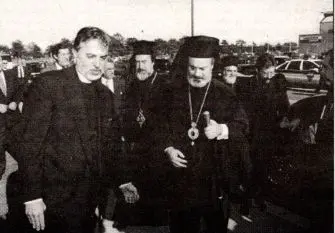
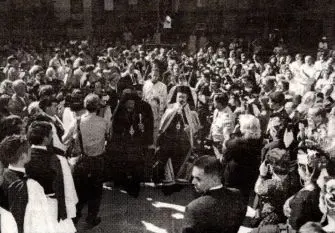
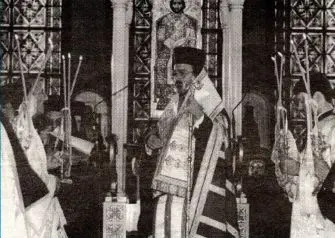
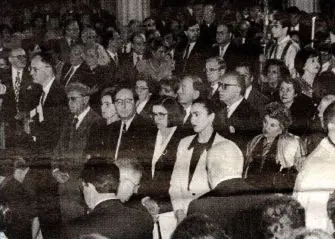
[ p 18 ]
|
REFLECTIONS |
Grand Gesture of Love Sets Tone of Change
It had all the ingredients of a human drama with a touch of the Divine. We had just marched into the histor- ic Holy Trinity Archdiocesan Cathedral in New York City preceding the entry of Archbishop Spyridon for his en- thronement ceremony.
By Fr. George Papaioannou
The jubilation the Byzantine pageantry with its soul elevating music had helped raise one's joy to its highest level. We all were in anticipation of the entry of the new spiritual leader as a symbolism and proclamation of a brighter future for Greek Orthodoxy in America.
The past and even the present are about ready to give way to the future, but not yet, not without the blessing of the past which is represented in the person of its leader, Archbishop Iakovos, who enters this magnif- icent setting to make the heartbeat of the congregation faster and remind it of its glory days. Being the master of these people's emotions, and the calmer of their fears, he walks slowly into the Cathedral that had been his spir- itual castle for 37 years.
Unlike other times, he is not directing his steps to- wards his throne. About a year ago he chose to give it up or, rather, to allow a younger hierarch to take over both the throne and the reign of the Archdiocese he had so dearly loved. He is escorted to a chair opposite his for- mer hierarchical throne to witness the ceremony of the ascent on it of his successor.
He comes only as a guest, not as a host in this grand Cathedral that had witnessed in the past so many glo- rious ceremonies and events in which he was the central figure. At his appearance the air of joy and jubilation is replaced for a few moments by a mixture of sorrow and gratitude. He will feel the emotion but he will succeed to hold back the tears, he has conditioned himself to pass the torch to his successor with pride and dignity, and will lead his former flock in the applause as their new spir- itual father and leader enters triumphantly yet solemnly the Archdiocesan Cathedral. Again the eyes and the at- tention are turned to the man of the hour, they all try to take a glimpse of their new Archbishop.
A breathtaking view; the grandeur of Byzantium, the majesty of Orthodoxy, the glorious past, the present all form a unity to project a promising future. Suddenly the congregation erupts. Axios! Worthy! What a marvelous experience! What a blessing for the Church, for the peo- ple, for those who labored before us to prepare for our better future!
The vision of Athenagoras the Patriarch, the dream of our immigrant forefathers but also the prayers of the faithful were heard and their wishes are realized in this one man, Archbishop Spyridon. He is flesh of their flesh and moreover he is the work of Providence. Youthful look- ing and trim, simple and yet majestic, gently and very comfortable in his new role he acknowledges the ap- plause solemnly with a blessing. He follows the proces- sion down the central isle and stops at the first pew to give a blessing, an embrace and filial kiss to the woman who gave birth and injected love in his heart for God and His Church. How special and how blessed and fortunate is this Mother! Undoubtedly today she is the most blessed woman in this congregation.
Following that stop, that embrace and that kiss the most dramatic moment took place so that will remain un- forgettable in the memory of those present and the thou- sands of television viewers throughout the land. Arch- bishop Spyridon directs his steps to the seat of Archbish- op Iakovos. The protocol of the letter gives way to the protocol of the heart. They embrace and exchange the kiss of love, peace and harmony. How great are the works of the Lord! No one who witnessed it shall ever forget the emotion that this embrace caused. Right there, in that embrace we saw, witnessed, and loved the passing of the torch from one generation to another, from the old to the new from the past and the present to this future, from Iakovos to Spyridon; and it was done with unprecedented grace, so peacefully, so humanly, so lovingly, so movingly.
Watching it, I couldn't help but think how wrong had we been to doubt our strength and our maturing for a peaceful transition. I looked at the congregation and I saw the emotion; I saw young and old, women and men to cry out of joy and shed tears unashamed and feel as if God Himself was a part of that historic embrace. And in- deed He was because that embrace of the past with the future, of Iakovos with Spyridon fulfilled his wish; To love one another. And I imagined all the people of our Church to be a part of that embrace for that was the message that these two may wish to pass to us all: To embrace each other, to love each other and to walk together the path of the faith and towards the future.
[ p 19 ]
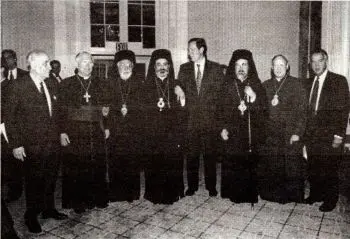
Lay and Church leaders together (L to R): The great benefactor of the Ecumenical Patriarchate Mr. Panagiotis Angelopoulos, William Cardinal Keeler, Roman Catholic Archbishop of Baltimore, Archbishop Iakovos, Archbishop Spyridon, New York Governor George Pataki, Metropolitan Ioakim of Chalcedon, Most Rev. Rembert Weakland, Roman Catholic Archbishop of Milwaukee, Senator Paul Sarbanes.
(D.Panagos photo)
[ p 19 ]
|
ARCHBISHOP SPYRIDON: |
|
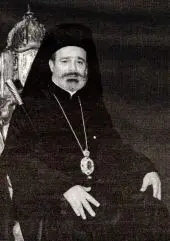 |
Enthronement at the Cathedral On September 21st, the Greek Orthodox Church in America hailed its first American-born leader, Archbishop Spyridon. Thousands of faithful, alongside Orthodox hierarchs and clergy from around the world and representatives of the political and religious communities in the United States, witnessed the enthronement of the fifth Archbishop in the history of the Archdiocese. With this videotape you can relive the excitement of the day as you watch the majestic procession that led to the Cathedral of the Holy Trinity in New York, the introduction ceremony, the Great Mandate and the Message of the Ecumenical Patriarch, the Enthronement and the Address of the new Archbishop (both in English and Greek) to his flock in America. Approximately 90 minutes |
|
GREEK ORTHODOX TELECOMMUNICATIONS |
|
|

[ p 19 ]
|
PEOPLE |
|
Earns degree Rev. John Tavlarides, dean of St. Sophia Cathedral in Washington, D.C., receives a diploma from Metropolitan Theodosius of the Orthodox Church In America for a Doctorate in Ministry he earned in May. He completed the doctoral program at St. Vladimir's Seminary in Crestwood, N.Y. |
Dr. Macris re-elected: Dr. Spiro Macris of Wilmington, N.C., won re-election to a second term as supreme president of the Order of AHE- PA at the organization's annual con- vention In Houston. |
||


[ p 21 ]
|
ST. NECTARIOS NAMEDAY |
|

As November 9th is rapidly approaching our commu- nity is not only preparing for our Patron Saint's Nameday, we are also finally under way with the construction of our new Shrine.
Back in May 1995, we had the first excavations clear- ing the land on the future site of Saint Nectarios. Then in August of 1995 we received our Conditional Use Permit. In September 1995 plans were submitted to the Los An- geles County Building Department and after many delays and disappointments due to recent civic codes related to construction in L.A. County, we finally received all our stamped and approved set of plans. In August 1996, with the Grace of God, construction has begun. To complete our task of the building of the St. Nectarios Shrine, the support of our fundraising must continue. Simple words cannot fully express the sincere gratitude we wish to convey to all of you for your strong support and part- nership to date for this most worthy cause. Your gen- erous donations in the past have made it possible for us to reach this point in the life of the St. Nectarios Shrine. Now as we have finally begun construction, any gift that you can possibly offer, small or large, would be most ap- preciated.
The Shrine has become a focal point of hope and faith to thousands who call and write each year, seeking prayer and assistance. Testimonies reveal that St. Nec- tarios is continuing his miraculous intercession in behalf of those who suffer in illness and misfortune. Let us not forget the Shrine belongs to all Christians in the Ameri- cas, not because they make donations, but because it is their right. We have a divine destiny and the sacred privi- lege to continuously pray for the sick, to serve those who come as pilgrims as Well as those who write and tele- phone for comfort and prayers. Please call us at 919/ 967-5524.
As many of you may already know, since 1979 we have been blessed to have a portion of St. Nectarios' Relic here in Covina from the monastery in Aegina, to serve the needs of the ill much in the same way as at the monastery in Aegina.
May the blessing of our Lord and Savior and the pro- tection of St. Nectarios be with you and your family. Be sure to send us the names of family and friends so that we may continue to pray for those in need during our weekly Parakleses Services. Also, at your request we will send you, at no cost, a bottle of the Holy Oil.
There are a number of ways you can help. We have the square foot program, the Brotherhood, donation certificates, etc. Will you please help with our mission?
[ p 21 ]
|
______________________________________________ |
PARISH PROFILE |
_____________________________________________ |
|
Parish of the Epiphany City |
|
|
____________________________ ____________________________
Name: Location: Tarpon Springs, Fla. Diocese: Atlanta Founded: 1908 Size: About 750 members
Clergy:
Rev. Tryphon Theophilopoulos (Holy
Noteworthy: ____________________________ ____________________________ |
|
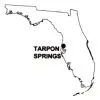
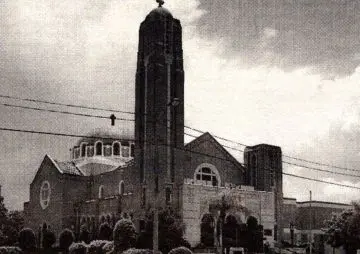
|
TARPON SPRINGS, Fla. — For more than 50 years, this resort city of about 18,000 located some 20 miles northwest of Tampa has been synonymous with the cele- bration in the United States of Christ's baptism and St. Nicholas Cathedral serves as its focal point. Each year for about 60 years crowds estimated in the tens of thousands attend the two-day ceremonies that include a hierar- chical liturgy followed by a pro- cession from St. Nicholas Cathe- dral to Spring Bayou for the dra- matic dive for the cross by dozens of teen-age boys. So important is the Epiphany cel- ebration in this community that, in 1975, the Tarpon Springs Board of Commissioners designated the city as an official "Epiphany City" of the United States. Yet this large community and major center of Greek ethnic life in the nation owes its existence to the lowly sponge, a primitive her- maphroditic creature that filters the equivalent of 64 glasses of wa- ter per day through its body. The first Greek to settle in Tar- pon Springs was John Cocoris, a native of the village of Leonidion, Kynourias, Greece, according to a parish history. He arrived in the U- nited States in 1895 and is cre- dited with founding the Greek sponge fishing industry and com- munity of Tarpon Springs. Cocoris brought his brother George from Greece in 1898 and another brother, Elias, in 1900. The brothers, at first employed by businessman John Cheney, devel- oped a chemical process to bleach sponges collected from nearby beaches. At that time, sponges were re- trieved by hook-and-spear, a meth- od used since the mid-1800s by residents of Key West and the Conch Indians. John Cocoris' dream was to introduce the special e- quipment used in the Greek is- lands to the fledgling sponge in- dustry of Tarpon Springs. He went back to Greece about 1903 and returned with a com- plete sponge crew from the island of Aegina. With a used fishing boat purchased for $180, the crew ven- tured out into the Gulf of Mexico with great success. Soon they bought more boats and word of their progress spread to Greece. Other sponge fisher- men arrived from Aegina, Hydra and Spetse, and from many of the Dodecanese islands, Kalymnos, Hal- ki and Symi. By 1905, 500 young men had arrived from these islands. Others came from elsewhere in the Unit- ed States and Canada, establish- ing restaurants, grocery stores and the ever-present taverns and cof- fee houses that defined a Greek community in those days. In 1907, the spongers formed a committee to establish a church and elected Nicholas Peppas of Ae- gina as the first president. He served as the driving force in the con- struction of the first St. Nicholas Greek Orthodox Church. The frame building had a seating capacity of 250 and cost about $3,500. The parish received a charter from the Church in Greece in 1908. However, after the organization of the Greek Orthodox Archdiocese of North and South America in 1922, St. Nicholas Church functioned as a separate community until 1976 when it received an Archdiocese charter after much prodding from Fr. Tryphon, the current dean. "They did not want to belong to the Archdiocese," he told the Ob- server. "They acted like an inde- pendent community." From the parish's founding un- til 1922, six priests served the com- munity. Then, in March of that year, the Rev. Theophilos Kara- phillis came to Tarpon Springs from Kalymnos and for the next 32 years put his stamp on the community. He established the first paro- chial school in the parish in 1925 with three teachers, five assistants and an enrollment of 200. By the mid-1930s, the church building could no longer house the ever-growing membership. A new church was desperately needed, but it was the midst of the De- pression and the community had only $20,000 in its treasury. Again, the sponge fishermen came to the aid of their church. They formed a plan to donate the best sponges of their catch to the church which, in turn, would sell them to Greek sponge buyers at higher than market-value prices. Through this method and from donations the parish raised the more than $150,000 needed to build a church. Construction began in late 1941. The new edifice was planned as a replica of St. Sophia of Constanti- nople. About a year later, the build- ing was completed and, in Janu- ary 1943, Archbishop Athenago- ras came to Tarpon Springs for the consecration during the Epi- phany festivities. He proclaimed the new church "one of the most beautiful Orthodox churches in the world." In 1954, Fr. Karaphillis retired, but remained active in the church until his death in 1963 at age 80. With the development of syn- thetic commercial sponges follow- ing World War II, the local natural sponge fishing industry went into a long period of decline, but even today, there are eight or nine boats still active, according to Fr. Tryphon. It was in 1960 that George Pa- pageorgiou returned to the United States after an absence of six years, to complete his high school edu- cation in Tarpon Springs, where many family members lived. His father, a medical doctor in Ohio who had retired to Rhodes, wanted him to further his educa- tion, recalled Elaine Tagarelli, a first cousin living in Tarpon Springs. "His father was a stickler for a great education and he had such great foresight," she told the Ob- server. Ms. Tagarelli, one of 12 first cous- ins of Archbishop Spyridon in the Tarpon Springs area, remembers him as "an excellent student, fun-loving and pretty popular in school." George lived with an uncle, George Tsourakis, who at the time was a city commissioner and went on to serve three terms as mayor. Ms. Tagarelli also recalled that he took part in church activities and assisted the priest, but that no one had an inkling that he would enter the priesthood. "We all an- ticipated him being a doctor like his father," she said, adding, "we're in total awe of him right now." Another cousin, Nicolette Hen- derson, was 9 years old when George graduated from high school in 1962. She remembers him as very soft-spoken, humble and car- ing. "He always had time for us," she said. During his high school years, George played on the football team named, what else, "the Spongers." He was the place-kicker. As was the case for the nation as a whole, the Sixties were a time of change for Tarpon Springs. One event in particular stands out in the annals of parish history. On Dec. 4, 1969, a cleaning woman noticed drops of moisture around the halo of the enclosed icon of St. Nicholas located inside the main entrance of the church. Over the next few days, thou- sands of people came to witness the event. The phenomenon ap- peared again on Dec. 14. During his Epiphany visit in January 1970, Archbishop lakovos examined the icon and said, "This may be a sign of the way the eternal God con- veys his message to the believers and only time will reveal the mes- sage." On another visit, in January 1976, the Archbishop elevated St. Nich- olas Church to cathedral rank af- ter the church joined the Arch- diocese and received its charter. Since coming to the parish in 1975, Fr. Tryphon, a native of Athens, Greece, has initiated many pro- grams. The parish has acquired more land around its church build- ing and its complex includes class- rooms for a Sunday School of 235 students and a Greek school of more than 100 students. There is also a pre-school, Philoptochos of- fice and a book store. In addition to the revenues gen- erated by the Epiphany-related e- vents, which include a two-day glen- di, the church budget is support- ed by a Greek festival the week before Great Lent, and dues of $88 for an individual, $154 per family, and $66 for retired persons. Fr. Tryphon has seen many chang- es in the community since his ar- rival 25 years ago. Some chang- es he calls "traumatic." With a trace of nostalgia in his voice, he observed that "all those oldtimers are gone. They were beautiful peo- ple." He lamented that "the young- er generation needs guidance. They think they know everything." Serving the younger people in the community is the parish's as- sistant priest, Fr. Nicholas Sama- ras who, in addition to being a graduate of Holy Cross School of Theology, is an accomplished poet of national repute and a former faculty member at Columbia Uni- versity and the University of Den- ver. Compiled by Jim Golding |
[ p 22 ]
|
HC/HC REPORT |
Record Number of Students Enroll
BROOKLINE, Mass. — Sixty-one students have en- rolled for the 1996-97 school year at Hellenic Col- lege/Holy Cross School of Theology. The figure topped last year's record enrollment by eight.
The new students received an official welcome to the campus during the Sept. 1314 feast of the Exaltation of the Holy Cross, the traditional start of the new academic year, at matriculation ceremonies led by the school's president, Rev. Dr. Alkiviadis Calivas.
Bishop Soterios of Toronto, acting as archepiscopal vicar, presided over the Friday evening vespers and Saturday morning liturgy.
Following the vespers, Dr. Aristotle Michopoulos, Hellenic College dean, introduced the new under- graduates and Rev. Dr. George Dragas recognized the incoming School of Theology students.
Bishop Soterios conducted the "rasophoria" ceremony.
New students in the theological school include: Fr. John Bernardi, Melrose, Mass; Innocentios Byakatonda, Kampala, Uganda; Carolyn Crossley, Torrance, Calif.; Michael Diavatis, Benicia, Calif.; Mark Doku, Worcester, Mass.
Evangelos Evangelidis, Scarsdale, N.Y.; Susan Fennell, Cocoa, Fla.; Dr. Helen Geanon, D.D.S., Addison, Ill.; Nicholas Georgiou, Cary, N.C.; Paul Gikas, Poway, Calif.
Fr. Quenton Gipp, Phoenix, Ariz.; Jacob Gorny, Portland, Oregon; Scott Hoffhines, Maplewood, Minn.; Michael Kailas, Fullerton, Calif.; Deacon Methodios Kalis, Patras, Greece.
John Katsoulis, St. Louis; Paul Keriotis, Warren, Ohio; George Ketrenos, Portland, Mich.; John Kokinos, Ph.D., Woods Hole, Mass.; Dr. Euthym Kondaxis, M.D., Scotts- dale, Ariz.
Nicholaos Kotsis, Ann Arbor, Mich.; Daryle Lamou- reux, Dover, N.H.; Konstantinos Liadis, Huntsville, Ca- nada; Nicholas Louh, Jacksonville, Fla.; Brother John Lopresti, Needham, Mass.
Vasile Mihai, Jacksonville, Fla.; Mihail Moisin, Brook- line, Mass.; Dimitrios Moraitis, Elmhurst, N.Y.; George Nikas, Upper Marlboro, Md.; Dimitrios Pappas, Denver.
Daniel Payne, Fort Collins, Colo.; Brant Pelphrey, Ph.D., Smithville, Texas; Timothy Robinson, Danville, Calif.; So- terios Rousakis, Clearwater, Fla.; James Shadid, Oklaho- ma City.
Constantine Simeonidis, Strongsville, Ohio; Michael Skrocki, Newton, Mass.; Michael Stearns, Chicago; Peter Stratos, Santa Ana, Calif.; Demetrios Tonias, Niskayuma, N.Y.
Those accepted to the undergraduate program at Hel- lenic College include:
Nektarios Antoniou, Brussels, Belgium; Christopher Cook, St. Petersburg, Ha.; Maria Dantos, Hanover, N.H.; Peter Goritsan, Chicago; Kariofillis Grozoudis, Greece.
Ryan Gzikowski, Canonsburg, Pa.; Anastasia Ioakimi- dou, Thessaloniki, Greece; Evagelia Kotsari, Athens, Greece; Gus Lazarakis, Salt Lake City; Larry Legakis, Royal Oak, Mich.;
Peter Milovanovic, Niagara Falls, Canada; George Pa- pacostas, Athens, Greece; Aliki Pistikos, Litochoro, Greece; John Smiliotopoulos, Brockton, Mass.; Andrew Tsikitas, Jamaica Plain, Mass.; Hiryt Yohannes, Addis-A- baba, Ethiopia.
Joshua Utomo, Indonesia; Nicholas Voyadgis, Syra- cuse, N.Y.; Abraham Wassef, Middletown, N.J.; Paul Za- haras, Cheyenne, Wyo.; and Paul Zamora, Washington, DC.
School Names New Director of Admissions
BROOKLINE, Mass. — Fr. Alkiviadis Calivas, president of Hellenic College and Holy Cross Greek Orthodox School of Theology, recently announced the appointment of Dr. John Klentos as director of admissions and records. Dr. Klentos replaces Fr. Athanasios Demos who will focus on his responsibilities as director of development and alumni.
According to a press release from the school, Klentos, an Oklahoma City native who attended the University of Oklahoma, received a bachelor's degree from Hellenic College in 1986 and a Masters of Divinity from Holy Cross School of Theology in 1989.
He pursued post-graduate studies in liturgical history at the University of Notre Dame, where he was awarded a Ph.D. in January 1996.
At Notre Dame he studied under Fr. Robert F. Taft, S.J., a preeminent authority in the field of Byzantine li- turgy. In the course of his studies, Klentos also attend- ed the Pontifical Oriental Institute in Rome.
He continues to collaborate with Bishop Kallistos Ware and others on The Queen's University of Belfast research project focusing on the history of monasticism in 12th century Constantinople.
Klentos has most recently taught undergraduate courses in theology at Notre Dame and was a visiting assistant professor at the College of St. Benedict and St. John's University in Collegeville, Minn.
Dr. Klentos was appointed director of admissions and records on the strength of his demonstrated inter- personal-skills. While teaching at Notre Dame, Klentos was nominated for the Outstanding Undergraduate In- structor award. His experiences with undergraduate stu- dents both in and out of the classroom have taught him how to interact with American college students.
His ongoing involvement with the national Phi Kappa Psi fraternity has made him aware of student recruitment and retention on a college campus. As someone sensitive to the attitudes of young people, Klentos will help Hellen- ic College and Holy Cross communicate their educational principles and goals to the next generation of Orthodox Christian leaders, through the development of new re- cruitment strategies and marketing approaches.
In addition to these duties, Dr. Klentos will exercise oversight over student records and develop new methods in the scheduling of courses, the registration process, and the maintenance of academic records and policies.
Assistant Director for Special Projects Named
BROOKLINE, Mass. — Reverend Dr. Alkiviadis Kalyvas, school president, has named Dr. Valerie A. Karras as assistant director of institutional planning and special projects.
Dr. Karras will provide assistance to the president re- lating to planning and developing summer programs, grant development, and activities connected with the up- coming 60th anniversary of the founding of Holy Cross.
A native of St. Louis, Dr. Karras received a Bachelor of
Arts degree in Political Science from Washington Univer- sity in 1979. She graduated with a Masters of Theological Studies from Holy Cross in 1982.
She then received a T.h.D. in Patristics, 1991, from the Aristotle University of Thessaloniki.
She is presently working on her second doctorate in Church History at Catholic University of America.
Dr. Karras has published articles in various journals and books.
[ p 23 ]
|
MISSIONS |
First Orthodox Conference For Prison Workers
ST. AUGUSTINE, Fla. — The first conference for all Orthodox Christian clergy and laypeople interested in ministry to those incarcerated in juvenile facilities, local jails, state, and federal institutions has been scheduled for Oct. 14-16, in St. Augustine. Approved and blessed by the Standing Conference of Canonical Orthodox Bish- ops in the Americas, the conference will be sponsored by the Orthodox Christian Mission Center (OCMC), which is located in St. Augustine. Chairing the event will be Fr. Duane Pederson, director of the Orthodox Christian Pris- on Ministry for the Antiochian Orthodox Archdiocese.
Among the featured participants are Fr. Nicholas Lassios, Fr. David Randolph, Ivan Sotirov, Dave George, Fr. Milton Magos, and Deacon Keith Powley. Bishop Basil of Enfeh will provide spiritual leadership and celebrate Divine Liturgy for the participants.
Everyone actively ministering to prisoners, or inter- ested in learning how to minister to prisoners, is wel- come to attend and participate. All levels of involvement will be addressed. Opportunities will be available to net- work to exchange ideas and information, and to plan for further cooperation.
Conference sessions and accommodations will be at the Howard Johnson Resort Hotel in St. Augustine Beach. The special convocation room rate is $50 per night (sin- gle or double), and the conference registration fee is $95 per person ($85 if received by Sept. 10).
For more information, contact the OCMC at P.O. Box 4319, St. Augustine, FL 32085, or call Andrew Lekos, conference coordinator, at 904/829-5132.
On the West Coast, contact Fr. Duane Pederson at 213/467-2720, or P.O. Box 1949, Hollywood, CA 90078.
|
AROUND THE USA |

|
Parish Completes Its First Year
ROCHESTER, N.Y. — The Church of the Holy Spirit took root one year ago and continues to thrive.
Since its founding as a mission church in October 1995, the community has grown to more than 90 fam- ilies. Diocese and Archdiocese charters were issued ear- lier this year.
The new parish rents space in an office/warehouse complex, but plans call for building a Byzantine-style church within two years.
Until recently, a part-time priest served Church of the Holy Spirit, Rochester native Fr. Kenneth C. Anthony, a 1990 Holy Cross graduate with an MBA from Stanford University. He worked for Ford Motor Company in Buffalo while commuting to hold services each weekend and to meet with the parish council.
He was recently transferred to Detroit and a new priest, Fr. George P. Savas, a native of Chicago and 1984 Holy Cross graduate who has served parishes in Atlanta, South Bend, Ind., and Charleston, S.C., has become pas- tor.
Since last year, the Holy Spirit parish has formed a Sunday school, altar boys group, HOPE, JOY and GOYA groups, campus ministry, and a number of standing com- mittees. Its choir is under the direction of George T. Georgantas who recently won the First Place Choir Award by the Mid-Eastern Federation of Greek Orthodox Choirs.
Plans are under way to expand the Sunday school, and to add a Greek school, children's Greek dance group and Philoptochos chapter.
Seven young people of the parish recently took part in the St. John Chrysostom Oratorical Festival.
Virginia Church Hits Half-Century Mark
CHARLOTTESVILLE, Va. — Metamorphosis Soteros Church will celebrate its 50th anniversary the weekend of Oct. 12-13.
Vespers will take place Oct. 12, followed by a ban- quet. After Sunday morning Liturgy, parishioners will at-
tend the opening of an exhibit at the Albemarle County Historical Society featuring the history, culture and spirit of Charlottesville's American Greek community. The exhibit will be open through Jan. 1.
Alabama Church Plans Iconography Project Ceremony
MOBILE, Ala. — Annunciation Church will dedicate its recently completed iconography project on Oct. 26.
The three-year project features 42 icons by icono- grapher Tom Clark in the area around the Platytera, in the dome and the drum of the dome, within the altar and
along the nave walls.
The church also received an icon of "Jacob's Ladder," donated by the Roman Catholic Archdiocese of Mobile in memory of Patriarch Athenagoras I. The event will in- clude a dinner at the parish's Center.
|
OBITUARY |
† Protopresbyter George Keramas
Rev. George Keramas died Aug. 24 in Orange, Conn., after a lengthy illness. He had served as pastor of St. Barbara Church in New Haven, Conn., for 32 years until illness forced him to relinquish his duties in 1982.
Fr. Keramas was born in Lowell, Mass., in April 1925. He was raised as a devout Christian by his mother, Athe- na Keramas, and after graduating from high school in Lowell enrolled at Holy Cross School of Theology in 1948.
In 1950, he became engaged to Vassiliki Alexa of Som- erville, Mass. There were married and became parents of three children.
In January 1951, he was ordained by Bishop Ezekial
of Nazianzus as a deacon at St. Barbara's Church in New Haven and as a priest at Annunciation Church in Newbury- port, Mass.
After his ordination, he was appointed as the priest in New Haven, where he received the offikion of "Sakel- larion" in 1957 from Archbishop Michael, and "Oikono- mos" in 1969 and protopresbyter in 1973 from Archbish- op Iakovos.
Upon being informed of Fr. Keramas' death, Archbish- op Spyridon sent condolences to his family and to his mother.
Funeral services took place Aug. 28 at St. Barbara's Church in Orange with Bishop Alexios of Troas officiating.
[ p 24 ]
|
RELIGIOUS EDUCATION |
Future Church Leaders Speak Up for Their Orthodox Faith
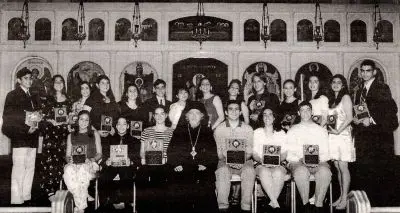
FINALISTS in the St. John Chrysostom National Oratorical Festival
with Bishop Isaiah of Denver.
Representing 10 Greek Orthodox dioceses in America, 10 young adults and 10 junior teens, recently competed in the St. John Chrysostom Oratorical Festival finals in Salt Lake City, according to a news release from Nicholas Karakas.
Each year, from parishes all over the United States and Canada, hundreds of Orthodox youth prepare and deliver their well-researched and rehearsed presenta- tions. Winners at the parish level proceed to the diocese oratorical matches where one junior and one senior are selected to compete in the finals, this year at Holy Trinity Cathedral in Salt Lake City.
A selected list of topics for each division are reviewed each year and about 15 are chosen for each group as the theme for their presentation, with participants making their own choice.
To assist the speakers in preparing their homilies, an extensive list of reference materials, including books, tapes and videos is made available.
Senior Steve Tsoraides of St. Demetrios Church in Ham- mond, Ind., Chicago Diocese, was awarded top honors, followed by, Matia Magoulias of Annunciation Church in Modesto, Calif., San Francisco Diocese, and Nathan Shand of Prophet Elias, Salt Lake City, Denver Diocese.
In the Junior division, Demytra Mitsis of Holy Trinity in London, Ontario, placed first, with Joseph Whitely, Annun- ciation Church, Modesto, second, followed by Anna Pardenek of St. George in Asbury Park, N.J.
Winners at the finals level receive college scholar- ships, while all participants earn certificates of merit, commendations and US Savings Bonds.
Now in its 13th year, the competition features some of Orthodoxy's brightest young men and women who eloquently articulate articles of their faith, historically saint and and Church Father, John Chrysostom.
As the Patriarch of the Mother Church in Constan- tinople, he preached powerful homilies and wrote elo- quently on what parents and teachers must do in leading their children toward a life of Christ.
Moreover, the Divine Liturgy celebrated in the Orthodox
Church on most Sundays and feast days is the Divine Lit- urgy of St. John Chrysostom. It is a fitting tribute to this noble saint that the oratorical festival carry his inspira- tional name. The St. John Chrysostom Oratorical Festival.
The competition, under the direction of Ernest Villas, director of the Department of Religious Education, has grown tremendously since its inception, and is, perhaps, one of the Archdiocese's best religious programs. Mr. Villas is ably assisted by Mrs. Vickie Villas and Rev. John and Presbytera Margaret Orfanakos, who coach and council the participants on organizing and managing the various diocesan events and stage the finals.
From a total participation of about 200 young men and women in 1984, the festival has grown to almost 1,000 aspiring student speakers this year.
Bishop Isaiah of the Diocese of Denver attended throughout the weekend to give encouragement and support to the participants.
After the difficult decisions of the judges were made known, His Grace commended the youthful orators as the "creme de la creme" of Greek Orthodox youth.
At the awards banquet, Nicholas Karakas, whose fam- ily foundation has been a long time contributor and ad- vocate of the oratorical festival, spoke directly to the participants. "Young people, you hold the future of Or- thodoxy in America in your hands. Armed with your faith, your convictions, your God-given gifts and talents, the keys are in your hands. From among you will come the presbyteres, clergy and faithful who in syndiakonia, work- ing together as clergy and laity, will provide the lead- ership of our beloved Church tomorrow."
At the conclusion of a weekend of excitement, fun, surprises, and many new friendships, Mr. Villas stated, "Our youth reflect good upbringing of their homes, the spiritual values of the Church and the experiences they have received in Sunday School, Greek language school, GOYA, summer camps, and other Church programs. These are made possible only through the support of the generous faithful to whom we are profoundly grateful."
[ p 25 ]
|
ENTHRONEMENT WEEKEND |
His Eminence Greets Faithful Upon Returning to Native Land
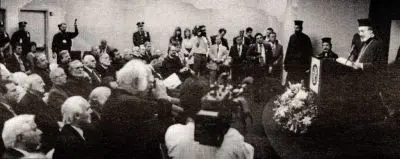
ONLY A few minutes after his Olympic Airways flight touched down, Archbishop Spyridon addresses a large gathering of Archdiocese clergy and lay leaders at the press room at Kennedy Airport. His Eminence received a warm response from the audience following his message which he read in English and Greek.
(Orthodox Observer photo)
J.F.KENNEDY AIRPORT, NY — The atmosphere was not only a crystal clear blue, but was also charged with ex- citement as dozens of church leaders, clergy and laity, waited for the moment anticipated since July 31, the arrival to America of our new Archbishop.
As did his predecessor, Archbishop Iakovos, His Emi- nence came directly from Greece, but the similarity ends there.
Archbishop Iakovos' trans-Atlantic voyage on an o- cean liner (the jet age had only dawned a few months earlier) was delayed 12 hours due to a storm at sea, resulting in an 11:15 p.m. docking in New York, and causing a one-day delay in the enthronement events.
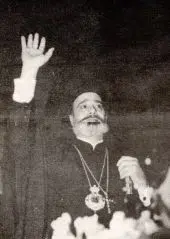
Archbishop Spyridon, responds to greetings from the crowd
(D.Panagos photo)
In contrast, Archbishop Spyridon's Olympic Airways 747 flight from Athens landed only 15 minutes be- hind schedule. The new era for the church in America began at 4:15 p.m. EDT.
A group of bishops, priests, lay leaders and diplomats greeted His Eminence at the arrival gate and a police escort whisked them to the press room of the nearby Port Authority Administra- tion building.
Visibly tired from the long flight (it was nearly 1 a.m. in Athens), he entered the room to a standing o- vation and a presentation of flowers by some children.
With bishops of the Archdiocese, Metropolitan Ioakeim
of Chalcedon, and other clergy who accompanied him on the flight standing in the background, the Archbishop stepped to the podium and read his arrival statement in English and Greek (text below). It was received with enthusiastic applause. He then greeted the more than 60 clergy, laypersons and news reporters on hand for the event.
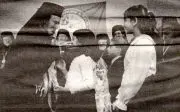
WELCOME YOUR Eminence! Upon entering the press room, Archbish- op Spyridon is greeted by three children representing the youth of the Archdiocese who presented him with flower bouquets. From left, Chryssa Golding, Nick Dimitriou and Mary Golding.
A motorcade, which al- so included his mother, sisters and brother who ac- companied him on the flight, through rush-hour traffic to Archdiocese head- quarters for his first wel- come by the staff. After a brief paraklesis in the Arch- diocesan Chapel of St. Paul, His Eminence placed a large bouquet in front of the icon of the Panaghia and spoke briefly, convey- ing the greetings of the Ec- umenical Patriarchate.
The following day, the Archbishop attended vespers at Holy Trinity Church in New Rochelle, followed by a dinner with more than 400 clergy and presbyteres.
He spent about two hours visiting each table and be- ing photographed with each priest and presbytera.
Among the speakers were Fr. Constantine Raptis, Arch- bishop Spyridon's priest in Tarpon Springs during his high school years; Rev. Chris Metropulos, the National Pres- byters Council president; and the Very Rev. Eugene Pap- pas of Three Hierarchs Church in Brooklyn, who pre- sented His Eminence with a gift from the clergy and pres- byteres, a silver staff.
Arrival Message of Archbishop Spyridon at Kennedy Airport
For me, as an American, it is a special joy to return to the United States to guide and serve the Greek Orthodox Church in America. But as I greet you for the first time as your new Archbishop, my joy is tempered by the thought of the great responsibilities that have been entrusted to me, and I beseech you all for your support, for your un- derstanding, and for your prayers.
I am uplifted to have alongside me my brother in Christ, Metropolitan Ioakeim, the representative of His All Holiness, Ecumenical Patriarch Bartholomew I, who will participate at my enthronement on Saturday. His All Holiness sends his patriarchal blessing and fatherly love to the Orthodox faithful of the Archdiocese, and his warm greetings to all the people of this country, the United States, which he looks forward to visiting in the fall of next year to celebrate the 75th anniversary of our Arch- diocese.
It is also a great joy for me to begin my ministry in this great city, New York, the gateway to the freedom and opportunity that this nation represents to the whole world. I am mindful that this most important journey of my ministry began in Constantinople, the capital of world Orthodoxy; paused in Athens, the capital of western civi- lization, and culminates in another capital — the capital of the world, as Mayor Giuliani calls it — New York City.
New York is the seat of our holy Archdiocese. I do not use the word holy lightly. We call the region around the sacred City of Jerusalem the Holy Land because it was there that Jesus Christ and the prophets walked and preached the message of God.
Wherever this message takes root is hallowed ground, and while it may seem that this frenzied metropolis is anything but holy, I know that there is great faith, love and compassion in this city, and I look forward to seeing it become the center of a new, vibrant and embracing Orthodox Church.
Our Church is now firmly established, not only in this city and this nation, but throughout the whole continent. Our communities have become an integral part of American society, and are accepted and admired by the other religious and ethnic groups that came to these shores before us.
We owe the acceptance and the respect we enjoy in the United States to the sacrifices of our parents and grandparents, who worked so hard to earn an honored place in American society and to prepare their children to seize the opportunities available in this great nation.
As the Chruch grew and matured under Archbishops Alexander, Michael, Athenagoras, and my beloved elder brother, Iakovos, its mission expanded to the larger com- munity in which it is planted, promoting human rights, seeking protection for our brethren in more dangerous parts of the world, and embracing new followers of our Faith.
Our mission is to preserve the best that our parents brought here from the old world, bind it together with the best that they found in this new land, and infuse it all with the new commandment our Lord Jesus Christ, that we love one another.
With God's blessing, and your help, I will do eve- rything in my power to carry out that mission; work with you to strengthen our communities; expand the teaching of our values, traditions and our rich Hellenic culture to our children; make our presence more keenly felt in A- merican society, not by increasing our demands, but by expanding our contributions; and show all Orthodox Chris- tians in America the relevance of our faith to our times.
Arriving here at JFK International Airport, I am re- minded of President Kennedy's moving inaugural speech some 35 years ago, when he announced that the torch had been passed "to a new generation of Americans." In my election as Archbishop, the torch of Orthodoxy in America is being passed to a new generation as well, born in this new land, and we are committed to see its flame burn brightly in the new millennium and unto the ages of ages.
I thank you for your warm greeting this afternoon. I look forward to working with you, and all our brothers and sisters throughout America, in the service of the Lord. We have much to do, but as St. Paul reminds us: "All things work together for good to those who love God."
May His love be with you always.
[ p 28 ]