VOL. 62 - NO. 1123FEBRUARY 1997http://www.goarch.org/goa/observer
Archbishop Spyridon at Presidential Inauguration
ARCHBISHOP SPYRIDON reads from the New Testament as President Clinton, Vice-President Gore and their families attend a National Prayer Service.
(N. Manginas photo)
WASHINGTON — Archbishop Spyridon was invited to take part in the Presidential Inaugural National Prayer Service in Washington on the morning of President Clin- ton's inauguration Jan. 20.
The service took place at the Metropolitan African Methodist Episcopal Church at 8 a.m. and featured scrip- tural
hymns and prayers.
His Eminence gave the New Testament reading, taken from the Book of Revelation 21:1-7, as follows:
"From the Sacred Island of Patmos, a Holy Shrine of the Ecumenical Patriarchate of Constantinople, in wis- dom, let us listen to the Book of Revelation by Saint John the Evangelist:
"And I saw a new heaven and a new earth: for the first heaven and the first earth were passed away and there was no more sea.
And I, John, saw the Holy City, New Jerusalem, com- ing down from God out of heaven, prepared as a bride adorned for her husband.
And I heard a great voice out of heaven saying, 'be- hold, the tabernacle of God is with men, and He will dwell with them, and they shall be His people, and God Himself shall be with them, and be their God.'
And God shall wipe away all tears from their eyes; and there shall be no more death, neither sorrow, nor crying, neither shall there be any more pain: for the former things are passed away.
And He that sat upon the throne said, behold, I make all things new. And He said unto me...
He that overcometh shall inherit all things; and I will be His God, and he shall be my son."
The service included several clergy from various faiths, among them Judaism and Islam. Since the inau- guration coincided with the holiday honoring Dr. Martin Luther King, the Rev. Jesse Jackson spoke on the Spirit of Dr. King's Legacy during the service.
[ pp 1, 3 ]
Hundreds Welcome Archbishop
A Homecoming Combined with the Epiphany
SURROUNDED BY well-wishers, Theodore Koulianos, 16, holds the cross he retrieved from Spring Bayou and the trophy he re- ceived from Archbishop Spyridon following his dive.
(N. Manginas photo)
TARPON SPRINGS, Fla. — Excitement mounted at Tam- pa International Airport on the evening of Jan. 3 as cos- tumed children wildly waving Greek and American flags, television and news photographers maneuvered for po- sition amongst the assembled
clergy, Greek Orthodox faithful and curious onlookers awaiting the arrival of TWA Flight 305 and His Eminence Archbishop Spyridon from New York.
By Nikki Stephanopoulos
An endless line of passengers disembarked, mystified by the lights, cameras and
enthusiastic crowd. A roar fi- nally went up, "There he is! There he is!" People strained to be the first to welcome him back home, cameras flashed, microphones were extended to pick up every word ― this was truly a glorious moment for the Greek Orthodox faith- ful of Tarpon Springs and the Tampa Bay area of Florida.
His Eminence Archbishop Spyridon, the first American-born prelate of 1.5 million Greek Orthodox Christians in America, graduated from Tarpon Springs High School in 1962. Though his given name was George P. Papageor- giou, he was known as "George" and came from Rhodes, Greece, to live with relatives for his junior and senior year of high school to improve his command of English.
This was a weekend to be long remembered in Tarpon Springs for it also marked the return of a Tarpon Springs native, Metropolitan Nikitas Lulias, who was enthroned Sunday, Jan.12 as the first Greek Orthodox Metropolitan of Hong Kong.
Of all the observances of Epiphany (Theophany-mani- festation of God) throughout the world, none is more deeply religious in tradition and significance or more co- lorful, than in the Greek Orthodox Church. and no- where does the observance take place on the scale wit- nessed in Tarpon Springs, which introduced the Greek E- piphany and its traditions to the American public in the 1930's.
Hundreds of pennants float in the breeze, Greek and American flags fly everywhere, lighted crosses decorate the lamp posts lining the streets and thousands of peo- ple, of every faith and denomination, from throughout the United States and Canada, come to witness the impres- sive ceremony which begins at St. Nicholas Cathedral, an exquisite Byzantine structure.
Hundreds packed the Cathedral to participate in the arch- ieratical liturgy celebrated by His Eminence Archbishop Spyridon assisted by Metropolitan Nikitas, Metropolitan Silas formerly of the Diocese of New Jersey; Bishop Ale- xios of Troas, newly appointed Vicar of the Diocese of Atlanta; Dean of the Cathedral Father Tryphon Theophi- lopoulos, Archdeacon Gerasimos, Deacon Anastasios, o- ver 20 priests, including area clergy and several retired priests; the Cathedral chanters and choir.
Dignitaries present in the congregation included the Am- bassador of Greece and Mrs. Loucas Tsilas, Congressman and Mrs.
Michael Bilirakis and Mayor Anita Protos of Tarpon Springs. Following the Blessing of the Waters, the entire congregation led by His Eminence Archbishop Spy- ridon proceeded out into a beautiful sunlit day where thousands line the streets and thousands more ringed the bayou.
HIS EMINENCE flings the cross into the bayou as more than 50 teen-age boys begin their dive in hopes of retrieving it.
(N. Manginas photo)
Long-awaited moment
The procession wound through the streets to the Spring Bayou. The Archbishop mounted the platform and some 50 young men, ages 16-18 awaited in boats preparing to dive for the cross, news and police helicopters flew over- head and the anticipation mounted. The Archbishop in- toned prayers, a white dove was released. However, rath- er than fly away, he chose to watch the proceedings perched on a branch above the golden mitre of the archbishop. Sud- denly, with the agility of the former football player he once was, the Archbishop cast a white cross into the water.
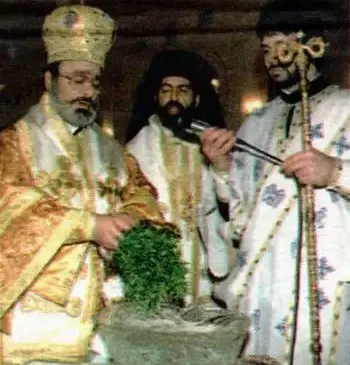
PRIOR TO the outdoor procession, Archbishop Spyridon held the Epiphany service in St. Nicholas Cathedral. Here, he dips the Basil plant into the blessed water before sprinkling the congregation.
(D. Panagos photo)
Sixty teenage boys dive into the 64-degree waters of the Spring Bayou for the annual "cross toss". Within 15 seconds 16-year-old Theo Koulianos, emerged with the cross. Shortly afterwards, His Eminence conferred his blessings to the winner and presented him with a trophy. Following the cross dive, an Epiphany Festival was held in Craig Park on the shores of the bayou complete with Greek food, music and entertainment. It is estimated that 40,000 participated in the day-long activities in Tarpon Springs.
Surprise Appearance at St. Petersburg
Though expected to attend the Divine
liturgy at St. Nicholas Cathedral on Sunday, Jan. 5, Archbishop Spyri- don, unexpectedly that morning, chose to visit St. Ste- fanos Church in St. Petersburg. "Metropolitan Nikitas was to celebrate the Liturgy, I wanted it to be his day" said the Archbishop. Let me visit another community." Though caught unawares, the community led by its
pastor Father George Patides, the packed church warmly welcomed His Eminence who officiated at the Blessing of the Waters and greeted each parishioner.
Following a full day on Saturday, which included in- dividual interviews with the Tampa Tribune and St. Pe- tersburg Times and NBC television, a luncheon hosted by the Philoptochos of St. Nicholas Cathedral, meetings with the area clergy and retired clergy, His Eminence attended a Dinner benefiting the rebuilding fund of St. John the Baptist Church, Tampa. On Tuesday, Jan. 7, he celebrated Liturgy on the occasion of the Feast Day of the Church. Following the Divine Liturgy, His Eminence visited the St. John's Greek Orthodox Day School. A beautiful complex with some 2,000 students (K8), led by the principal James J. Larkin and a dedicated staff. The Archbishop visited several classrooms and thoroughly enjoyed interacting with the students.
That evening he also had the opportunity to have din- ner with many of his relatives, first and second cousins, who live in the Tarpon Springs area and proudly enjoyed every minute of the visit of their "favorite cousin" and spiritual leader.
Former residence
On Wednesday morning, Jan. 8, His Eminence paid a nostalgic visit to the home he lived in while attending Tar- pon Springs High School and then went on to the High School where he assisted in unveiling a Sponger's Statue (donated by the Dodecanese and Kalymnian Societies of Florida) and attended a program given by the Greek Club students.
Traditionally, the Order of Ahepa and its auxiliaries hold meetings during the Epiphany weekend. On Sunday, the Ahepa family hosted a luncheon in honor of His Eminence and that evening an Epiphany Dinner in honor of His Eminence attracted over 600 people.
During his stay in Florida, His Eminence gave gener- ously of his time for newspaper, radio and television inter- views.
"I'm happy to report," wrote the Tampa public rela- tions chairman, "that we had a very successful "media re- lations weekend" here in Tampa Bay during the Arch- bishop's visit. For six nights in a row we had the Arch- bishop on all four major television channels, including three cameras during the St. John's Liturgy. The two pa- pers covered the Archbishop daily, with several cover spreads. Our great and profound Orthodox message was experienced by many thousands of people, and that to me is the best thing of all," Yours in Christ, Patti Paxson, St. John Greek Orthodox Church.
IN A CROWD - The search ended quickly as Koulianos (at right) breaks the surface holding
the cross.
(N. Manginas photo)
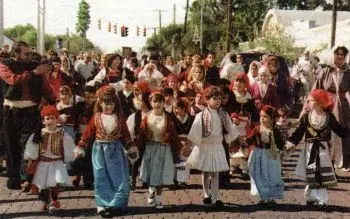
A PROCESSION of Greek School children makes its way to Spring Bayou on a balmy
winter day.
(D. Panagos photo)
[ pp 1, 28 ]
1996 Stewardship Giving Exceeds Past Years' Totals
Efforts by the Archdiocese to increase parish financial contributions through greater outreach proved very suc- cessful as income from the 1996 Total Commitment Pro- gram has surpassed the previous high by nearly $658,000.
According to information from the Department of Stew- ardship Ministry, the Archdiocese received more than $8.15 million for the year. The figure for 1995 was $7.46 mil- lion and the 1994 total over $7.49 million, the highest amount raised prior to this year.
Upon learning the news, Archbishop Spyridon respond- ed that he was "most grateful to all the bishops and the communities within their respective dioceses who came forward to fulfill their obligations to the national Church."
The Archbishop added, "We must begin to reach all the faithful and provide the services and ministries essential for the growth and expansion of our Church here in the A- mericas."
He also said that a greater effort will be made to keep the communities informed "of how their moneys are be- ing returned to them as services." One way he plans to do this will be through the Orthodox Observer, which be- ginning in March will increase its frequency to 18 issues per year.
Funds from the Total Commitment Program support the Archdiocese National Ministries. These include religious e- ducation and Hellenic College-Holy Cross School of Theo- logy, the diocesan ministries, which receive a portion of stewardship revenue, outreach programs that include youth ministry and Orthodox missions, community services such as the Registry Department, support of the Ecumenical Patriarchate and world Orthodoxy, and communications.
A major factor in the program's success was the stepped-up efforts since September by the Stewardship Ministry and diocesan bishops to contact parishes, especially those that had not sent in their contributions, and to empha- size the importance of their participation.
"We worked with each parish and the funds started coming in," said Stewardship Ministry Director Paulette Poulos. "The parishes did their part more than in the past and we want to publicly thank everyone."
She also praised the bishops for their support and lead- ership in their dioceses. "The key to a successful stew- ardship ministry can only be through the cooperation, guidance and leadership of the diocesan bishops," she said. "We plan to make every effort to work in conjunc- tion with each bishop and chancellor to secure that all parishes faithfully offer their monthly commitment to the Archdiocese."
Even the smallest communities have given their whole-hearted support to the Total Commitment Program. One example is St. George Church in Lynchburg, Va., a com- munity consisting of 21 persons and no full-time priest, but that has fulfilled its annual commitment of $1,020 without prodding from Stewardship Ministry officials.
While the amount raised for the National Ministries o- ver the past year will greatly reduce the nearly $1 million budget deficit, Stewardship officials said they plan to ex- pand their fund-raising efforts to increase the Church's revenue next year. These include two areas, the 1997 To- tal Commitment Program and the LOGOS (League of Greek Orthodox Stewards), which will be restructured.
"We want to generate more interest from individuals who would like to donate more to the Archdiocese so the entire burden does not fall on the communities," said Ms. Poulos.
[ pp 1, 3 ]
Archbishop Spyridon Pays First Visit to Chicago Area
CHICAGO — Archbishop Spyridon spoke of the need for unity during his first visit to the Chicago Diocese in mid-December.
During his Dec. 13-15 weekend stay, His Eminence attended events and services at the Diocese headquar- ters, at St. Spyridon's Church in Palos Heights and at Sts. Constantine and Helen Church in Palos Hills.
The Archbishop spoke of his greatest concerns, in- cluding education of the laity, interchurch marriages and the liturgical language.
The Counsul General of Greece in Chicago with Mrs. Nicholas Zafiropoulos, exchange greetings with His Eminence Archbishop Spyridon and Bishop Iakovos of Chicago.
(Elias Zimianitis photo)
He urged the faithful to better publicize the Church and challenged them to increase their basic theological knowledge. "Better articulation of our faith is the central issue I see before us," he said.
When he addressed a group of young adults, the Arch- bishop told them, "Your jobs today are in computer tech- nology, AIDS research, medicine, genetic engineering, bio- logical sciences, business and other such areas. Let us look to better articulate our faith as a church so that all the other issues with which we deal can be answered with wisdom."
The Archbishop also discussed his concerns about reclaiming many Greek Orthodox who have left the Church. He said he wants them to return and that the Archdiocese will create a Department of Evangelism and several task forces to "bring back thousands of faithful
LEFT: WELCOME TO THE NFL ― Fr. James Gordon presents His Eminence, a former high school halfback, with a Chicago Bears football helmet on behalf of the Diocese Young Adult League members. The helmet bears the inscription "To Archbishop Spyridon, our spiritual head coach."
(Elias Zimianitis photo)
RIGHT: A LITTLE GIRL presents the Archbishop with a chocolate rose at the airport.
we have lost on the road."
He also addressed concerns on the language used in the liturgy. "It is important that our priests, that we as a church, do not impose a certain language on our congre- gations," said the Archbishop.
"What is important is to see what the congregation wants. We have certain priests who are trying to impose either their Greek or their English ... but this is not what we should allow to happen."
Chicago's Bishop Iakovos expressed his support of the Archbishop's position in an interview with the Chicago Tribune.
"He appreciates, as all of us should, heritage, lan- guage, theology which is Greek Hellenistic," the Bishop
WITH 'HOOP STARS' - Members of the basketball teams at Sts. Constantine and Helen parish following a pep talk from His Eminence.
YOUNG ADULTS gather around His Eminence during their meeting. Also seated are Bishop Iakovos and Fr. Gordon, the Diocese Director of Youth and Young Adult Ministries.
said. "At the same time, he realizes that, naturally, there will come an American Orthodox — an English Orthodox Church — without forcing the issue, which would create divisions immediately."
While the Archbishop mainly addressed internal church matters, he also spoke of outward concerns, primarily e- cumenical dialogue.
"The express will of Christ is that we all be one in him," Archbishop Spyridon told the Tribune. "There can be no Christian against the unity of the Christian Church, and the only way to achieve this is through dialogue ... carried out through truth and love."
[ p 2 ]
A Warm Reception at Palos Hills Church
PALOS HILLS, Ill. — Parishioners and clergy of Sts. Constantine and Helen welcomed His Eminence to their church on Dec. 15. He was accompanied by Bishop Iako- vos, Fr. Alexander Karloutsos, former assistant pastor of the community, and the Very Rev. John Heropoulos.
Among those greeting him were Frs. Byron Papaniko-
laou, the head priest; and Nicholas Jonas, parish council members, the pastoral assistant, various representatives from the parish's organizations, and children of the par- ish's Koraes Elementary School.
The Archbishop also toured the church complex and vis- ited with the parish staff.
[ p 2 ]
INCREASED FREQUENCY
Keeping with Archbishop Spyridon's ef- forts to increase direct contact with the faithful and to better communicate the message of the Church throughout the na-
tion, the Orthodox Observer, beginning in March, will increase its frequency of pub- lication from eleven to eighteen issues a year.
[ p 2 ]
Bishop Alexios of Troas Named Vicar of Atlanta
NEW YORK — Bishop Alexios of Troas was named Archiepiscopal Vicar of the Atlanta Diocese as of Jan. 1, with responsibility for 56 parishes and 13 missions in eight southern states ranging from the Carolinas to Florida and Louisiana.
Bishop Alexios succeeded retired Bishop Iakovos of Catania who had been serving as locum tenens since the sudden death of Bishop Philip on Dec. 28, 1995.
Alexios was consecrated as titular bishop of Troas on May 17, 1987, by Archbishop Iakovos at Holy Trinity Arch- diocesan Cathedral. He was enthroned one month later as bishop (horoepiscopos) of St. Demetrios Cathedral in Astoria.
The bishop had served as director of the Hellenic Cul- tural Center in Astoria since
January 1989 and also was auxiliary bishop for the parishes of Queens, Long Island, southern Connecticut and Upstate New York.
Born Dec. 25, 1943, in Patras, Greece, the first child of Spyridon and Angeliki Panagiotopoulos, Bishop Alexios is one of five brothers and two sisters.
Following junior high school, he entered the Eccle- siastical Academy of Athonias on Mount Athos and was tonsured a monk at the famed Monastery of Vatopaidiou on the Saturday of Lazarus in 1963.
He graduated from the academy in 1964 and was or- dained a deacon in November 1965. Alexios served the Church of Greece in Patras and Athens until 1972.
Ordained to the priesthood on Aug. 27, 1972, he was assigned to St. Sofia Church in Patras. During this time, Alexios also was a monk at the Monastery of the Virgin Mary of Gerokomion Patras, where he lived.
Since the fall of 1969 he also had been enrolled at the University of Athens School of Theology, graduating in 1973.
He then came to the United States to pursue doctoral studies at Boston University and earned his Doctor of Ministry (D.Min) degree in 1977. While in Boston, he served as pastor of Dormition of the Mother of God Church in Burlington, Vt.
Following his studies, Alexios returned to Greece as abbot of his monastery in Patras.
Returning to the United States in 1978, Alexios served as dean of Sts. Constantine and Helen Cathedral in Brooklyn, N.Y., before being assigned to the Hellenic Or- thodox community of Astoria in 1979.
[ p 3 ]
SCOBA Hierarchs Hold First Meeting with Archbishop
NEW YORK - Hierarchs of the Standing Conference of Canonical Orthodox Bishops in America recently held their first meeting with Archbishop Spyridon at the Greek Orthodox Archdiocese.
His Eminence reaffirmed the harmony and commun-
ion of purpose that binds all of the jurisdictions together, stating plainly that the Church's unity is manifested through the unity of faith, doctrine, practice and worship which have always existed in the Orthodox Church of Christ.
HIERARCHS OF SCOBA meet at the Archdiocese. At right is Rev. Dr. George Dragas, ecumenical officer.
(Orthodox Observer photo)
In emphasizing the true and absolute unity of the Church, His Eminence commented on the need to contin- ue expending every effort to connect the different juris- dictions in the everyday witness of the Church, both to society at large and to the flock of Christ.
During their sessions, the hierarchs discussed the Or- thodox Christian response to various issues, including the legalization of same-sex marriages in Hawaii, which the Orthodox Church rejects.
They also discussed the recent instruction by the U.S. Catholic Bishops Conference to their clergy, regarding the giving of their Holy Communion to Orthodox, without con- sideration that the Orthodox Church does not permit her faithful to commune in any Church but their own.
This unilateral decision by the Roman Catholic bishops will be fully addressed at the next SCOBA meeting, with specific guidelines to the various Orthodox jurisdictions in America.
The hierarchs also agreed to a common and unified ef- fort to issue joint pastoral encyclicals addressing contem- porary problems that affect the Orthodox Christians in America.
The re-unification of the Ukrainian Church with the Ecumenical Patriarchate was singled out as an important step in the journey of the Orthodox Church here in Amer- ica.
Regarding this canonical regularization of the Ukrai- nian Church in America and the Diaspora, Metropolitan Theodosius of the former Metropolia (OCA) reported that the OCA is in full communion with the Ukrainian Church.
At the close of their meeting, the hierarchs expressed their appreciation and support for Archbishop Spyridon.
[ p 3 ]
Mayor comes calling
(Orthodox Observer photos)
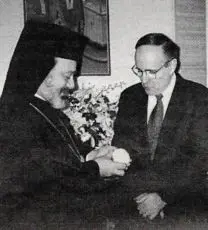
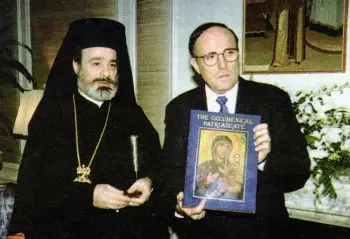
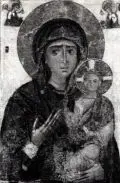
New York Mayor Rudolph Giuliani made his first of- ficial visit to Archbishop Spyridon at Archdiocese head- quarters on Jan. 15. The two discussed many subjects of interest in a meeting which stretched to more than an hour, including the upcoming visit in the fall of Patriarch Bartholomew. "We're very excited about it," commented Mayor Giuliani to journalists who covered the event. The mayor brought His Eminence a gift of a crystal apple (left), symbolizing the "Big Apple," and engraved with the city's seal. Archbishop Spyridon presented His Honor with an illustrated book about the Ecumenical Patri- archate.
[ p 3 ]
Yearbook of Ecumenical Patriarchate
The ecclesiastical yearbook of the Ecumenical Patri- archate commemorates the 75th anniversary of the Arch- diocese of America.
In his introduction in the yearbook, Patriarch Bartho- lomew states: "The Holy Great Church of Christ, the E- cumenical Patriarchate, having the responsibility for over- seeing all Orthodox Churches, both according to the holy canons as well as traditionally for many centuries, un- dertook the responsibility for the pastoral guidance of the Orthodox Christians of America, which they need to avoid assimilation by their new diverse doctrinal environment, included them under a new eparchy, the Orthodox Arch- diocese of America" established on May 17, 1922 under the Patriarchal and Synodic tome."
The introduction also includes two photographs, one of Patriarch Bartholomew during his enthronement and a second with First Lady Hillary Rodham Clinton during her visit to the Ecumenical Patriarchate in March 1996.
[ p 4 ]
Leadership meeting
Executive Committee members and staff of the 'Leadership 100' Endowment met in mid-January with Archbishop Spyridon, who expounded on his vision and goals for the Archdiocese and Leadership 100.
(Orthodox Observer photo)
[ p 4 ]
Visit of Laity
His Eminence also met recently with officers and representatives of the Ortho- dox Christian Laity organization at Archdiocese headquarters.
[ p 4 ]
With Key Aides
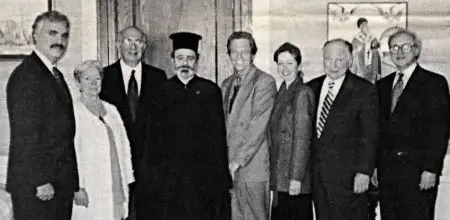
During his trip to Washington for the President's inauguration, Archbishop Spyridon met three top administration officials of Greek background at the White House, (from left), Victoria Radd, Chief of Staff to the White House Chief of Staff; John Podesta, Deputy White House Chief of Staff; and Sylvia Mathews, also Deputy to White House Chief of Staff. Radd's family came from Mytilene, Podesta's roots are in Leonidion, Arcadia, and Mathews' forbears came from Zakynthos and Elia in the Peloponnesos. Both women are Massachusetts na- tives and Harvard graduates.
(N. Manginas photo)
[ p 4 ]
Thessaloniki to Display Its Byzantine Legacy
THESSALONIKI (ANA) — Greece's second city has been delving into its rich cultural history, spanning more than 2,000 years, to come up with some rare gems for its year as Europe's cultural capital in 1997. An unprece- dented exhibition of Byzantine art from the nearby all-male monastic community of Mount Athos, where women are forbidden, is expected to draw more than a million visitors.
"After two years of preparation, the treasures of our By- zantine tradition, which has been kept alive for centuries, will be displayed for the first time outside Mount Athos," Thessaloniki Mayor Constantine Kosmopoulos told report- ers. A total of 589 items, ranging from gold-leaf icons to rare manuscripts, will be sent from the Byzantine mon- asteries dotting the Athos peninsula to be shown at the new Byzantine museum from June.
Thessaloniki, founded in 316 BC and named after Al- exander the Great's sister Thessalonikeia, is determined to show off both its unique roots and its new air as a vi- brant university city.
"We want to project Greek culture as continuing to the present, not a relic of the past," said Culture Minister Evangelos Venizelos while hosting a tour of the city.
Events will range from ancient Greek drama to plays by Jean Cocteau and Samuel Beckett; from modern jazz to Puccini's La Boheme and Verdi's II Trovatore.
Exhibitions span the work of Caravaggio to sculptures by the surrealist Max Ernst and a retrospective of Hans Arp; from engravings by Goya to contemporary Yugoslav art. "We want to promote Greece through a festival of ideas, not by projecting a silly chauvinism," Panos Theo- doridis, the cultural capital's artistic director, told report- ers.
Mr. Theodoridis' vision pays tribute to the medley of religions and ethnic groups that have left their mark on the waterfront city, where St. Paul preached in 50 AD.
"We remember and pay tribute to the historic com- munities of the Armenians and the Jews, who, along with the traditional communities of the Moslems and Chris- tians, helped the city reach its peak," he said.
Dotted with Byzantine churches, Ottoman mosques and bath houses, the city became part of Greece in 1913 dur- ing the Balkan wars. Its streets combine the charm of an eastern marketplace with the gray solemnity of a west- ern industrial hub.
Part of the Roman and Byzantine empires, Thessalo- niki was ruled at times by Saracens, Crusaders and Ve- netians until it fell to the Ottoman Turks.
It is the birthplace of Cyril and Methodius, who convert- ed the Slays to Christianity in the 800s as well as Kemal Ataturk, the founder of modern Turkey.
Thessaloniki got its major economic and cultural boost after the settlement of 20,000 Jews expelled from Spain and Portugal in 1492. The Nazis sent 50,000 Jews from the city known as the Second Jerusalem to the death camps. About 2,000 Jews live here to day.
About 30 European and Middle East countries are send- ing artists to perform next year. The United States, Can- ada, Australia and Japan are also participating.
Thessaloniki fears the year might be such a success that it could have difficulty putting up a huge number of visitors.
"Thessaloniki does have a problem with hotels," Mr. Venizelos said. "That's why we made arrangements to have cruise ships docked at the port to cover any such needs."
[ p 4 ]
YOUTH
Archdiocese To Train Church Youth Specialists
Archbishop Spyridon, recognizing the Church's need for a trained Church youth specialist, directed that an ac- ademic program be established on the St. Basil Acade- my campus that will train persons with skills to fill this void.
The Church youth specialist will serve at the parish level as coordinator for the Religious and Greek Educa- tion, and parish youth outreach ministries. The curricu- lum will include three components: Youth organizational, Greek and Religious Education.
The curriculum will include introductory course work in choral music that will equip the Church youth specialist with skills to organize and lead junior choirs. The first class will be admitted in the fall.
Those persons wishing to enroll in the youth specialist program or need information, should write to the:
Dean of Admissions, Church Youth Specialists Pro- gram, Saint Basil Academy - R2, Box 8A; Garrison, NY 10524
Brockton Goyans Sponsor Food Drive
BROCKTON, Mass. — GOYA members of Annunciation Church recently sponsored their annual program to provide food, clothing, toys and money to needy families whose names are supplied by the Brockton Visiting Nurse Association.
This year, the parish helped 40 families and 25 indivi- duals.
Merrick Goyans Sponsor Pageant
MERRICK, N.Y. — Goyans of St. Demetrios parish will sponsor the annual regional Pageant of Achievement on Feb. 23. The event will draw participants from many par- ishes of the Archdiocesan District.
It will take place at the Crystal Palace East in Farmingdale. For more information, contact the church at (516) 379-1368.
New Jersey Group Donates Turkeys
NEWARK, N.J. — Northern New Jersey Greek Ortho- dox Young Adult League members donated 20 turkeys, several bags of canned goods and other food to the A- merican Rescue Workers Homeless Shelter in December.
YAL'ers solicited several businesses for donations and brought canned goods and turkeys to all their social and religious events. They started collecting turkeys when the operator of the shelter told them one year that he had no turkeys for Christmas dinner.
Scout Wins Scholarship
FREEPORT, N.Y. — Eagle Scout Stathi
Pappas of St. Bas- il's Church in Stockton, Calif., recently won the fourth annual National Eastern Orthodox Scholarship funded by the Eastern Orthodox Committee on Scouting.
According to EOCS California coordinator Nick Tarlson, the 18-year-old Pappas is using his scholarship at the U- niversity of California-Berkeley to study anthropology and history.
Pappas, the son of John and Paula Pappas of Stock- ton, began as a Cub Scout and over the years has won numerous scouting and academic honors.
[ p 4 ]
Orthodox and Adventists Discuss Missionary Controversy
GENEVA (ENI) — A recent historic first visit by leading officials of the Seventh-day Adventist Church to the Ecu- menical Patriarchate in Phanar, the Greek quarter of Is- tanbul, Turkey signifies a major advance in relations be- tween the Seventh-Day Adventist and Orthodox churches.
However, the issue of the Protestant presence in East- ern Europe still remains an obstacle to better relations between Adventists and Orthodox, despite some agree- ment on moral issues, according to a spokesperson for APD, and Adventist press service, based in Basle, Swit- zerland.
Since the fall of communism in Eastern Europe and the former USSR, the growth and the missionary work of many Protestant churches in the region have angered lo- cal, traditional Orthodox churches who regard such ac- tivity as a form of religious trespassing.
There has been tension between Adventists and Or- thodox particularly in Romania, where Adventists are re- latively numerous, and in Bulgaria. There has also been conflict in Greece, where the Orthodox Church is by far the biggest church, with a strong influence on the gov- ernment.
According to APD, "the goals of the visit (on Oct. 25 to the Ecumenical Patriarchate) were to achieve better mutual understanding and to break down false stereo- types, and to discover points of friction between Ortho- dox and Adventist Christians."
The Ecumenical Patriarch, Bartholomew I, is tradition- ally regarded as the leading patriarch and international representative of the Eastern Orthodox churches.
APD reported that the Adventist General Conference officials, from the United States, who visited Phanar ― Dr. Bert Beverly Beach, Adventist director of interchurch relations, and Dr. John Graz, director for public affairs and religious liberty ― described the meeting as "friend- ly... the Adventist Church leaders appreciated the open- ness in all of the conversations offered to the small dele- gation."
A spokesman in Geneva for the Ecumenical Patriar- chate told ENI that the Orthodox/Adventist discussions had been "frank and open. It was a breakthrough in the debate concerning proselytism in Eastern Europe. It was also agreed that such exploratory meetings should con- tinue."
Commenting on the new Orthodox dialogue with Prot- estant churches, the spokesman said: "In the case of the Baptists, the reason (for the meeting) was to have an in-depth discussion about ongoing proselytism and the 'planting of churches' in areas where the (Orthodox) church has a 1,000-year history.
[ p 5 ]
U.S. Envoy Visits Ecumenical Patriarchate
ISTANBUL — Ecumenical Patriarch Bartholomew re- ceived a formal visit Jan. 17 from the U.S. special envoy to Cyprus, Greece and Turkey, Kerry Cavanaugh, director of the U.S. State Department Office of Southeastern European Affairs, at the Patriarch's official office at the Phanar, Istanbul. Mr. Cavanaugh was accompanied by Stephen Kimmel, U.S. Consul in Istanbul.
Mr. Cavanaugh, during a 45-minute visit with the Ecu- menical Patriarch, requested His All Holiness' blessing of his ongoing work and expressed the abiding interest and support of the United States for the welfare for the Ecu-
menical Patriarchate. His All Holiness, in turn, wished his distinguished visitor success in his mission to establish a lasting peace in the region.
Mr. Cavanaugh also expressed his pleasure upon hearing news of the Ecumenical Patriarch's forthcoming three-week pastoral visit to the United States, scheduled for October 1997. The Patriarch's visit is scheduled to coincide with the occasion of the 75th anniversary of the Greek Orthodox Archdiocese of America and the 60th anniversary of Holy Cross Seminary in Brookline, Mass.
[ p 5 ]
For Holding Easter Service
Metropolitan Iakovos Convicted by Turkish Court
ISTANBUL (Athens News Agency) — A Turkish court yes- terday sentenced an Ecumenical Patriarchate metropo- litan to five months in prison for having officiated over an Easter Saturday evening liturgy held in the Bulgarian com- munity's church in the Phanar district.
Sources told the Athens News Agency yesterday that Metropolitan Iakovos of Laodikeia was convicted by a mis- demeanors court in the Turkish city of Fatih. The deci- sion, which has not yet been officially publicized, does not mean, however, that the metropolitan will be incar- cerated.
The case was brought to court following a lawsuit brought against the metropolitan by a plaintiff identified
as Muzindar Cipov, a member of the Bulgarian parish's ad- ministrative board.
Mr. Cipov claimed that the presence of Metropolitan Iakovos at the Easter service in the Bulgarian parish con- stituted part of an effort by the Ecumenical Patriarchate to "Hellenize" the Bulgarian community.
The Turkish court also issued the same sentence on the vice-president of the Bulgarian community for invit- ing Metropolitan Iakovos to officiate the service.
However, several members of the small Bulgarian com- munity in Istanbul said Mr. Cipov does not express their opinion, adding that the Bulgarian community remains faith- ful to the Ecumenical Patriarchate and the Metropolitan of Laodikeia.
[ p 5 ]
U.S. Undersecretary of State Praises
Patriarch's Environmental Efforts
WASHINGTON — In a U.S. Information Agency For- eign Press Center briefing on Dec. 17 concerning the critical issue of pollution in the Black Sea, Undersecretary of State Timothy Wirth noted the efforts of the Orthodox Church and Ecumenical Patriarch Bartholomew to in- crease the international awareness of environmental issues.
In his comments, Wirth said, " I might note ... the great interest in the Orthodox Church, which as you know dominates most of the countries around the Black Sea, except when you get further down towards Turkey, ob- viously. But the Ecumenical Patriarch of the Orthodox Church, who lives in Istanbul ... has been instrumental in beginning to bring together the leadership of all the many Orthodox churches going up through that whole area to focus on issues of the environment and God's creation, that man has an obligation in every way to think about that which was given to us and which we in fact are fouling significantly.
"There was a major program that the Ecumenical Pa- triarch did last year on this issue. He is launching, I un- derstand, another seminar this summer on the question of the Black Sea, attempting to use his convening power to bring people together with a sense of urgency about what has to be done."
In an unrelated subject, a reporter from the Turkish Daily News questioned why certain military orders were not delivered to Turkey. He blamed Sen. Paul Sarbanes of Maryland for blocking the arms sales based on human rights reports the Senator received from a State Depart- ment official at the U.S. Embassy in Ankara.
[ p 5 ]
D.C.-Area Archons Raise
$10,000 for Patriarchate
WASHINGTON — Archons of Metropolitan Washington, Maryland and Virginia recently contributed $10,000 for the Ecumenical Patriarchate.
According to information from Emmanuel Athanasia- des, the group raised the funds at the semi-annual luncheon under the chairmanship of regional Commander Harry Magafan.
Magafan noted that this group of Archons is the only
one holding annual fundraising meetings and expressed the hope that the Archons in other areas will initiate activities in support of the Order of St. Andrew.
Among those attending the luncheon were Steve Georgilakis, D.G. Kousoulas, Dr. V. Deltas, Mimis Tsinto- las, Andy Manatos, Stavros Papadopoulos, William Hun- ter, John Deoudes, Gus Anthony, Gus Bochanes, Dr. E. A- damopoulos, Steve Yeonas and Peter Paleologos.
[ p 5 ]
Travel to Greece with the Spiritual Odyssey
program of Ionian Village! June 8 - June22
Spiritual Odyssey is much more than simply a trip to Greece. It is a spiritual journey back to the roots of our faith and our culture, where young adults from the United States and Canada can experience for themselves the timeless treasures of Orthodoxy in a land that has always been Orthodox and the wealth of Hellenism in its birthplace.
The highlight of the trip will be an audience with His All Holiness the Ecu- menical Patriarch Bartholomew in Constantinople and a tour of the Byzan- tine monuments of the City.
[ p 5 ]
The Theological School of Halki:
Events such as the recent bombing of the Ecumenical Patriarchate which generated reaction in America and Eu- rope, also brought forth the issue of the re-opening of the Theological School of Halki in Istanbul. The disap- proving comments and resolutions aimed against this hid- eous deed also refer to the religious freedom which mi- norities must enjoy. The prohibition of the operation of the Theological School of Halki by the Turkish authorities in 1971 is an example of the violation of this freedom.
Story and photos
In Congress, the House Committee on International Re- lations, in a letter signed jointly by the chairmen, Ben Gilman and Lee Hamilton the ranking democrat, recently
urged the Turkish government to allow the re-opening of the School.
The closing of the famous School of Halki by the Turk- ish authorities 25 years ago was a severe blow to the E- cumenical Patriarchate, the entire Orthodox world and its theology, but also to the very prestige of Turkey. By this act, Turkey appears to experience great difficulties in keep- ing pace with Europe and the respect of religious free- dom in its territory frequently runs the risk of remaining dead letter.
The suspension of the operation of the
School has se- verely hampered the pastoral work and mission of the Ecumenical Patriarchate. It has deprived the Center of Or- thodoxy of the nursery, where future leaders were trained for the geographical area of the See, as well as for the
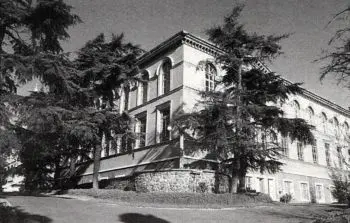
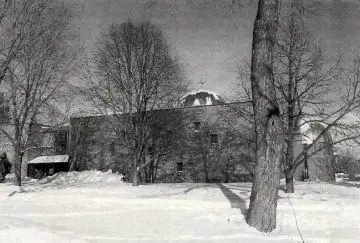
FRONT VIEW and gardens of the Theological School of Halki
Side view of the main classroom building of the school.
archdioceses and eparchies under its jurisdiction all a- round the world (Europe, America, Australia, Asia).
The granting of a permit for the reconstruction of the Patriarchal House in 1987 gave rise to hopes the School may open again. With this aim, the late Patriarch Dimi- trios handed a written request to Prime Minister Turgut Ozal, which, despite all promises, brought about no change in the attitude of the Turkish government on this issue.
One of the basic aims of the new Ecumenical Patriarch Bartholomew, as he noted in his enthronement speech, is the re-opening of the School of Halki.
In January 1992, when the Patriarch visited the Pres- ident of Turkey, the Prime Minister, the Minister of Educa- tion and other government officials, the issue of Halki ranked first in a catalogue of problems that are of con- cern to the Ecumenical Patriarchate and the Greek com- munity and need solution. Those problems were present- ed to the political leadership of Turkey. The then minister of education showed an interest and assured that he would
do his best to satisfy this request.
During the two years of the Ciller premiership no meet- ing between her and the Patriarch occurred, despite the Patriarch's repeated requests which remained unan- swered. Neither did the Secretary General of the World Council of Churches, Dr. Conrad Reiser, receive any an- swer to a letter which he sent to Mrs. Ciller in December 1993 regarding the re-opening of the School.
In April 1996 Patriarch Bartholomew again brought forth the issue during his meeting with Prime Minister Mesut Yilmaz, which resulted in encouraging signs for the re-opening of the School.
Yet, the operation of the School can only be viable un- der certain circumstances, like the permission to admit students from abroad and the employment of professors from other countries. This is how the School operated be- fore 1971. It should also be noted that most of the last professors of the School have now retired and only a few of those who might be able to continue teaching have re-
PATRIARCH BARTHOLOMEW:
Hoping and Praying for the School's Re-opening
To one of our questions concerning this issue, the Primate of Orthodoxy Bartholo- mew answered: "Now that the hopes of the Mother Church and all of us for the so long- expected re-opening of the Theological School of the Ecumenical Patriarchate have re- kindled, we refer to this issue in deep emo- tion, envisioning our School open again and the students 'going up and down' the Hill of Hope, as the hill of Halki Island, on top of which the fine marble building of the School dominates, is so symbolically named.
We so fervently wish that the renowned School will be alive and teaching and no more sleeping, because Halki is not just a school building, but a school of thought, which is composed and expressed by all those who had the joy to study there.
And this illuminating thought is needed today, at the threshold of the 21st century, more than ever by the Church and the world; because it concerns the ecumenical spirit of Hellenism and Orthodoxy and Ro- miosyne, that is the spirit which sees far, flies high and composes history.
May our hopes not be falsified this time. Turkey has nothing to fear from the re-opening of the Theological School of the Orthodox Christians. On the contrary, it will benefit from it.
We pray and wait. We hope and expect. Twenty five years of compulsory inactivity and silence are enough for an educational establishment that has provided humanity with enlightened clergy and theologians, preaching the God of love and creating a school of civilization".
mained in Istanbul.
Another condition is that the School must open and op- erate according to the regulation which was effective when School was closed.
Those conditions are absolutely necessary due to the lack of students, which is caused by the dwindling of the Greek community during the last 20 years. This causes severe problems to the staffing of the Patriarchate.
It is noteworthy that in Turkey, just as in any other part of the world, citizenship is granted to any type of foreign athletes, but clerics who have a service to fulfill cannot even obtain a work permit. But, all that is def- initely not accidental.
The hope that the School will operate again is ground- ed on the expectation that Turkey, through the European orientation it is trying to promote and despite the current situation, will give the green light for the operation of the School, so that this spiritual beacon may continue its mul- tifarious contribution to Orthodoxy and Christianity. This contribution is manifested by the progress of the School's graduates. It is true that the graduates of the Theological School of Halki have occupied and still hold high ranks so much in the ecclesiastical as in the academic and spir- itual domain. The School has nurtured patriarchs, archbish- ops, metropolitans, university professors, researchers, writ- ers, etc.
Through the history of ecclesiastical education, the School of Halki in Istanbul has become the bulwark of Orthodoxy, the cradle of deep theological thought and the nurse of great personalities in the life of the Orthodox Church, from the middle of the last century until today.
The School of Halki owes its name to the homony- mous beautiful island, where its impressive campus, on top of the Hill of Hope, dominates the whole Propontis. The School is located in the Patriarchal Stavropighac Monastery of the Holy Trinity, a historic monastery whose foundation dates back to the years of Patriarchs Photius I (858-867-866), Metrophanes III (1565-1572) and Ger- manos IV (1842-1845). Patriarch Photius is mentioned as the founder.
The School which was founded by the Patriarchate commenced its operation during the days of Patriarch Germanos IV who played a leading role. The inauguration ceremony took place on October 1, 1884 under Metropo- litan Paisios of Caesarea.
The first building was made of wood. After its destruc-
ECUMENICAL PATRIARCH Bartholomew
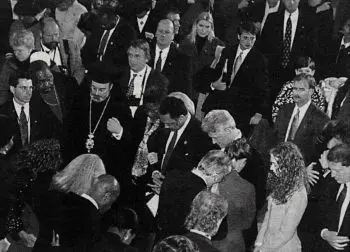
150th ANNIVERSARY ceremonies included hierarchs, other clergy, theo- logians and educators who graduated from the school. To the right of His All Holiness (center) is Patrairch Teoctist of Romania (in white garb); to the Patriarch's left are Patriarch Parthenios of Alexandria (now deceased), and Archbishop Anastasios of Albania.
tion by an earthquake, today's magnificent building was constructed at the expenses of Pavlos Skylitzis-Stefano- vik, the Great Benefactor of the Nation. It included a three-year lyceum and a four-year theological university course.
The Scholarchis (Dean) was at least an archimandrite, but usually a bishop or a metropolitan. At the same time, he also served as president of the Society of Professors and abbot of the monastic coenobitic fraternity. In a special way, the brothers of the monastery were the students.
The first Scholarchis was Metropolitan Konstantinos Typaldos of Stavroupolis (1844-1864). Until the suspen- sion of the School's operation, Metropolitan Maximos Repanellis (1955-1971) served as Scholarchis. He died in January 1991 with the unfulfilled expectation of the re-opening of the School.
The professors of the School, clergy and laity, have always supportive of the Church in all sides of her life, have served as members of synodic committees, have participated in conferences as representatives of the Pa- triarchate and have generally contributed greatly to the inter-Orthodox and pan-Christian mission of the Mother Church. They produced the 1920 encyclical concerning the League of Churches, i.e. the collaboration of all Chris- tian Churches, as well as the encyclical of 1973 on the 25th anniversary of the World Council of Churches. Ac- cording to Patriarch Athenagoras, they were "the scien- tific personnel of the Mother Church."
The students came from Istanbul, the other eparchies of the Throne in Turkey, Europe, America, Australia, other Orthodox Churches, mainly the Church of Greece, and the minor Eastern Churches. Auditors were admitted from het- erodox Churches.
A common characteristic of the graduates of the The- ological School of Halki, patriarchs, archbishops, priests and lay scientists, is that they are nurtured in the spir- itual and theological tradition of the Great Church of Constantinople, which they spread afterwards.
Among the theological schools of the other Orthodox Churches, the School of Halki exhibited a special and u- nique character in terms of theological education. The contribution of the "Halkites" of all ranks is inestimable and acknowledged by the Orthodox and the non-Ortho- dox world. The Churches which belong to the jurisdiction of the Ecumenical Patriarchate (Europe, America, Aus- tralia, New Zealand, Crete, Dodecanese), the other Pa- triarchates and the Church of Greece, owe a lot to the
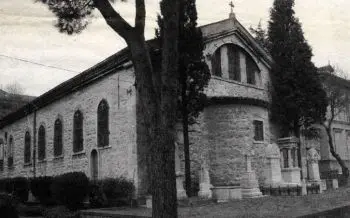
THE HOLY TRINITY church at the Theological School of Halki.
HALKI'S LIBRARY includes more than 40,000 volumes of outstanding theo- logical works.
pastoral activity of the Halkites.
To the students, the holy Theological School of Halki had the great advantage of combining theological education with coenobitic life. Theology was placed in the right frame- work inside the coenobium-school, where the liturgic life of our Church as the center of everyday life for all the students. In this manner, theology became life. It tres- passed the limits of narrow scientific knowledge and opened itself to the domain of mystical experiencing of the presence of God. This liturgical and mystic character was never lost to "Halki", never became "sounding brass or clanging cymbal", in the way in which theological edu- cation degenerates when divested of those essential char- acteristics.
An additional rich source of learning was the historical library of the Holy Monastery, which belongs to the Ecu- menical Patriarchate and is at the disposal of the School. With over 40,000 volumes, the library contributed to more complete theological training.
The School with its fruitful contribution remained young, never aging we could say, during its 127 years of opera- tion. But, on top of all, the School remained literally free. There was no obligation to follow the example of other educational foundations under state supervision. It devel- oped within the bosom of the Church and became her strength. The School's professors were clerics and lay people and were not performing a profession, they did not possess the cold status of a government employee, but they were dedicated to the sacred service entrusted to them by the Church.
For Orthodoxy, knowledge never became the object of
an autonomous effort, but sprang from the Church; it served the Church and ended in the Church. Thus, the relations between the School and the Patriarchate were so close, that it would not be an exaggeration to say that Halki meant Phanar and Phanar meant Halki.
This is how the School of Halki lived theology and pre- cisely this is the reason why its contribution lasted through time.
This year, 25 years were completed since the suspen- sion of the operation of the School. The hope for its re-opening has been vivid throughout this period. Today, the persistent efforts of Patriarch Bartholomew to achieve the re-opening of the School constitute the greatest hope ev- er that the School will, sooner or later, continue its inter- rupted contribution. Patriarch Bartholomew graduated from the School in 1961. While he was an archimandrite, he served for four years as the assistant of the last Scholarch is, Metropolitan Maximos of Stavroupolis. His dream was to teach one day in this School. Yet, Divine Providence appointed him Ecumenical Patriarch.
During the last few years, the premises of the School have served more and more often for the organization of seminars, conferences and other events by the Ecume- nical Patriarchate. The annual international ecological sem- inar is already in its fourth year and has produced pos- itive and encouraging results.
Lately, a certain mobility around the issue of the re-o- pening of the School can be observed. Towards this di- rection, Patriarch Bartholomew has been making great ef- forts since the day of his ascent to the Patriarchal Throne.
[ pp 6-7 ]
OPINIONS
_____ EDITORIALS
____________________________________________________________________________________________
An Outrage
On Jan. 15, a Turkish court sentenced Metropo- litan Iakovos of Laodikeia to a five-month jail term and fine for officiating at an Easter service in a Bulgarian Orthodox church near the Phanar.
This is an outrage and yet another example of the deplorable state of human rights in Turkey. In an era when freedom and democracy proliferate to a greater extent than ever before, it is highly a- nachronistic that the justice system of a modern nation striving to be accepted as "western" should tolerate such a proceeding in the first place.
The case serves to underscore the reports of or- ganizations such as Helsinki Watch that has chron- icled Turkey's disregard for human rights.
An appeal has been filed with the highest court of appeals in Ankara. The judges should demonstrate to the world that Turkey is serious about being a mod- ern democracy and throw the case out of court.
A Right to Die?
The U.S. Supreme Court has before it a case that advocates the constitutional right to doctor-assisted suicide for terminally ill patients.
The Supreme Court justices were asked in early January by New York State Attorney General Den- nis Vacco to overturn two federal appeals-courts decisions in 1996 that supported doctor-assisted suicide in lawsuits brought in New York and Se- attle.
The case could be to suicide what the 1973 Roe vs. Wade decision was to abortion.
Among the right-to-die proponents are eutha- nasia activist Derek Humphry and Michigan's Dr. Jack Kevorkian, who has assisted at least 45 sui- cides, most of whom were not terminally ill.
The notion that persons have the right to take their own lives, or decide when they want to die, and that this has become part of a national debate is tragic.
However, such a challenge to society's funda- mental values and the laws of God is in keeping with the "culture of death" permeating Western so- ciety with great intensity in recent decades.
Life has become cheap, disposable. The assault that began against the womb, has shifted to the threshold of the tomb.
It is but a short step from allowing physicians to hasten a patient's death, to opening the gates to anyone contemplating suicide for whatever reason, a key argument of opponents of such a "right."
Most states have laws against suicide. However, in 1994 Oregon voters passed the nation's first law legalizing doctor-assisted suicide.
Yet, when individuals feel that they are a law unto themselves, desiring to do whatever pleases them, the effects become detrimental to society. Consider that more than 30 million humans in this country have met an untimely end through abor- tion since 1973.
The Orthodox Church opposes murder, whether it be suicide, euthanasia or whatever, and regard- less if it is cloaked in terms like "death with dignity".
A person contemplating ending it all because of despondency instead should turn to God for strength and support. The Book of Job serves as a prime example of how someone overcomes ex- treme suffering by staying focused on God.
And Christians should do a better job of minis- tering with greater compassion to the terminally ill, whether they suffer from cancer, AIDS or other illness, to help ease their suffering.
We have contemporary role models who have had to endure pain and suffering, but did not give in to despondency.
Among them was former Senator Paul Tsongas who, despite years of treatments and prolonged pe- riods of hospitalization for lymphoma and related problems, continued to lead a productive life which greatly benefited his family and his community.
But such examples and biblical teachings such as the body being the temple of God, and "you are not your own, you were bought with a price" fall on deaf ears in our contemporary hedonistic soci- ety. As Derek Humphry observed in a recent book, "Religion no longer has the hold it once did."
Pro-death proponents continuously raise the cry that they do not want anyone (read Christians) "forcing" their values on society. Yet this is exactly what this group has been doing through the courts and legislatures for years.
Life is a precious gift from our Creator. By throw- ing it away, or by condoning the efforts of those who would compel others to do so, we show the ultimate ingratitude and will someday pay the price.
[ p 8 ]
COMMENTARY
Bad Timing for This Hedonistic Pair
Announcement: It's a boy! Born to Brian Peterson Jr., and Amy Grossberg at 4 a.m., Nov. 12, 1996 — 6 pounds, 2 ounces, 20 inches long.
By Fr. Angelo Artemas
The boy was born in Delaware. He passed from the womb of this mother into a garbage bag in a motel dump- ster where autopsy reports reveal he died from multiple skull fractures due to blunt force head trauma. An al- ready jaded society and legal system ask how could this have happened, while teenagers Brian and Amy are facing possible execution.
Why didn't these well-educated and affluent teens use effective birth control? Why didn't they take advantage of their "right" to an abortion, even up to the ninth month?
Why didn't they simply abandon the child like many terrified young mothers do? With so many "choices" how could anyone beat a one-day-old infant to death?
While only Brian and Amy are responsible for this sin against human nature, the legal system and the educa- tional system have to face their failures. Unrestricted a- bortions and the legality of "partial-birth" abortions have clouded our young people's notions of what is legal and what is moral.
On Oct. 16 in Corpus Christi, Texas, a drunk driver who slammed into a pregnant woman's car, killing her month-and-a-half old premature baby was convicted of murder.
In other similar court cases convictions have not oc- curred because laws dictate a murder can only occur if a baby is born first. Brian and Amy's timing in avoiding legal trouble was off by a few hours.
Clinics have been coaching teenagers on the many choices available to them. What teenagers need are few- er choices and more moral direction. The education sys- tem has been putting condoms in the hands of teens for years. Educators instead should put human infants in their arms. Enough of these failed experiments with car- ing for a raw egg or bag of flour for a few days, teens need to experience infants.
There was a time when teenage girls would "ooh" and "aah" at the sight of a baby and fight over who gets to hold the child. What would happen today if an infant was brought into a sophomore class? Would the girls know how to hold the baby? Teenage boys are so unaccus- tomed to handling a young life because they lack ex- perience and because they have yet to "get a life."
If teachers do not want to see a repeat of Brian and Amy's tragedy, they should take time out from their "choice-oriented" health curricula, and spend a week having students take turns holding, feeding, changing, and otherwise caring for infants. The intention being to let them experience a fragile human life in its earliest stages. Sex education is meaningless unless teens first comprehend that life is sacred and valuable.
It's time to stop valuing condoms and start valuing children. Faith in condoms has given young people the message that they will mess up. Faith in human beings sends the message that teens can make better choices.
In Delaware, Brian and Amy may ultimately face death by lethal injection. Society faces a lot worse if it keeps treating teens as hedonistic, sexual animals rather than as valuable human beings capable to responsible and moral behavior.
[ p 8 ]
LETTERS
Reasons for encouragement
Editor,
For years it's been my pleasure to read the Orthodox Observer and follow the laborious efforts of our ethnic forbears and our Orthodox faith in it's struggle to become amalgamated in the mainstream of America, despite the prejudices of our detractors!
Often when discouraged by the political (secular) and Church politics of our fellow Christian brethren, I get dis- couraged and wonder to what avail, is all this struggling and arguing about and I feel like "What's the use?"
Fortunately, the Observer comes to my home and I sit and realize that much progress has been made through the years, as evidenced by the increased Greek tongue by today's learned Greek clergy who are revitalizing the older parishes, and establishing new ones in unlikely places in the States as well as abroad. As for their mis- sionary efforts, I remember attending St. Nicholas Rus- sian Orthodox Church and praying alongside my fellow Orthodox Japanese in Tokyo.
Well, our church has come a long way since the post-war years but its struggles for survival continue espe- cially in Constantinople and in the Balkans. For that rea- son, I would like to see all petty rivalries laid aside, and the Orthodox band together, so as to make Orthodoxy's impact felt as a Faith, not only rich in tradition but in numbers as well.
Of interest in a lighter vein is the delightful bit of dem- ographics, and historical background of the little known or under-appreciated human interest facts of the growth of Greek communities in such unlikely places as Poca- tello, Idaho.
The founding of these communities in the heartland of America, or such diverse countries as New Zealand and Australia, are heart-warming and inspiring! I for one, ex- tend my congratulations to the brave souls, religious and lay people, who "do us proud" by their "pioneering" ef- forts, both here in the cosmopolitan U.S. and in the "Out-backs" the world over!
S. Demetrios Critides, MD
An open letter to the clergy
You are in my thoughts and prayers throughout the year. Many of you, especially the younger priests, I have known as young seminarians. It is with great joy that I see you from time to time in my travels in your own parishes conducting the liturgy or other sacraments. Wonderful, wholesome, spiritual leaders. My wish for you on your graduation was, always, that you would be happy.
I am writing this open letter to all the members of our
clergy to encourage you to remember Holy Cross through- out the year, especially as you cut the vasilopita and set aside a piece for your alma mater.
If there is present a graduate of Hellenic College/Holy Cross, or a family member of a current or past seminar- ian, I would urge you to give it to them. Or perhaps it could be given to a young person who might some day become one.
Holy Cross School of Theology is so very vital for our church, if we are to have priests needed for our children and our grandchildren.
We should take every opportunity to keep our people aware of our beloved school.
Dr. Angelyn Konugres-Coupounas
The writer is former vice chairman of the HC/HC trustees.
To 60 Minutes
Editor's note: The following letter was written by Fr. Demetrios Constantelos to CBS 60 Minutes in response to a recent pro- gram on Afrocentrism.
60 Minutes - To CBS Television
524 West 57th Street
New York, NY 10019
Dear Sirs,
If the Greeks (Solon, Socrates, Plato, Aristotle, Sopho- cles, Euripides, etc.) stole everything from the Egyp- tians as Afrocentrists teach, how come the Greeks did not adopt Egyptian literature and scientific terms such as school, academic, program, method, biology, physics, math- ematics, geometry, geography, philosophy, politics, de- mocracy, monarchy, aristocracy, oligarchy, therapy and some 58 percent of the physician's technical lexicon as is the case when one culture encounters another? A lan- guage is a mirror of ideas, interests, problems, occupa- tions, names and experiences of the people that use them.
There is a strong causal relationship between the lex- icon and the interests of a people. People lack words for objects and experiences with which they have fewer dealings. While Greek linguistic influences on Near East- ern languages are numerous, we know of about 70 He- brew or Semitic, and scarcely any Egyptian words in the Greek language.
Seeking to maintain an ethnic identity and identify roots is honorable, distorting history for "political correct- ness" is dishonorable.
Demetrios J. Constantelos
[ p 8 ]
The Plight of Our Retired Priests
I am not sure about the reason I am writing this letter. I don't know if it is because I want to alleviate my burden and soften my personal pain or if it is because I wish to correct an injustice and help my father. I am the daughter of a man who has dedicated his entire life to the Church, serving as a priest for over a period of 45 years, and who has just entered his retirement. I don't know how other priests cope with the trauma of retirement but my father was not prepared emotionally, mentally, and especially economically for retirement. The lack of preparation was not caused by negligence but rather by the fact that he had to raise and educate four children. It breaks my heart to see this good man, who until recently was so active, alert and useful, now feeling that he is finished. It seems to me that the Church should bear some respon- sibility in preparing both the priests who are about to retire as well as their parishes and the priests who are to replace their senior colleagues. There is a need to protect the dignity of these men who gave everything they had to the Church.
Am I asking too much for my father to be able to live the rest of his life in a dignified way?
R. P.K.
Your letter caused me pain and sadness but I thank you for having the courage to bring to our attention the plight of the retired priests. We are deeply in debt to these priests who have served as pillars of our Faith.
You are right to suggest that it is the responsibility of the Church to secure a dignified and useful retirement for our priests. Retiring from any kind of work or profession is a traumatic experience; retiring from an active priestly life is so much more painful and traumatic.
By Fr. George Papaioannou
Any other profession requires hard work and dedica- tion, but the demands of the priesthood are so much great- er. A priest's life is completely consumed by the zeal to serve God, His Holy House and the people who worship in it.
We are what we are as a Church today because of these servants, the priests. Therefore, there is no excuse for our failure to secure a dignified retirement for all of our priests. It will take the good faith, the will and the cooperation of the Archdiocese and the local parish to re- solve this painful issue.
For most of our retired priests, things are not as bleak today as they used to be. Financially, the Archdiocese, since the early 1970's, had made considerable progress by helping to develop a pension program for our priests. To- day most priests are enrolled in the pension program and the vast majority of the communities support it financially.
It is true, however, that this kind of pension alone can- not secure a decent retirement for our priests and many of them, in addition to the emotional and mental discom- fort, face economic hardship as they enter this new phase of life.
Is it possible to improve the situation? I believe it is: by increasing the parish and Archdiocesan contributions to the Pension Fund.
In 1994, the delegates of the Clergy-Laity Congress in Chicago made a commendable decision to secure a dig- nified retirement for our bishops by increasing their pen- sion to 80 percent of their salary. I believe that some- thing similar can and should be worked out for our priests; after all they are the backbone of our institutional exis- tence. They deserve that much.
But alleviating the financial burden will not by itself make a priest's retirement happy. There are some other equally important elements. The retirement of the priest should take place in a way that will bring him honor — not de- motion and a permanent exit from the Holy House he has so dearly loved and served.
Preparation and guidance should begin with the local bishop who, in a loving way, prepares the priest for his life in retirement. Sudden and enforced retirements should be avoided.
One of our better priests of yesteryear confided to me his painful story. His bishop visited his parish, and, with- out first advising him of his intention to retire him, sur- prised him and the congregation by announcing during the Divine Liturgy the retirement of the priest who had served that parish for forty years. These surprise retire- ments should be avoided.
Following the retirement of the priest and the assign- ment of the new pastor, the parish must do its best to make the transition as loving as possible by reassuring the retired priest of their continuous respect and affec- tion for him. The priest who succeeds a retired colleague can play a beneficial role in that retirement.
I know many young priests who go out of their way to assist their retired predecessors in adjusting to their new way of life. By doing so not only do they help create a good relationship between them, but they also help cre- ate good feelings in the community.
Retired priests need not be inactive. The vast majority of retired priests possess a wealth of experience and wisdom, and priests and parishes can be the beneficiaries of that wealth. They can serve as confessors, offer the Di- vine Liturgy, and assist in religious education.
I have been the beneficiary of at least one such re- tired priest. About 12 years ago, Father Theotokis Pappas a retired priest, settled in the Washington, D.C. area. He came to see me and to offer his services. "Father," he said, "I am retired but not retarded; please let me help." I never did regret accepting his offer. That holy man had a special affection and talent for dealing with children.
He was very well versed in theology and became un- officially our theologian and religious education instructor for the Sunday School teachers. He was a graduate of the first class of Holy Cross School of Theology.
How useful can a retired priest be to the church? Here is the testimony of one of them. Father George Papa- deas, well known to all Greek Orthodox in America for his Holy Week Service Book, wrote to me recently abut his life in retirement:
"I retired from active duty in 1983, at the age of 65 because I was afflicted with asthma. It was painful be- cause I loved the priesthood and I felt depressed thinking about walking away from it. But God had other plans for me.
Shortly after my retirement I began serving the reli- gious needs of the few Greek Orthodox in Lecanto, Fla., traveling 112 miles from my home in Daytona Beach e- very week, feeling God's strength in me the whole time.
Now I am 78 years old and I continue to travel and serve the people because the community cannot afford to have a paid priest yet. In one or two years, I believe that parish will be strong enough to have its own priest so that I can stop my traveling." How marvelous are the works of the Lord! And he uses his servants the retired priests to do it. It is imperative, therefore, that we treat them with respect, that we love them and honor them and allow them to transmit to us God's love and blessings.
[ p 9 ]
"I'll never forget the summer I spent at Ionian Village_ the people I met... the coun- selors and priests were wonderful. I learned to appreciate my heritage and my faith, and the friendships I made will last forever"
This Year give a gift with a lifetime of memories.
During the past 27 years, nearly 10,000 teenagers and young adults from America and Canada have had the experience of a lifetime in Greece at Ionian Village.
The Highlight of this year's SPIRITUAL ODYSSEY will be an audience with
[ p 9 ]
Boston Diocese Ministries Video Released
BROOKLINE, Mass. — Bishop Methodios has announced the release of the newest video on the ministries of the Diocese of Boston.
This 25-minute video was professionally produced for the faithful throughout New England to see and under- stand the scope and breadth of the Diocesan Ministries. "Many of our stewards do not realize the various minis- tries that are offered on both the Diocesan and Archdio- cesan levels," stated Bishop Methodios.
"We must do our best to inform our people so that they may actively involve themselves in, and benefit from these Christ-centered opportunities for service and growth."
A copy of this video has been sent to each parish in the Boston Diocese. Bishop Methodios asked the clergy to show this video to every organization of the communi- ty — the Parish Council, the Philoptochos, the young a- dults, the PTA and Sunday School teachers, etc.
He also suggested that other opportunities be organ- ized for all parishioners to view the video after Liturgy during the coffee fellowship, or in a small group setting. The bishop noted that, "In a society that is pulling our flock away from their Christian values and moral way of life, we need to provide as many opportunities as we can to keep them connected with our Orthodox Faith and Holy Traditions."
This video together with the BDC (Boston Diocese Camp) video that was sent to each community at the beginning of the year, as well as the Diocesan Youth Mission Trip video, will serve as resource and will become permanent additions in the church libraries. Copies of these videos may be acquired through the Diocese office.
New Hampshire Parishes to Host Winter Camp
BROOKLINE, Mass. — This year's annual Boston Dio- cese Winter Camp for Orthodox youth will take place in February at two New Hampshire communities.
For Junior Orthodox Youth (JOY) Campers, ages 8-11, the parish of St. Philip in Nashua, will host the three-day event February 7-9.
The GOYA camp will take place at St. George Cathe- dral in Manchester, February 14-17. This will mark the fifth year that St. George Cathedral has hosted the Dio- cesan Winter Camp program.
Theme of the BDC Winter Camp '97 will be based on the events of Holy Week surrounding the Lord's Passion.
Discussion sessions and theatrical performances will help campers understand the depth and meaningfulness of the most solemn week in the life of the Church so that as they attend Holy Week services they can better ex- perience the passion, betrayal, arrest, trial, crucifixion, death, burial and resurrection in a new and personal way.
Other events scheduled for the GOYA weekend in- clude a day of skiing or bowling and ice skiing.
Campers will also have the opportunity to go to the Sacrament of Confession as they prepare to receive Holy Communion during the Divine Liturgy.
More information and applications are available by calling the Boston Diocese Youth Office, (617) 277-4742.
WINTER CAMPERS - Anastasia Mousis, one of many young a- dult staff members of the Boston Diocese Camp, leads the young campers on a winter snow-hike.
Bishop Methodios Welcomes Back College Students
BROOKLINE, Mass. — As the new semester began, Bish- op Methodios welcomed all college students who come to Boston to study from across the country and from around the world.
The Bishop encourages and invites all Orthodox col- lege students to become involved in the Diocesan college campus ministry—Orthodox Christian Fellowship (OCF).
The Boston Diocese sponsors weekly college campus ministry programs on the campuses of Boston College, Boston University, Harvard, MIT, Northeastern and Tufts in the greater Boston area as well as programs in New Hampshire, Rhode Island, Maine, Worcester and Easton, Mass.
A monthly newsletter is mailed out to college stu- dents throughout New England and is also available through the internet for those hundreds of Orthodox stu- dents who are on-line. Bishop Methodios also visits the campuses and celebrates the Divine Liturgy on a differ- ent college campus each semester.
OCF is a diverse group of Eastern Orthodox Christians students from a variety of ethnic backgrounds. Its pur- pose is to offer Orthodox Christian students an opportu- nity to grow in their faith and tradition, while providing an Orthodox Christian witness on the campuses.
The ministry fosters a sense of community between all students of the Orthodox Faith, develops a fruitful re- lationship between them and other Christian organiza- tions and seeks to improve campus life through fellow- ship, discussion, social events, lectures, retreats, church visitations, and Orthodox Christian Liturgy and worship.
For more information on the Boston Diocese OCF col- lege ministry program visit the web page at http://www. goarch.org/access/ocf.
Calendar of Events
Following is a listing of major events for the Boston Diocese through July:
February 1: Church School Teachers' Conference Sts. Constantine and Helen Andover, Mass.
February 7: BDC Winter Camp for JOY campers (Ages 8-11) St. Philip Parish Nashua, N.H.
February 14-17: BDC Winter Camp for GOYA campers ages (12-18) St. George Cathedral - Manchester, N.H.
March 1: Vespers and Dinner Reception with Arch- bishop Spyridon
Annunciation Cathedral - Boston 8 p.m. Welcome Dinner - Westin Hotel, Copley Place 7:30 p.m.
March 2: Divine Liturgy and Luncheon with Archbish- op Spyridon St. Spyridon Cathedral - Worcester, Mass. Welcome Luncheon to follow
April 6: Greek Independence Day Parade Boston Com- mons - Boston
April 11-13: YAL Lenten Fellowship Weekend Diocesan Center - Brookline, Mass.
May: Diocesan Oratorical Festival Diocese Center - Brook- line
May 4: Annual Walk For Hunger Boston Commons - Boston
June 8: Diocesan Awards Dinner Westin Hotel - Cop- ley Place, Boston
June: Mission Trip to Mexico for graduating high school seniors - Tijuana, Mexico
July-August: BDC Summer '97. To be announced.
July: Vacation Church School, Hellenic College/Holy Cross - Brookline
[ p 10 ]
OBITUARIES
†
Rev. George Stephanides
IRVINE, Calif. — The Rev. George Ste- phanides, pastor of St. Paul's Church for 20 years, died Dec. 17 after suf- fering a heart attack.
He came to Irvine in June 1978 and established the community with 57 families, which has grown to more than 700. In 1991, Fr. Stephanides initiated a $3.5 million building pro- gram that created the present church complex.
Born Nov. 4, 1933, in Boston, the son of the late Sta- vros and Maria Stephanides, he attended elementary school in that city before his family moved to Springfield, Mass., where he completed high school.
Fr. Stephanides went on to Holy Cross School of The- ology in 1951 where he earned a BA degree in religion and classics in 1957 and a Bachelor of Divinity in 1958. He also received a Master's of Sacred Theology degree in New Testament and history from Princeton Theological Seminary in New Jersey (1958), and a Master's of Re- ligious Education from Boston University (1970). He also earned a Certificate of Studies from the University of Athens, Greece (1958-59), and pursued other graduate studies at Harvard Divinity School (1960) and Rutgers University in New Jersey (1962-63).
He married Elaine Kolofolias of Lowell, Mass., and was ordained a deacon July 17, 1960, and a priest on July 31.
Fr. Stephanides served parishes in Trenton, N.J., Brock- ton and Worcester, Mass., and also established the parish in Castro Valley, Calif.
Over the years, Fr. Stephanides held numerous posi- tions on Church organizations and boards, and commu- nicated the message of the faith in various writings and on radio and TV. He also translated many Church texts from the original Greek.
Fr. Stephanides held offices with the Clergy Brother- hood, the St. Nicholas Ranch and Retreat Center, Gua- dalupe Homes for Children, Guadalupe Manor, United Way of Orange County, National Conference of Christians and Jews, and many others.
He also served on the Archdiocesan Council, the San Francisco Diocese Council, Hellenic College/Holy Cross Board of Trustees and as diocesan vicar of Southern California.
He also was involved with Project Mexico and served as a representative to the National Council of Churches and intra-Orthodox committees.
Fr. Stephanides was a recipient of the Church offices of Confessor, Sakellion, Economos of the Ecumenical Pa- triarchate, and Protopresbyter.
Survivors include his wife of 35 years, Presbytera E- laine; a daughter, Mary Brown; a son, Steven; and a grand- daughter.
A Trisagion service took place on Dec. 20 with Bishop Anthony of San Francisco officiating, assisted by diocese clergy. Fr. Peter Costarakis of San Bernardino, Calif., a lifelong friend, delivered the eulogy. An all-night church vigil followed.
Funeral service took place Dec. 21, beginning with a hierarchical Divine Liturgy celebrated by Bishop Anthony, assisted by the Very Rev. John Heropoulos, who repre- sented Archbishop Spyridon and who read a message of sympathy from His Eminence.
Other clergy assisting included Frs. Spencer Kezios, Peter Costarakis, Michael Kouremetis, the four priests who had served as assistants to Fr. Stephanides: Fr. Martin Ritsi, James Pappas, Dean Kouldukis and John Konugres, and Deacon John Alexandres.
Bishop Anthony offered his message and Fr. Kezios gave the eulogy.
Memorials may be made to St. Paul's Mosaic Fund, 4949 Alton Parkway, Irvine, Calif.
[ p 11 ]
†
Rev. Constantine Poulakidas
PHOENIX — Fr. Constantine Poulakidas, 82, died Dec. 6 in Phoenix where he was living the past few years. He was born at Hora, Trifilias, in September 1904.
He completed high school at the theological school of Tripoli/Corinth where he graduated in 1931.
In July 1933, he married Zafiroula Andonaropoulou. The had five children, Andrew, Christina, Dionysios, Thanos and Angeliki.
After his marriage, he became ordained as a deacon and a priest by Metropolitan Andreas of Trifilias and O- limpias.
His ordination as a deacon took place at Evangelismos Tis Theotokos Church of Kiparissias in Kalamata, and as a priest at St. Athanasios Filiatron in Kalamata.
After his ordination, Fr. Constantine assumed duties at St. Athanasios, where he served until November 1936. He decided to come to the United States and was named head priest at Holy Trinity parish in Tulsa, Okla., where he served until 1941.
Following this assignment, he served Holy Trinity in Sioux City, Iowa (1941-44), Holy Trinity, Dallas (1944-51), St. Spyridon, Chicago (1951-57), Holy Trinity, Phoenix (1957-65), St. Dionysios, Pittsburg, Calif., (1965-66), West Contra Costa in Concord , Calif. (1966-68), and Holy Tri- nity, Indianapolis (1968-70). He retired in November 1970 due to illness.
In honoring his service, the Church bestowed upon Fr. Constantine the offikia of confessor in 1937, and econo- mos in 1975.
Archbishop Spyridon sent condolences to his presby- tera and children.
Funeral services took place Dec. 10 at Holy Trinity with Bishop Anthony of San Francisco officiating, assisted by other priests.
[ p 11 ]
†
Rev. Nicholas Tsahnides
FORT LAUDERDALE, Fla. — Fr. Nicholas Tsahnidis (Nich- olas Nick), 78, died Dec. 15 in Fort Lauderdale.
He was born in Middletown, Ohio, in 1919. After com- pleting high school in Dayton, he enrolled at Holy Cross Theological School in Pomfret, Conn., graduating in 1945.
In Oct. of that year, he married Angeliki Dendri. They had four children, Chrysoula, Christos George and Dimi- trios.
He became ordained as a deacon after his marriage by Bishop Athenagoras of Boston at Holy Trinity Church in Danielson, Conn., and as a priest by Bishop Gerasimos of Chicago in Dayton.
He was assigned to Holy Trinity Church in Portsmouth, N.H., serving from 1945-48. His subsequent assignments included Holy Trinity-St. Nicholas in Cincinnati (1948-59), Holy Trinity, Augusta, Ga..,(1959-64), and St. Demetrios, Ft. Lauderdale (1964-89). He retired in May 1989.
Fr. Nicholaos received the offikia of confessor in 1950 and economos in 1967. He was named protopresbyter in 1971.
Upon learning of his passing, Archbishop Spyridon sent condolences to the family.
Funeral services took place Dec. 19 at St. Demetrios Church with Bishop John of Amorion officiating, assisted by other priests.
[ p 11 ]
Paul E. Tsongas
BOSTON — Former Massachusetts Senator and candidate for the Democratic Presidential nomination Paul Efthe- mios Tsongas died Jan. 19 at a local hospital. He had been hospitalized on Jan. 3 with a liver problem related to his treatments for non-Hodgkin's lymphoma and later developed pneumonia.
The 55-year-old native of Lowell, Mass., was born Feb. 14, 1941, the son of Efthemios and Katina Tsongas, who immigrated from Greece. His mother died of tuberculosis when he was 6. His father died in 1980.
As a young man, he worked in his father's dry-clean- ing business in Lowell.
Tsongas campaigned for the presidential nomination in 1992, beginning with a primary victory in New Hamp- shire and wins in three other state primaries and the cau- cuses of four states.
After he left the race, Tsongas practiced law and helped start the Concord Coalition, a non-profit group that fo- cused attention on the budget deficit and other economic problems.
Inspired by President John F. Kennedy, Tsongas en- tered the Peace Corps in 1962 and spent two years as a teacher in Ethiopia.
Afterwards, he attended Yale Law School and spent two summers working in the Washington office of Republican Congressman F. Bradford Morse who represented Tson- gas' home district.
Tsongas began his political career in 1969 on the Low- ell City Council, serving until 1972 when he won election as a Middlesex County Commissioner.
In 1974, he ran for Congress and became the district's first Democratic member in 90 years.
Tsongas then defeated Sen. Edward W. Brooke, a two- term Republican, in 1978 with 55 percent of the vote.
Discovering he had cancer Tsongas left the Senate af- ter one term to devote time to his family. He underwent a bone marrow transplant in late 1983.
The former senator joined a Boston law firm and con- tinued his involvement in local civic affairs.
He had received a bone-marrow transplant from his twin sister in 1986 and had undergone another bone marrow transplant in 1996 to correct myelodysplasia, a disorder that can occur in people who have recovered from lymph cancer.
Tsongas' efforts to promote his hometown of Lowell brought a ren- aissance to the city, which had fal- len on hard economic times.
As a result, the city has a na- tional historic park, a minor league baseball team and a stadium being built, a Sheraton ho- tel, 14 new schools, thousands of jobs and a greatly re- newed sense of civic pride.
Tsongas had been cancer free for five years when he decided to seek the Democratic nomination in 1991.
Survivors include his wife, the former Nicola Sauvage; three daughters, Ashley, Katina and Molly, and his twin sister, Thaleia Schlesinger.
Funeral services took place Jan. 23 at Transfiguration Church with Bishop Methodios of Boston officiating, as- sisted by Fr. Peter Gregory and retired pastor Fr. John Sarantos. Tsongas grew up in the Transfiguration parish and sang in the choir as a youth.
Among those attending were a 16-member delegation from the U.S. Senate, Secretary of the Interior Bruce Bab- bitt, Secretary of Defense-designate and former Senator William Cohen of Maine, former Gov. Michael Dukakis and others. Thousands lined the streets during the proces- sion.
In his remarks during the funeral Bishop Methodios said of Tsongas, "He set high standards for himself. He was a man of principle who was unwilling to compromise his unwavering commitment to the ideals and values he learned from his parents who raised him in a Greek Orthodox Christian home here in Lowell...the city that he loved and helped transfigure into a vibrant city of the Commonwealth."
[ p 11 ]
Virginia Halas
MONTREAL — Virginia Halas, the only living sibling of Archbishop Iakovos, died Jan. 20 at the age of 90 after a lengthy illness.
She was highly respected for her philanthropic work.
The funeral took place Jan. 22 at the Greek Orthodox Cathedal of Montreal. Archbishop Iakovos went to Montreal, accompanied by friends and former co-workers.
Ecumenical Patriarch Bartholomew sent his condolences and named Metropolitan Sotirios of Toronto to represent him at the funeral. Upon learning of Mrs. Halas' death, Archbishop Spyridon telephoned his condolences from Washington where he was attending President Clinton's in- auguration.
Other survivors include a daughter, Maria Doussi, her husband, Jerry, and a granddaughter, Georgina Daouse.
[ p 11 ]
ΕΤΟΣ 62ΦΕΒΡΟΥΑΡΙΟΣ, 1997ΑΡΙΘΜΟΣ 1123
Θεοφάνεια στο Τάρπον Σπρινγκς
ΤΑΡΠΟΝ ΣΠΡΙΝΓΚΣ. ― Με τη συμμετοχή χιλιάδων προσ- κυνητών και σε ατμόσφαιρα θρησκευτικής εξάρσεως, τελέσθηκε ο Αγιασμός των υδάτων και η κατάδυση του Τιμίου Σταυρού από τον Σεβ. Αρχιεπίσκοπο Αμερικής κ. Σπυρίδωνα στην «Ελληνική Πόλη» του Τάρπον Σπρινγκς της Φλόριδας.
του ανταποκριτή μας Νικολάου Μαγγίνα
Από τον Καθεδρικό ναό του Αγίου Νικολάου του Τάρ- πον Σπρινγκς, όπου τελέσθηκε η Θεία Λειτουργία, ξεκίνη- σε η ιερή πομπή με επικεφαλής τον Αρχιεπίσκοπο Αμε- ρικής και κατευθύνθηκε στην παραλία, στο Spring Bayou, όπου μετά την Ακολουθία του Αγιασμού, ο Αρχιεπίσκοπος έριξε το Σταυρό στη θάλασσα.
Εξήντα περίπου νέοι έπεσαν στα νερά και το Σταυρό ανέσυρε ο δεκαεξάχρονος Θεόδωρος Κουλιανός, ο οποίος ευθύς μετά, γονατιστός μπροστά στον Αρχιεπίσκοπο με δάκρυα χαράς και συγκίνησης για την ιδιαίτερη αυτή ευ- λογία που είχε, έλαβε από τον Σεβασμιότατο το ειδικό α- ναμνηστικό κύπελλο και χρυσό επιστήθιο σταυρό.
Ο εορτασμός των Θεοφανίων και οι σχετικές εκδηλώ- σεις στο Τάρπον Σπρινγκς συγκεντρώνουν κάθε χρόνο με- γάλο αριθμό προσκυνητών και επισκεπτών, Ελληνοαμε- ρικανών αλλά και Αμερικανών, οι οποίοι δείχνουν ιδιαίτε- ρο ενδιαφέρον για τον Αγιασμό των υδάτων, όπως τελεί- ται στην ελληνορθόδοξη παράδοση. Φέτος υπολογίζεται ότι το πλήθος ξεπέρασε τις τριάντα χιλιάδες.
Στη Θεία Λειτουργία και στις εορταστικές εκδηλώσεις των Θεοφανίων έλαβαν μέρος ο Μητροπολίτης Σαράντα Εκκλησιών κ. Σίλας, ο νέος Μητροπολίτης Χονγκ Κονγκ κ. Νικήτας, ο οποίος και κατάγεται από το Τάρπον Σπρινγκς, ο βοηθός του Αρχιεπισκόπου Επίσκοπος Τρωάδος κ. Α- λέξιος και πολλοί κληρικοί. Παρέστησαν ο πρέσβης της Ελ- λάδος στην Ουάσιγκτον, Λουκάς Τσίλας, ο ομοσπονδιακός βουλευτής Μάικλ Μπιλιράκης, η δήμαρχος του Τάρπον Σπρινγκς Ανίτα Πρώτος, Αρχοντες του Οικουμενικού Πα- τριαρχείου, μεταξύ των οποίων και ο Αντιπρόεδρος του Τάγματος των Αρχόντων Τάσος Μάνεσης, ο Πρόεδρος της ΑΧΕΠΑ Σπύρος Μακρής, γνωστοί μεγάλοι επιχειρηματίες της ομογένειάς, όπως οι Αρχοντες, Αλεξ. Σπανός, Τζον Παγιαβλής, Μάικλ Καντούνιας, Σπυρίδων Θεοφίλου κ.α.
ΤΑΡΠΟΝ ΣΠΡΙΝΓΚΣ ― Ο 16χρονος Θεόδωρος Κουλιανός υψώ- νει με περηφάνεια τον Σταυρό που μόλις ανέσυρε από τα γα- λανά νερά στην προκυμαία του Τάρπον Σπρινγκς.
Στα πλαίσια της παραμονής του στο Τάρπον Σπρινγκς, ο Αρχιεπίσκοπος μετέβη εκτός προγράμματος και απροει- δοποίητα στο ναό του Αγίου Στεφάνου του Σεντ Πίτερσ- μπουργκ, όπου και χοροστάτησε κατά την Θεία Λειτουργία της Κυριακής και τελεσε τον Αγιασμό της παραμονής των Θεοφανίων. Επίσης χοροστάτησε και στον πανηγυρίζοντα ναό του Αγίου Ιωάννη της Τάμπα, ανήμερα της εορτής.
Κατά την πενθήμερη παραμονή του, ο Σεβασμιότατος παρεκάθησε σε γεύμα που παρέθεσαν προς τιμή του: Η Φιλόπτωχος του Αγίου Νικολάου Τάρπον Σπρινγκς, στο δείπνο του ναού Αγίου Ιωάννη της Τάμπα, στο γεύμα της ΑΧΕΠΑ με τον πρόεδρό της Σπύρο Μακρή και στο δείπνο των Επιφανίων που παρέθεσε η τοπική ΑΧΕΠΑ. Ακόμη, ε- πισκέφθηκε και γευμάτισε στο χώρο της γιορτής που δι- οργάνωσαν ο Καθεδρικός ναός του Αγίου Νικολάου και οι κυρίες της Φιλοπτώχου. Στη διάρκειά της, παιδιά, νέοι και νέες, φορώντας ελληνικές παραδοσιακές φορεσιές, χόρε- ψαν παραδοσιακούς χορούς προς τιμή του Αρχιεπισκόπου.
Τελος, προέβη στα αποκαλυπτήρια του αγάλματος του «σφουγγαρά» που δωρήθηκε από τους Συλλόγους Δωδε- κανησίων και Καλύμνιων της Φλόριδας προς το Λύκειο του Τάρπον Σπρινγκς. που ονομάζεται χαρακτηριστικά «Λύ- κειο των Σφουγγαράδων» ενώ παρέστη στην εκδήλωση που διοργάνωσε προς τιμή του ο Ελληνικός Μαθητικός Σύνδεσμος του ιδίου Λυκείου.
Στο διάστημα της επισκέψεώς του στο Τάρπον Σπρινγκς και στις κοινότητες της γύρω περιοχής, ο Αρχιεπίσκοπος εξέφρασε την ιδιαίτερη ικανοποίηση και χαρά του για την επικοινωνία που είχε με το ελληνορθόδοξο στοιχείο, το οποίο αποτελεί ένα από τα πιο δυναμικά και σημαντικά της Ελληνορθόδοξης Εκκλησίας μας στην πολιτεία.
[ σ. 13 ]
Ο Σεβασμιότατος στην ορκομωσία Κλίντον-Γκόρ
Επώνυμοι και μή, κλίνουν την κεφαλή σε μια στιγμή προσ- ευχής. Δεξιά του Αρχιεπισκόπου διακρίνονται ο πάστορ Τζέσι Τζάκσον, ο πρόεδρος Κλίντον, η κόρη του Τσέλσι και ο αντι- πρόεδρος των ΗΠΑ, Αλ Γκόρ. Ο Σεβασμιότατος ανέγνωσε από- σπασμα από την Αποκάλυψη του Ιωάννου.
(φωτο. Ν. Μαγγίνα)
ΟΥΑΣΙΝΓΚΤΟΝ ― Στα πλαίσια των εκδηλώσεων για την ορκωμοσία και εγκαθίδρυση του Προέδρου Μπιλ Κλίντον, ο Αρχιεπίσκοπος Αμερικής Σπυρίδων, μαζί με εκπροσώ- πους άλλων χριστιανικών δογμάτων και θρησκειών, έλαβε μέρος στην τελετή της «Εθνικής Προσευχής» που έγινε στο Μητροπολιτικό Αφρικανικό Μεθοδιστικό Επισκοπικό Ναό της Ουάσιγκτον.
Ο Αρχιεπίσκοπος, ανέγνωσε από του βήματος απόσπα- σμα από το Βιβλίο της Αποκάλυψης, το οποίο γράφτηκε από τον Αγιο Ιωάννη τον Ευαγγελιστή ―όπως τόνισε ο Σεβασμιότατος― στην ιερά νήσο της Πάτμου, προσκύνη- μα του Οικουμενικού Πατριαρχείου.
Το απόσπασμα έχει ως εξής:
Από της Ιεράς Νήσου της Πάτμου, Ιερού Προσκυνήμα- τος του Οικουμενικού Πατριαρχείου Κωνσταντινουπόλεως, ακούσωμεν εν σοφία του Βιβλίου της Αποκαλύψεως Ιωάν- νου του Αγίου και Ευαγγελιστού:
Και είδον ουρανόν καινόν και γην καινήν' ο γαρ πρώ- τος ουρανός και η πρώτη γη απήλθον, και η θάλασσα ουκ έστιν έτι· και την πόλιν την Αγίαν Ιερουσαλήμ καινήν εί- δον καταβαίνουσαν εκ του ουρανού από του Θεού, ητοι- μασμένην ως νύμφην κεκοσμημένην τω ανδρί αυτής, και ήκουσα φωνής μεγάλης εκ του ουρανού λεγούσης· ιδού η σκηνή του Θεού μετά των ανθρώπων και σκηνώσει μετ' αυτών, και αυτοί λαοί αυτού έσονται, και αυτός ο Θεός έσται μετ' αυτών, και εξαλείψει ο Θεός παν δάκρυον από των οφθαλμών αυτών, και ο θάνατος ουκ έσται έτι, ούτε πένθος ούτε κραυγή ούτε πόνος ουκ έσται έτι' ότι τα πρώτα απήλθον. Και είπεν ο καθήμενος επί τώ θρόνω· ιδού καινά ποιώ πάντα και λέγει μοι... ο νικών κληρονομήσει ταύτα και έσομαι αυτώ Θεός και αυτός έσται μοι υιός. (21:1-7)
[ σ. 13 ]
Συγκίνηση για το θάνατο του Τσόγκα
ΒΟΣΤΩΝΗ.- Με συγκίνηση και βαθιά θλίψη η Ομογέ- νεια πληροφορήθηκε το θάνατο του πρώην γερουσιαστή και προεδρικού υποψηφίου Πολ Τσόγκα. Μια ατέλειωτη σειρά προσωπικοτήτων αλλά και απλών ανθρώπων αποτί- σαν φόρο τιμής στον εκλιπόντα για το σημαντικό έργο και τον ακέραιο χαρακτήρα του. Ηγέτες της Ομογένειας ανα- φέρθηκαν και στους αγώνες του για την προώθηση των ελληνικών εθνικών θεμάτων εντός και εκτός του Κογ- κρέσου και, κυρίως, στο γεγονός ότι ―μαζί με τον Μάικλ Δουκάκη― ενέπνευσε νέες γενιές Ελληνοαμερικανών να αναμειχθούν στην αμερικανική πολιτική σκηνή και να συν- εχίσουν το έργο του.
Γόνος Ελλήνων μεταναστών, ο Τσόγκας, αναρριχήθη- κε στις υψηλότερες βαθμίδες της πολιτικής ζωής των ΗΠΑ, ξεκινώντας από δημοτικός σύμβουλος του Λόουελ, για να καταλήξει αντιπρόσωπος της Μασαχουσέτης στη Βουλή των Αντιπροσώπων και τη Γερουσία, ενώ το 1992 διεκδί- κησε το χρίσμα των Δημοκρατικών για την Προεδρία των ΗΠΑ.
Η τιμιότητα που τον χαρακτήριζε στην πολιτική του στα- διοδρομία, αντανακλούσε τα βαθειά του συναισθήματα η- θικής και θάρρους, ειπώθηκε για τον εκλιπόντα, που το παράδειγμά του θα συνεχίσει να εμπνέει τις νεότερες γε- νιές.
Ο Σεβ. Αρχιεπίσκοπος Αμερικής κ. Σπυρίδων, που πλη- ροφορήθηκε το γεγονός στην Ουάσινγκτον, όπου βρισκό- ταν για την ορκωμοσία του Προέδρου Κλίντον, τέλεσε Τρισ- άγιο για ανάπαυση της ψυχής του στον Ιερό Ναό Αγίας Σοφίας.
«Πρόκειται για μία μεγάλη απώλεια για την Ελληνοα- μερικανική μας οικογένεια και την αμερικανική πολιτική» δήλωσε ο Σεβασμιότατος, τονίζοντας ότι «υπήρξε άνθρω- πος έντιμος, ευθύς, που έδειξε έμπρακτα το ενδιαφέρον του για τα ελληνικά θέματα και αισθανόμαστε βαθειά την απώλειά του».
Ο Τσόγκας πέθανε από επιπλοκές πνευμονίας, το Σάβ- βατο, 18 Ιανουαρίου, στις 7 το βράδυ, σε νοσοκομείο της Βοστώνης, όπου νοσηλευόταν από τις 3 Ιανουαρίου με προβλήματα στο συκώτι, που δημιουργήθηκαν από την αν- τικαρκινική θεραπεία την οποία ακολουθούσε.
Γεννήθηκε στις 14 Φεβρουαρίου του 1941 στο Λόουελ της Μασσαχουσέτης. Ο πατέρας του, Ευθύμιος Τσόγκας, είχε γεννηθεί στην Ελλάδα, στην Καρδίτσα και ήρθε στην Αμερική με τους μετανάστες γονείς του σε ηλικία τεσ- σάρων ετών. Συνεχίζοντας τις σπουδές του, στο γυμνάσιο και το πανεπιστήμιο, δούλευε το απόγευμα στο καθαρι- στήριο του πατέρα του, ο οποίος ήταν συντηρητικός Ρε- πουμπλικανός και τον είχε προειδοποιήσει για τις παγίδες και τους κινδύνους μιας πολιτικής καριέρας.
Μετά την αποφοίτησή του από το πανεπιστήμιο Ντάρ- μουθ, υπηρέτησε στο Peace Corps στην Αιθιοπία και μετά συνέχισε τις σπουδές του και αποφοίτησε από τη Νομική Σχολή του πανεπιστημίου Γέιλ, το 1968. Ο πόλεμος του Βιετνάμ ήταν η κυριότερη αιτία που τον έκανε να πάψει να υποστηρίζει τις θέσεις των Ρεπουμπλικανών και να στρα- φεί προς το δημοκρατικό κόμμα. Σε ηλικία μόλις 33 ετών, το 1974, κέρδισε μια έδρα στη Βουλή των Αντιπροσώπων, εξασφαλίζοντας το 61% των ψήφων. Υπήρξε ένας από τους πιο σκληρούς επικριτές του προέδρου Νίξον, για το σκάνδαλο του Γουότεργκειτ, αλλά είχε ταχθεί επίσης επ- ανειλημμένα εναντίον της υπερβολικής ισχύος και παρα- δοσιακής επιρροής του συνδικαλιστικού κινήματος στη διαμόρφωση της πολιτικής του δημοκρατικού κόμματος. Το 1978 μεταπήδησε στη Γερουσία. Αποφάσισε να μη βάλει εκ νέου υποψηφιότητα για επανεκλογή στο σώμα, όταν πληροφορήθηκε το 1984 ότι πάσχει από καρκίνο.
Το 1991, μετά τη διαβεβαίωση των γιατρών ότι είχε ε- πιτύχει πλήρως η αποθεραπεία του, ήταν ο πρώτος από τους Δημοκρατικούς, που ανακοίνωσε την υποψηφιότητά του για το Λευκό Οίκο.
Μετά την αποχώρησή του από την καμπάνια για την προεδρία, το Μάρτιο του 1992, επειδή δεν διέθετε τα α- παραίτητα κονδύλια για συνέχιση της εκστρατείας σε με- γάλες πολιτείες όπως η Νέα Υόρκη, ο Τσόγκας εργάστηκε σε ένα μεγάλο δικηγορικό οίκο της Βοστώνης και εξακο- λούθησε να συμμετέχει ενεργά στα δημόσια πράγματα της ιδιαίτερης πατρίδας του. Μαζί με τον πρώην γερουσιαστή, Ρεπουμπλικανό Γουόρεν Ράντμαν, ίδρυσαν τον συνασπι- σμό Concord Coalition με στόχο τη χάραξη μιας νέας, συν- τηρητικότερης οικονομικής πολιτικής για την αντιμετώ- πιση των μεγάλων οικονομικών διλημμάτων του κρατικού μηχανισμού.
Αφησε πίσω του τη σύζυγό του Νίκη
και τις τρεις θυ- γατέρες τους.
[ σσ. 13, 17 ]
Επίσκεψη του Δημάρχου Ν. Υόρκης
Μια αξιόλογη έκδοση με θέμα το Οικουμενικό Πατριαρχείο πρόσ- φερε ο Σεβασμιότατος στον Δήμαρχο της Νέας Υόρκης.
(φωτο. Ν. Μαγγίνα)
ΝΕΑ ΥΟΡΚΗ.― Η επίσκεψη του Οικουμενικού Πα- τριάρχη κ. Βαρθολομαίου τον Οκτώβριο στη Νέα Υόρκη, στα πλαίσια της περιοδείας του στις Ηνωμένες Πολιτείες, ήταν βασικό θέμα της συνομιλίας που είχαν ο Σεβ. Αρχι- επίσκοπος Αμερικής κ. Σπυρίδων και ο Δήμαρχος Νέας Υόρκης Ρούντι Τζουλιάνι, σε συνάντηση μιας ώρας στην Αρχιεπισκοπή.
Ο κ. Τζουλιάνι εξήρε την προσωπικότητα και τα προ- σόντα του Σεβασμιοτάτου και επισήμανε το γεγονός ότι είναι ο πρώτος αμερικανογεννημένος Αρχιεπίσκοπος των Ελληνορθοδόξων στις ΗΠΑ, γεγονός που του δίνει τη δυ- νατότητα να είναι άριστος γνώστης τόσο της ελληνικής, όσο και της αμερικανικής νοοτροπίας και πραγματικό- τητας.
[ σ. 14 ]
Η «Δόξα του Βυζαντίου»
ΝΕΑ ΥΟΡΚΗ.― Για πρώτη φορά, το Μητροπολιτικό Μου- σείο Τέχνης της Νέας Υόρκης θα παρουσιάσει μεγαλειώδη έκθεση της εποχής της Βυζαντινής Αυτοκρατορίας (843-1261), με τριακόσια πενήντα σπάνια κομμάτια εκείνης της περιόδου από την Ελλάδα, Ρωσία, Βουλγαρία κι άλλες 17 χώρες. Η έκθεση θα παραμείνει ανοικτή από τις 11 Μαρ- τίου μέχρι τις 6 Ιουλίου 1997 και διοργανώνεται με τη συνεργασία του ελληνικού υπουργείου Πολιτισμού. Πρό- κειται για συνέχεια προηγούμενης με Θέμα «Εποχή και Πνευματικότητα» που πραγματοποιήθηκε στο Μουσείο το 1977.
Εκθέματα παραχώρησαν στην έκθεση 19 μουσεία και μοναστήρια της Ελλάδας, όπως του Αγίου Ιωάννη του Θεο- λόγου στην Πάτμο, η Μονή Ιβήρων του Αγίου Ορους, η Μονή Βλαντάδων της Θεσσαλονίκης, κ.ά. Η Μονή Αγίας Αικατερίνης στην Αίγυπτο παραχώρησε μερικά σπάνια κομ- μάτια, ενώ εικόνες, κεραμικά, κοσμήματα, χρυσαφικά, α- σημένια και χρυσά αντικείμενα απο μουσεία είκοσι και πλέον κρατών θα συμπεριληφθούν στην έκθεση, στην ο- ποία φυσικά η Ελλάδα έχει τον βασικότερο ρόλο.
Η έκθεση θα χωριστεί σε τέσσερα κύρια μέρη:
• Το πρώτο μέρος με Θέμα «Ο Θρησκευτικός και Λάίκός Πολιτισμός της Δεύτερης Χρυσής Εποχής του Βυζαντίου» αναλύει τον σημαντικό ρόλο του Βυζαντίου.
Η «Παναγία η Οδηγή- τρια» απο την Καστο- ριά, έργο του 12ου αιώνα.
• Στο δεύτερο, με τίτλο «Επίδραση του Βυζαντίου στις γει- τονικές χώρες» διαπιστώνεται η μεγάλη σημασία της επιρ-
ροής του Βυζαντίου στα γειτονικά κράτη.
• Το τρίτο μέρος με θέμα «Η αλ- ληλο-επίδραση του Βυζαντίου με την Ισλαμική Ανατολή» αναφέρεται στις αμοιβαίες επιδράσεις της Ορθόδοξης Χριστιανοσύνης και του Μουσουλ-μανισμού στο Βυζάντιο, και,
• το τέταρτο μέρος που φέρει τον τίτλο «Η αλληλεπίδραση του Βυ- ζαντίου με την λατινική Δύση» πε- ριλαμβάνει εκθέματα που φανερώ- νουν την δραματική επίδραση της Ορθόδοξης θρησκείας στον λατινι- κό δυτικό κόσμο.
Στα πλαίσια της έκθεσης θα πραγ- ματοποιηθούν ποικίλες εκδηλώσεις. Εκπαιδευτικά προγράμματα διοργα- νώνονται ειδικά για τα μέλη των ελληνοαμερικανικών κοι- νοτήτων της Νέας Υόρκης, αλλά και για μαθητές, σπουδα- στές, απόφοιτους και εκπαιδευτικούς.
Εφοροι στην έκθεση είναι ο William D. Wixon, ο Mi- chael David Weill διευθυντής Μεσαιωνικής Τέχνης στο Μουσείο Cloisters της Νέας Υόρκης και η Helen Evans α- ναπληρωματική έφορος για Πρωτοχριστιανική και Βυζαν- τινή Τέχνη, στο τμήμα Μεσαιωνικής Τέχνης του Μητρο- πολιτικού Μουσείου.
[ σ. 14 ]
Οι Πατέρες της Εκκλησίας και «Το ελληνίζειν»
Ο περασμένος μήνας ήταν πλήρης μεγάλων εορτών ι- στορικής, θεολογικής και εκκλησιαστικής σημασίας. Πρω- τοχρονιά, ημέρα ευχών, πολυχρονισμών, ελπίδων και ο- ραματισμών. Θεοφάνια, «ο εστι Θεού φανέρωσις εν αν- θρώποις», ημέρα κατά την οποία ο προαιώνιος Λόγος, ο Ιησούς Χριστός, φανερώθηκε στους ανθρώπους ως Θεάν- θρωπος για να θεανθρωπίσει τον άνθρωπο.
του π. Δημ. Ιω. Κωνσταντέλου
Οι εορτές του Μεγάλου Βασιλείου, του πατέρα της ορ- γανωμένης φιλανθρωπίας, τον Μεγάλου Αντωνίου, πατέρα του χριστιανικού μοναχισμού· του Μεγάλου Αθανασίου, με- γάλου μαχητή υπέρ της ορθής δόξας ― της ορθόδοξης κα- θολικής διδασκαλίας περί Χριστού ως ενανθρωπήσαντος Λόγον του Θεού· του Γρηγορίου Νύσσης, ενός εκ των πλέον βαθυστόχαστων θεολόγων-φιλοσόφων του Χριστια- νισμού· του Γρηγορίου του Θεολόγου, Πατριάρχη Κων- σταντινουπόλεως και του κατ' εξοχήν θεολόγου των πρω- το-χριστιανικών αιώνων· του Ιωάννη Χρυσόστομου (της ανακομιδής του) του πλέον δημοφιλούς εκκλησιαστικού ιεροκήρυκα, ηθικολόγου, και υπερασπιστή της φτωχολο- γιάς. Και ο κύκλος των μεγάλων εορτών συμπληρώνεται με την εορτή των Τριών Ιεραρχών (Βασιλείου, Γρηγορίου του Θεολόγου και Ιω. Χρυσοστόμου), η οποία υιοθετήθηκε τον ενδέκατο αιώνα για να ικανοποιήσει όλους τους Χρι- στιανούς που είχαν προτιμήσεις για τον ένα ή τον
άλλο από τους τρεις μεγάλους πατέρες.
Η εορτή όμως των Τριών Ιεραρχών έχει ιδιαίτερη ση- μασία, γιατί, μεταξύ άλλων, οι Πατέρες έδωσαν μια τελική απάντηση στα ερωτήματα γύρω από τις σχέσεις θρησκευ- τικής πίστης και πολιτισμικής κληρονομιάς, ηθικής, πνευ- ματικών και ανθρωπιστικών αξιών. Ελληνόφωνοι και ελ- ληνoτραφείς, οι τρεις πατέρες αναδείχθηκαν και τα πιο μεγάλα αναστήματα που εναρμόνισαν πίστη και γνώση, φυσική και αγιογραφική αποκάλυψη, χριστιανική Θεολογία και «το Ελληνίζειν», δηλαδή την ελληνική παιδεία και γλώσ- σα. Ό,τι γράφτηκε για τον Γρηγόριο, ότι ήταν «υπέροχος Χριστιανός και Ελληνας» ισχύει και για τους άλλους δύο πατέρες, οι οποίοι γεννήθηκαν, ανατράφηκαν και σπού- δασαν σε μεγάλες ελληνικές πόλεις.
Ως Ελληνορθόδοξοι Χριστιανοί και κάτοικοι μιας πολυ- εθνικής, πολύθρησκης και πολύγλωσσης χώρας (η απο- γραφή του 1990 αποκαλύπτει ότι σήμερα ομιλούνται στις Ηνωμένες Πολιτείες 104 γλώσσες, από τις οποίες μόνο δύο παρακμάζουν (η ολλανδική και, ναι, δυστυχώς, η ελληνι- κή) αντιμετωπίζουμε συχνά το ερώτημα: γιατί πρέπει να επιμένουμε στη διδασκαλία και στη χρήση της Ελληνικής, και γιατί οφείλουμε να αγωνιζόμαστε πάντοτε για την επι- βίωση της εθνικής και πολιτισμικής μας ιδιαιτερότητας; Η απάντηση είναι ότι αποτελούμε μια μοναδικότητα γλώσσας και πολιτισμικής-εθνικής ιδιαιτερότητας, ότι δεν πρέπει να συγχωνευθούμε σε ένα καμίνι και να απολέσουμε την ταυ- τότητά μας. Κάτι παρόμοιο απασχολούσε τους πρώτους χριστιανούς και τους ηγέτες πατέρες της Εκκλησίας. Σε πιο βαθμό έπρεπε να αποκόψουν τις ρίζες τους με την παιδεία, τα γράμματα, την παράδοση που είχαν κληρονομήσει; Η απάντηση τους ήταν ότι δεν έπρεπε.
Κατά τον τέταρτο αιώνα, ο αυτοκράτορας Ιουλιανός έ- βγαλε ειδικό νόμο στην προσπάθειά του να απαγορεύσει τους χριστιανούς να διδάσκουν και να διδάσκονται τα ελ- ληνικά γράμματα, τους αρχαίους Ελληνες σοφούς. Θεω- ρούσε τους χριστιανούς προδότες της ελληνικής κληρο- νομιάς επειδή είχαν αλλαξοπιστήσει. Στα επιχειρήματα του Ιουλιανού απάντησαν και οι τρεις Ιεράρχες, και η απάντη- σή τους έχει κύρος και για μας που αντιμετωπίζουμε παρ- όμοια προβλήματα.
Σε δύο στηλιτευτικούς λόγους, που έγραψε κατά το 364 εναντίον της πολιτικής του Ιουλιανού, ο Γρηγόριος ρωτά: Πώς τολμάς να μας αποστερείς το δικαίωμα του «ελληνίζειν»; Η ελληνική κληρονομιά είναι τόσο δική σου όσο και δική μας. Μόνο η Θρησκευτική πίστη μας χωρίζει. Και έχουμε δικαίωμα όχι μόνο να μιλάμε ελληνικά αλλά και να διδάσκουμε τη σοφία των προγόνων μας, προσθέτει ο Γρηγόριος.
Ενα ή δύο χρόνια αργότερα απάντησε και ο Μ. Βασί- λειος με μια κλασική στο είδος της μονογραφία, την οποία απεύθυνε στους νέους: «Πως Θα ημπορούσαν να ωφελη- θούν από τα ελληνικά γράμματα». Ο μεγάλος πατέρας μι- λάει για προγονική περηφάνια και προσθέτει ότι, αυτά που μας βοηθούν στην παρούσα ζωή οφείλουμε και να τα αγαπούμε και να τα επιδιώκουμε με όλη τη δύναμή μας. Και ναι μεν ο πρώτος καρπός για την ωφέλεια
της ψυχής είναι η χριστιανική αλήθεια, αλλά δεν είναι αταίριαστο πράγμα η αλήθεια να έχει ντυθεί και την «έξω σοφία», δηλαδή την ελληνική, η οποία προσφέρει στην χριστιανική αλήθεια σκέπη και ομορφιά.
Γύρω από το 379, ο Ιωάννης Χρυσόστομος έγραψε κι αυτός μια ωραία πραγματεία με θέμα τον ιερομάρτυρα Βαβύλα και «κατά του Ιουλιανού». Ο Χρυσόστομος καυ- τηρίασε την ειδωλολατρική θρησκεία αλλά δεν αρνήθηκε την αξία της αρχαίας ελληνικής κληρονομιάς. Για τον Χρυ- σόστομο οι αρχαίες ελληνικές ηθικές αξίες βρήκαν την εφ- αρμογή τους μεταξύ των Χριστιανών και συμπληρώθηκαν από την χριστιανική διδασκαλία. Η αγάπη μάλιστα των πα- τέρων και εκκλησιαστικών συγγραφέων για την ελληνική σοφία είχαν προκαλέσει κατηγορίες μη Χριστιανών φιλο- σόφων, όπως ο Πορφύριος, ο Κέλσος και άλλοι, ότι οι Χρι- στιανοί χρησιμοποιούσαν τα ελληνικά γράμματα για να προωθήσουν τη χριστιανική πίστη.
Η Ορθόδοξη Καθολική Εκκλησία ανά τον κόσμο, και ειδικότερα η ελληνόφωνη, είναι συνδεδεμένη άρρηκτα με τον ελληνισμό, τη γλώσσα του, τη νοοτροπία του, τη φι- λοσοφία του, την πνευματικότητά του (πνευματικώς, εί- μεθα όλοι Έλληνες γράφει ο σύγχρονος μέγας Ρωμαιο- καθολικός θεολόγος Χιούγκα Ράνερ). Η εορτή όμως των Τριών Ιεραρχών δε μας υπενθυμίζει μόνο την αγιότητα και το τεράστιο έργο των πατέρων, που κατόρθωσαν την αρ- μονική σύζευξη Χριστιανισμού και Ελληνισμού, αλλά πε- ρισσότερο μας προκαλεί και μας προσκαλεί όχι μόνο να διατηρήσουμε τη μνήμη αλλά και να συνεχίσουμε το έργο τους. Με αυτούς τους λόγους «φθέγξομαι οις θέμις εστι, θύρας επίθεσθε βέβηλοι» (Ευσέβιος Παμφίλου, Προπα- ρασκευής Ευαγγελικής).
_________________________________________
Ο Αιδ. Πρωτοπρεσβύτερος Δημήτριος Ιω. Κων- σταντέλλος είναι καθηγητής Ιστορίας στο κολέγιο Στόκτον της Νέας Ιερσέης.
[ p 14 ]
ΣΥΝΑΝΤΗΣΗ
με το Διοικητικό Συμβούλιο των συνταξιού- χων κληρικών της Ι. Αρχιεπισκοπής είχε ο Αρχιεπίσκοπος Αμερικής, κατά την επίσκεψή του στο Τάρπον Σπρινγκς της Φλόριδας για τα Θεοφάνια. Κατά την διάρκειά της, οι κληρικοί έθεσαν υπ' όψη του Αρχιεπισκόπου τα θέματα που τους απασχολούν καθώς και τις ποικίλες απόψεις τους γύρω από τα θέματα της σημερινής εκκλησιαστικής ζωής. Από την πλευρά του, ο Σεβασμιότατος εξέφρασε την αναγνώριση και την ευγνωμοσύνη της Εκκλησίας για την μέχρι τώρα πολύτιμη προσφορά τους και επεσήμανε το γεγονός ότι για την Εκκλησία δεν θεωρούνται ως «συνταξιούχοι» κληρικοί, που είναι κοσμικός τρόπος προσ- εγγίσεως, αλλά ως κληρικοί που διακρίνονται για την συνε- χή και αδιάκοπη προσφορά και διακονία τους στο χώρο της Εκκλησίας.
✣ ✣ ✣ ✣ ✣
ΠΟΙΜΑΝΤΙΚΗ
επίσκεψη στην Επισκοπή Βοστώνης θα πραγ- ματοποιήσει το διήμερο 1-2 Μαρτίου ο Σεβ. Αρχιεπίσκο- πος Αμερικής κ. Σπυρίδων. Το απόγευμα του Σαββάτου, 1ης Μαρτίου, θα προεξάρχει σε Μέγα Αρχιερατικό Εσπερι- νό στον Καθεδρικό Ναό Ευαγγελισμού της Θεοτόκου, στη Βοστώνη. Μετά τον Εσπερινό θα παρατεθεί προς τιμή του Σεβασμιοτάτου, δείπνο στο ξενοδοχείο «Γουέστιν», στη πε- ριοχή Κόπλεϊ. Την επομένη, Κυριακή 2 Μαρτίου, θα τελέσει Θεία Λειτουργία στον Καθεδρικό Ναό Αγίου Σπυρί- δωνος, στο Γούστερ και στη συνέχεια θα παρακαθήσει σε γεύμα που θα παραθέσει η ομώνυμη κοινότητα.
✣ ✣ ✣ ✣ ✣
ΔΕΝ ΕΙΝΑΙ ΜΟΝΟ
οι τρεις «θεσμοφύλακες» του Λευκού Οίκου (βλέπε άλλη στήλη) που μας κάνουν περήφανους για την καινούργια γενιά των Ελληνοαμερικανών. Κι άλλο διαμάντι μας κοσμεί το στερέωμα της νέας κυβέρνησης: Η νέα υπουργός Εξωτερικών και πρώτη γυναίκα στη θέση αυτή, Μαντλίν Ολμπραϊτ, διάλεξε για επιτελάρχη της τη στενή συνεργάτιδά της στα Ηνωμένα Εθνη, Ελεν Κάθριν Τσόχας.
Βορειοηπειρώτισα την καταγωγή, η Τσόχας γεννήθηκε στη Μασαχουσέτη από Ελληνες γονείς, οι οποίοι έφθασαν στην Αμερική σε νεαρή ηλικία, η μητέρα της Αριστούλα α- πό το Λόγγο και ο πατέρας της Αρθουρ από το Αργυρο- χώρι, δυο χωριά, που ύστερα από τον Παγκόσμιο Πόλεμο «δόθηκαν» στην Αλβανία.
Η Ελεν Τσόχας ―της οποίας είναι θρυλική η επιμονή της να κρατιέται μακριά από τους προβολείς της δημοσιό- τητας― παρακολουθούσε, όπως και οι τέσσερις αδελφές της, τρεις φορές την εβδομάδα τα μαθήματα του ελληνι- κού κοινοτικού σχολείου και την Κυριακή το Κατηχητικό.
Πρόμαχος των ανθρώπινων δικαιωμάτων και της προ- στασίας των καταπιεσμένων, αναμένεται να βοηθήσει εν- εργά την κ. Ολμπραϊτ να δώσει στην εξωτερική πολιτική των ΗΠΑ ένα πιο ανθρώπινο πρόσωπο, που να βρίσκεται πιο κοντά στα αμερικανικά ιδεώδη.
✣ ✣ ✣ ✣ ✣
ΟΙ ΑΠΟΔΗΜΟΙ
Κεφαλλονίτες και Ιθακίσιοι της υφηλίου θα συμπεριλαμβάνονται σε κατάλογο που θα κυκλοφορήσει σύντομα, ανακοίνωσαν οι εκπρόσωποι του Συλλόγου «Κέ- φαλος» και της Ομοσπονδίας των. Το μεγαλεπήβολο αυτό έργο που βρίσκεται στο τελευταίο στάδιο συμπλήρωσής του, δημιουργήθηκε με τα τελευταία μέσα τεχνολογίας από μια ομάδα νεαρών επιστημόνων με καταγωγή από την Κεφαλ- λονιά και έχει σκοπό να φέρει κοντά άπαντες τους Κε- φαλλονίτες και Ιθακίσιους που βρίσκονται σκορπισμένοι σε διάφορα μέρη της υφηλίου.
ΤΟ ΟΘΩΜΑΝΙΚΟ
λουτρό του Κιλκίς, ένα από τα σπάνια δια- σωθέντα μνημεία του 19ου αιώνα, που έχει κηρυχθεί δια- τηρητέο, κινδυνεύει να καταστραφεί καθώς η ιδιοκτήτρια του επιμένει να το μετατρέψει σε ουζερί, ενώ το Κεντρικό Αρχαιολογικό Συμβούλιο καθυστερεί να στείλει τους αρ- χαιολόγους που θα εξετάσουν επί τόπου το κτίριο. Κα- τασκευάστηκε γύρω στα 1830 και έχει χαρακτηρισθεί ως μνημείο άριστης αρχιτεκτονικής.
✣ ✣ ✣ ✣ ✣
ΑΥΣΤΡΙΑΚΟΣ
χαράκτης είναι ο δημιουργός του «γιούρο», του νέου νομίσματος της Ευρωπαϊκής Ενωσης που εφ' όσον η νομισματική ένωση θα εξελιχθεί κανονικά, θα τε- θεί στην κυκλοφορία τον Δεκέμβριο του 1999. Το νέο χαρ- τονόμισμα φέρει στη μία όψη του την πολιτιστική πορεία της Ευρώπης: την κλασική Ελλάδα, τη Ρωμαϊκή εποχή, την περίοδο της Αναγέννησης, την εποχή του Ροκοκό και τον 21 ο αιώνα. Στην άλλη όψη του, απεικονίζεται η «Ευ- ρώπη των 15» και η σημαία της Ευρωπαϊκής 'Ενωσης, εν- ώ στο πάνω μέρος υπάρχει μία γέφυρα, η οποία ανάλογα εκφράζει το πέρασμα από την μια εποχή στην άλλη.
✣ ✣ ✣ ✣ ✣
ΤΟΥΡΙΣΤΙΚΟΣ
και τοπογραφικός χάρτης των ελληνικών νη- σιών, πόνημα του Ιταλού ταξιδιώτη των αρχών του 15ου αιώνα, Κριστόφορο Μπολντεμόντι, αγοράστηκε από άγνω- στο, σε πλειστηριασμό του οίκου Σόθμπυ, στο Λονδίνο. Ερωτευμένος με την κλασική Ελλάδα, ο Μπολντεμόντι έ- φτασε στη Ρόδο το 1415 για να μάθει την ελληνική γλώσ- σα και έμεινε εκεί οκτώ χρόνια. Κατόπιν περιόδευσε επί έξι χρόνια όλα τα νησιά του ελληνικού αρχιπελάγους, α- πό το Ιόνιο στις Κυκλάδες και τα Δωδεκάνησα και μετά από σταθμό στην Κωνσταντινούπολη επισκέφθηκε τη Σα- μοθράκη, τη Θάσο, την Εύβοια και την Αίγινα.
✣ ✣ ✣ ✣ ✣
ΤΟ ΙΔΡΥΜΑ
Ελληνικού Πολιτισμού ανέλαβε την ευθύνη συντονισμού του ελληνικού τομέα της Διεθνούς Τράπεζας Πληροφοριών. Πρόκειται για μεγαλεπήβολο πρόγραμμα του Πανεπιστημίου Κάρνεγκι Μελον της Πενσιλβάνιας, που σκο- πεύει να συγκεντρώσει ένα διεθνές ηλεκτρονικό αρχείο βιβλίων, εφημερίδων, επιστημονικών άρθρων, ιστορικών μελετών, περιοδικών, ταινιών, καθώς και στοιχείων από πολιτικές, κοινωνικές και πολιτιστικές εκδηλώσεις.
✣ ✣ ✣ ✣ ✣
ΤΟ ΟΘΩΜΑΝΙΚΟ
προσκύνημα (namazi) του 1999 θα γίνει στην Αγία Σοφία, λέει ο υπουργός Πολιτισμού της Τουρ- κίας, Ισμαήλ Καχραμάν, σύμφωνα με άρθρο της τουρκι- κής εφημερίδας «Χουριέτ». Συγκεκριμένα, ο Τούρκος υ- πουργός δήλωσε ότι η επέτειος για τα 700 χρόνια από την ίδρυση της Οθωμανικής Αυτοκρατορίας, που θα γιορτα- στεί το 1999, θα έχει «με το θέλημα του Αλλάχ» επίκεν- τρο το «ιερό μουσουλμανικό τέμενος» που, όμως, δη- μιούργησε ο Ιουστινιανός...
✣ ✣ ✣ ✣ ✣
ΤΟ ΑΞΕΧΑΣΤΟ
έργο του 1978, «Το Εξπρές του Μεσονυκ- τίου», καλώς ή κακώς δημιούργησε μια αρνητική εικόνα σχετικά με την κατάσταση που επικρατεί στις φυλακές της Τουρκίας. Μολαταύτα, οι περιβόητες φυλακές θα ανοίξουν τις πόρτες τους και πάλι, με εντελώς νέα προσωπικότητα αυτή τη φορά, σαν ξενοδοχείο 5 αστέρων όπου οι φιλο- ξενούμενοι θα ζήσουν τη χλιδή και την περιποίηση ενός υπερπολυτελούς ξενοδοχείου, αψηφώντας την «αξέχα- στη» εμπειρία εκείνων που φιλοξενήθηκαν κάποτε στο τουρκικό μπουντρούμι.
Κειμήλια κινδυνεύουν να χαθούν,
ΘΕΣΣΑΛΟΝΙΚΗ.― Ενα ασπροκόκκινο λάβαρο σταυρο- φοριών, που η παράδοση υποστηρίζει ότι ανήκει στον Ρι- χάρδο τον Λεοντόκαρδο, χειρόγραφα βιβλία που χρονο- λογούνται από το 1811 και αγιογραφίες του 17ου, του 18ου και του 19ου αιώνα, κινδυνεύουν από τη φθορά, αλλά και τους αρχαιοκάπηλους, στην κοινότητα Παναγίας της Θάσου.
Τα σημαντικότατα αυτά κειμήλια, μαζί με παλιά εκκλη- σιαστικά σκεύη και μπακιρένια νομίσματα φιλοξενούνται στον ναό της Κοιμήσεως της Θεοτόκου, η ανέγερση του οποίου έγινε το 1831, πάνω στα ερείπια δύο παλαιότερών εκκλησιών. Η ακριβής χρονολόγηση της ανέγερσης των δύο προηγούμενων κτισμάτων δεν είναι δυνατή, λόγω της ολοκληρωτικής καταστροφής των σχετικών αρχείων. Πάν- τως, από διηγήσεις περιηγητών και έγγραφα της εποχής, προκύπτει ότι η δεύτερη εκκλησία χτίστηκε γύρω στο 1700, σε αντικατάσταση μιας πολύ παλαιότερης βυζαντινής.
Ιδιαίτερο ενδιαφέρον παρουσιάζει και το ξυλόγλυπτο τέμ- πλο του ναού, που χρονολογείται από τις αρχές του προ- ηγούμενου αιώνα, ενώ διασώζεται και τμήμα του τέμπλου της παλαιότερης εκκλησίας, που χρησιμεύει σήμερα ως ει- κονοστάσι και απεικονίζει δύο νεαρά αγόρια με ομφάλιους λώρους. Η παράδοση του νησιού λέει ότι το υπόλοιπο τμή- μα του ξυλόγλυπτου δωρίστηκε στη μονή Ιβήρων του Αγίου Ορους, όταν αυτή καταστράφηκε από πυρκαγιά.
Την αρχαιολογική και ιστορική αξία του μνημείου ενι- σχύει το γεγονός ότι ένα μεγάλο τμήμα του, χτίστηκε με μάρμαρα που αποσπάστηκαν από αρχαίους ναούς της πε- ριοχής, με αποτέλεσμα να διατηρούνται μέχρι σήμερα στο κτίσμα επιγραφές μη Θρησκευτικού περιεχομένου. Στη βιβλιοθήκη μάλιστα της Βενετίας υπάρχει ταξιδιωτικό χει- ρόγραφο ενός Γερμανού περιηγητή που επισκέφτηκε την εκκλησία της Παναγίας, ο οποίος αναφέρεται στην ύπαρξη μιας αρχαίας επιγραφής στο δάπεδο του ναού. Η επιγρα- φή δεν υπάρχει πια.
Σήμερα οι κάτοικοι της περιοχής προσπαθούν να περι- σώσουν μόνοι τους τα κειμήλια του χωριού. Η κοινότητα, σε συνεργάσία με την εκκλησία, επιχειρεί την ανέγερση ε- νός μικρού μουσείου όπου θα στεγαστούν, τοποθετημένα σε προθήκες, το λάβαρο, οι εικόνες, τα σκεύη και τα νομί- σματα.
«Πρέπει οπωσδήποτε να γίνουν κάποιες προσπάθειες τουλάχιστον για να χρονολογηθούν κατά προσέγγιση αυ- τά τα κειμήλια και φυσικά για να στεγαστούν», τόνισε ο δάσκαλος του χωριού, που προσπαθεί σε συνεργασία και με άλλες αρχές της Παναγίας, να ευαισθητοποιήσει το ελ- ληνικό κράτος και την κοινή γνώμη, προς την κατεύθυν- ση της προστασίας του ναού.
[ p 15 ]
ην 6η Φεβρουαρίου, κάθε χρόνο, η Εκκλησία μας τιμά τη μνήμη του Αγίου Φωτίου του Μεγάλου, Πατριάρχη Κωνσταντινουπόλεως κατά τον 9ο αιώνα. Και τον τιμά και τον εορτάζει και τον επαινεί η Εκκλη- σία μας, γιατί υπήρξε ένας από τους μεγαλύτερους Ιε- ράρχες και Πατέρες που καταφώτισαν το στερέωμα το πνευματικό της Ελληνικής Ορθοδοξίας.
του καθ. Γ. Σ. Μπεμπή
Καταγόταν από οικογένεια επιφανή που είχε ανα- δείξει πολλά μέλη της στα ύπατα αξιώματα της αυτο- κρατορικής αυλής, αλλά και στο πανάγιο αξίωμα του Πατριάρχη. Ετσι δεν ήταν παράδοξο, ότι ο νεαρός Φώ- τιος είχε την ευκαιρία να μορφωθεί και να σπουδάσει όλες σχεδόν τις επιστήμες της εποχής του. Αλλά πέρα απ' αυτό, ο Θεός τον είχε προικίσει με καταφώτεινα προ- σόντα απαράμιλλης ευφυίας, σπάνιας μνήμης και αξιο- θαύμαστης εργατικότητας και επιμέλειας. Πολυμαθέ- στατος κατά πάντα.
Ενας σύγχρονος συγγραφέας, όχι φιλικά διακεί- μενος προς τον Φώτιο, ο Νικήτας Δαβίδ, Επίσκοπος Πα- φλαγόνος, γράφει για τον ιερό Φώτιο, ότι είχε σπου- δάσει γραμματική και φιλολογία, φιλοσοφία και νομι- κά, αστρονομία και ιατρική, μουσική και μαθηματικά και βεβαίως και θεολογία. Σε όλους αυτούς τους κλά- δους αναδείχθηκε αντάξιος επιστήμονας και στοχαστής και εξαίρετος δάσκαλος ταυτόχρονα, διδάσκοντας την αρχαία Ελληνική αλλά και τη Χριστιανική Γραμματεία στους εκλεκτούς μαθητές του, οι οποίοι με πραγματικό θαυμασμό και προσδοκία έτρεχαν να ακούσουν και να διδαχθούν από τον σοφότατο αυτόν καθηγητή. Ο Φώ- τιος είχε γίνει ήδη διάσημος.
Δεν είναι του παρόντος μικρού πονήματος να εξε- τάσουμε πώς έγινε Πατριάρχης Κωνσταντινουπόλεως. Θα πούμε μόνον ότι «ούτως ο Θεός ηυδόκησεν...», γιατί ήταν αλήθεια το θέλημα του Θεού. Σε μια εβδο- μάδα ανέβηκε όλα τα αξιώματα της ιεροσύνης και την 25η Δεκεμβρίου του 857, ανήμερα Χριστούγεννα, χει- ροτονήθηκε Επίσκοπος και Πατριάρχης της Βασιλεύου- σας. Η στάση του έναντι του προκατόχου του, Πατρι- άρχη Ιγνατίου, υπήρξε άψογος. Και η στάση του έναν- τι του υπερφίαλου επισκόπου Ρώμης, Νικολάου, υπήρ- ξε απόλυτα ευγενική, αλλά ταυτόχρονα αδέκαστη.
Το Ορθόδοξο δόγμα και η Κανονική τάξη έπρεπε απαρασάλευτα να διαφυλαχτούν. Η ανεξαρτησία της Μητρός Εκκλησίας και όλων των κατά τόπους Εκκλη- σιών έπρεπε να διασφαλισθούν έναντι του αντιπαρα- δοσιακού φαινομένου του Παπικού πρωτείου. Επιπρόσ- θετα, ο άγιος Φώτιος, μια για πάντα έθεσε σε στερεές βάσεις την οικουμενική μεθοδολογία της Ορθοδοξίας, διακηρύσσοντας στον Πάπα Νικόλαο Α' ότι «η ετερό- της και παραλλαγή» στα εκκλησιαστικά ήθη και έθιμα δεν αντιβαίνουν στην ενωτική παρουσία του Παναγίου Πνεύματος.
έσα στην έντονη θρονική του δραστηριότητα,
ο ιερός Φώτιος δεν λησμόνησε το ιεραποστολικό έργο της Εκκλησίας. Ετσι, σε αυτόν οφείλονται η δι- οργάνωση των ιεραποστολών στους Σλάβους και στους Χαζάρους. Και συνέχιζε να γράφει, να διδάσκει, να εμ- πνέει, να καθοδηγεί. Τι να πρωτοθυμηθεί κανείς από τα πάμπολλα συγγράμματά του; Το Λεξικό του; Τη Μυ- ριόβιβλό του, μια έξοχη συλλογή τίτλων και περιγρα- φών εκατοντάδων βιβλίων, που μόνο ο Φώτιος μας διέσωσε; Ή τις ομιλίες του και τις επιστολές του; θη- σαυρίσματα πάγχρυσης θεολογίας και κατασταλάγματα πίστης και ταπείνωσης; 'Η ακόμη και την περίφημη «Μυσταγωγία περί Αγίου Πνεύματος», που αποτελεί το επιστέγασμα της βαθυνούστατης ενημέρωσής του πά- νω στις αιώνιες πηγές της Αγίας Γραφής και της Πα- τερικής Παράδοσης;
Πέθανε βέβαια μακριά από τον Πατριαρχικό του θρόνο ο άγιος Φώτιος. Αλλά η Εκκλησία, πάραυτα, τον κατάταξε στην πανάχραντη χορεία των Αγίων και Με- γάλων Πατέρων της Εκκλησίας. Ετσι για να είναι, εσ- αεί, πάμφωτο παράδειγμα, για όλους μας, κληρικούς και λαϊκούς, παράδειγμα σοφίας και σύνεσης, Ορθό- δοξης συνέπειας και Ορθόδοξης καταξιωμένης ζωής.
[ σ. 16 ]
Σύσκεψη στο Φανάρι για το Αγιο Ορος
ΚΩΝΣΤΑΝΤΙΝΟΥΠΟΛΗ.―
Αγιορείτες πατέρες, εκπρό- σωποι της Ιεράς Κοινότητος το
Αγίου Ορους επισκέφθη- καν το
Φανάρι, όπου έγιναν δεκτοί από
τον Οικουμενικό Πατριάρχη κ.
Βαρθολομαίο και είχαν μακρά
σύσκεψη για επείγοντα θέματα
του Αγίου Ορους. Κατά τη
διάρκειά της εξετάστηκαν τα
διάφορα θέματα και προβλήματα που έ- χουν ανακύψει τα
τελευταία χρόνια στις σχέσεις
Οικου- μενικού Πατριάρχου και
Αγιορείτικης Πολιτείας.
Στη σύσκεψη συμμετείχαν ο νέος Διοικητής του Αγίου Ορους
κ. Σταύρος Ψυχάρης και ο αναπληρωτής διοικητής Αριστείδης Κασμίρογλου.
Στην εμπνευσμένη, ησυχαστικού και θεολογικού πνεύ- ματος ομιλία του, ο Πατριάρχης Βαρθολομαίος απευθυνό- μενος στους εκπροσώπους του Αγίου Ορους, υπογράμμισε τον κίνδυνο από το κοσμικό πνεύμα που απειλεί να εισέλ- θει στον Αθω, λέγοντας χαρακτηριστικά:
«Η πλάνη αυτή οδηγεί εις μίαν υπερδραστηριοποίησιν και, προκειμένου περί προσβληθέντων υπ' αυτής μονα- χών, εις μίαν εκκοσμίκευσιν, ως εάν η σωτηρία του κόσμου δεν προέρχεται εκ της μυστικής χάριτος της διαχεομένης εκ της σταυρικής θυσίας του Κυρίου και Σωτήρος ημών, της εν εκάστη Θεία Λειτουργία επαναβιουμένης και επί πά- σαν την κτίσιν αγαθώς επενεργούσης, αλλ' εκ των ευτε- λών έργων ημών, των καλών μεν ίσως, αλλά τοις κοσμι- κοίς εμπεπιστευμένων και μικράν ανάπαυσιν αλλ'ουχί την σωτηρίαν, τοις πέριξ παρεχομένων.
Σε άλλο σημείο της ομιλίας του ο Πατριάρχης Βαρθο- λομαίος επισήμανε το γεγονός ότι το Οικουμενικό Πατρι- αρχείο ουδέποτε έπαυσε και ούτε θα παύσει στο μέλλον να ακούει τα αιτήματα του Αγίου Ορους και να βοηθά στην επίλυσή τους στα πλαίσια των κανονικών δικαιοδοσιών του και επέστησε την προσοχή των Αγιορειτών στο να μη εισ- έλθουν στο Ορος σκέψεις και επιδιώξεις ξένες προς το μο- ναχικό πολίτευμα, εκφράζοντας την ελπίδα ότι οι διαφω- νούντες θα κατανοήσουν τον εσφαλμένο δρόμο τους και θα καταλάβουν ποιά πορεία πρέπει να ακολουθήσουν.
Κατά την σύσκεψη επικράτησε κλίμα εγκαρδιότητας και αμοιβαίας κατανόησης και διαφάνηκε ότι οι σχέσεις Πατριάρχου―Αγίου Ορους βρίσκονται σε καλό δρόμο.
Από το αποτέλεσμα της συνάντησης αναμένεται πε- ραιτέρω σύσφιξη των σχέσεων και αγαστή συνεργασία μεταξύ Οικουμενικού Πατριάρχου και Μοναστικής Πο- λιτείας.
Κατά τη συνάντηση με τον Πατριάρχη, ο νέος Διοικη- τής του Αγίου Ορους Σταύρος Ψυχάρης στην προσφώνη- σή του προς τον Προκαθήμενο της Ορθοδοξίας, αφού εξέ- φρασε τον σεβασμό και την αφοσίωσή του προς το Οι- κουμενικό Πατριαρχείο τόνισε μεταξύ άλλων τα εξής:
«Είναι καταφανές, επιτρέψατέ μου Παναγιώτατε και πάν- τες οι σεβαστοί εν τη αιθούση ταύτη Πατέρες να είπω, ότι όλοι, από του Πατριάρχου μέχρι του τελευταίου εξ ημών, είμεθα αποφασισμένοι να παραδώσωμεν τοις επιγενο- μένοις το Περιβόλι της Παναγίας "ουκ ελαττώ" κατά το ιδιαίτατον αυτό περιβάλλον και φρόνημα. Προσθέτως, η Πολιτεία ην εκπροσωπώ έχει την απόφασιν να βοηθήσει πάση δυνάμει την υλοποίησιν προγραμμάτων τα οποία θα διαφυλάξουν και θα 'ενισχύσουν το Αγιον Ορος ως Κι- βωτόν της Ορθοδοξίας»
Αντεπιστέλλον μέλος της
Ακαδημίας
ΑΘΗΝΑ.- Σε έκτακτη συνεδρία της η Ακαδημία Αθηνών υποδέχθηκε επίσημα τον Μητροπολίτη Γέροντα Εφέσου Χρυσόστομο, συνοδικό ιεράρχη του Οικουμενικού Πατρι-αρχείου, ως αντεπιστέλλον μέλος της. Μετά τον χαιρετι- σμό που απεύθυνε ο Πρόεδρος της Ακαδημίας Ιωάννης Πεσματζόγλου, το λόγο έλαβε το μέλος της, Μητροπολί- της Περγάμου Ιωάννης, ο οποίος αναφέρθηκε στο πολύ- πλευρο ποιμαντικό και επιστημονικό έργο του τιμώμενου Ιεράρχη. Ακολούθησε η εμπεριστατωμένη ομιλία του Μη- τροπολίτη Γέροντα Εφέσου με θέμα: «Ορθοδοξία και Ορ-
θόδοξος Πολιτισμός εις την Ευρώπη κατά το τελος μιας χιλιετίας, ιστορική αναδρομή ― προβληματισμοί».
Στην εκδήλωση, τον Οικουμενικό Πατριάρχη Βαρθολο- μαίο εκπροσώπησε ο Μητροπολίτης Μύρων Χρυσόστομος και τον Αρχιεπίσκοπο Αθηνών και πάσης Ελλάδος Σερα- φείμ, ο Μητροπολίτης Βρεσθένης Δημήτριος. Παρέστησαν ιεράρχες από την Ελλάδα και το εξωτερικό, κληρικοί, ακα- δημαϊκοί, μαθητές του τιμωμένου, καθηγητές, άλλοι επί- σημοι και πλήθος κόσμου.
Διδακτορικό στον Οικουμενικό
Πατριάρχη
ΞΑΝΘΗ.― Σε επίτιμο διδάκτορα θα ανακηρυχθεί ο Οι- κουμενικός Πατριάρχης κ. Βαρθολομαίος από το τμήμα Περιβάλλοντος, της Πολυτεχνικής Σχολής Ξάνθης του Δημοκριτείου Πανεπιστημίου Θράκης. Το σκεπτικό της α- πόφασης, που έλαβε ομόφωνα η Σύγκλητος του Πανεπι- στημίου, σχετίζεται με την ανάδειξη από το Οικουμενικό Πατριαρχείο του θέματος της προστασίας του περιβάλ- λοντος, ως κορυφαίου προβλήματος της ανθρωπότητας.
Προς την κατεύθυνση αυτή ο Οικουμενικός Πατριάρχης κ. Βαρθολομαίος έχει αναπτύξει έντονη δραστηριότητα, όπως με τις ομιλίες του στο Ευρωκοινοβούλιο για την Οικο- λογία, στο Πανεπιστήμιο της Μυτιλήνης, στην Ιαπωνία, στην Αγγλία, στο πλωτό οικολογικά Συμπόσιο της Πάτμου το 1995 και βέβαια με την καθιέρωση των οικολογικών σε- μιναρίων εδώ και τρία χρόνια, κάθε καλοκαίρι, που διοργα- νώνονται στην κλειστή πλέον Θεολογική Σχολή της Χάλκης.
Ο Λευκός Οίκος σε καλά χέρια
ΟΥΑΣΙΝΓΚΤΟΝ.― Τρία παιδιά της Ομογένειας βρέθη- καν με τη νέα κυβέρνηση σε υψηλές θέσεις στο Λευκό Οίκο. Πρόκειται για τον αναπληρωτή επιτελάρχη Τζον Ποντέστα, τη βοηθό επιτελάρχη Σύλβια Μάθιους και τη διευθύντρια του γραφείου του επιτελάρχη Ερσκιν Μπό- ουλς, Βικτώρια Ραντ. Χαρακτηριστικό είναι ότι ούτε ο Πρόεδρος ούτε ο Επιτελάρχης του γνώριζαν την ελληνική καταγωγή των «Τριών Ελλήνων» όπως ήδη άρχισαν να τους αποκαλούν στους κύκλους της Ουάσινγκτον.
Ο Τζον Ποντέστα κατάγεται από το Λεωνίδιο της Αρκα-
δίας (η μητέρα του Μαρία είναι γένος Κυριαζή). Η Σύλβια Μάθιους κατάγεται από την Ζάκυνθο και την Ηλεία, ενώ η Βικτώρια Ραντ από τη Μυτιλήνη. Και οι δύο γεννήθηκαν στην περιοχή της Μασσαχουσέτης και δεν παρέλειψαν να υπογραμμίσουν πόσο τους ενέπνευσαν ο Μάικλ Δουκάκης και ο αέιμνηστος Πολ Τσόγκας. Αμφότερες είναι πτυχιού- χες του Χάρβαρντ, με την Βικτώρια Ραντ να έχει αποφοι- τήσει και από το φημισμένο πανεπιστήμιο της Οξφόρδης, όπως άλλωστε και ο μέχρι πρότινος προεδρικός σύμβου- λος Γιώργος Στεφανόπουλος.
Απεδήμησε η Βιργινία Χάλας
Πέθανε στις 19 Ιανουαρίου σε ηλικία ενενήντα χρό- νων και έπειτα από μακρόχρονη ασθένεια, η αδελφή του πρώην Αρχιεπισκόπου Αμερικής Ιακώβου, Βιργινία Χάλας. Ηταν το τελευταίο επιζών μέλος της οικογέ- νειας Κουκούζη, από την Ιμβρο. Εκτός απο τον α- δελφό της, η Βιργινία Χάλας άφησε στη ζωή τη θυ- γατέρα της Μαρία Νταούση, τον σύζυγό της Τζέρι και
μια εγγονή, τη Τζίνα Νταούση. Η εκλιπούσα ζούσε στο Μοντρεάλ του Καναδά και φημίζετο για τις αγαθοερ- γίες της και τον πλούσιο ψυχικό της κόσμο. Η διεύ- θυνση και το προσωπικά του «Ορθοδόξου Παρατη- ρητή» εκφράζει τα βαθιά και ειλικρινή της συλλυπη- τήρια στον Σεβασμιότατο κ. Ιάκωβο και στην υπό- λοιπη οικογένεια της εκλιπούσης.
[ p 16 ]
Καρναβάλια και Μασκαράδες
Κυριακή της Αποκριάς στις 2 Μαρτίου στη Ελλάδα και φαίνεται ότι η πανδαισία των Μασκαράδων, οι Αποκριές, παρά το ότι μπήκαν στο στόχαστρο πολλών, συνεχίζουν να αποτελούν κατά βάση λαϊκή γιορτή ψυχικής ανανέω-σης αλλά και θρησκευτικής ανάτασης. Και η συνύπαρξη αυτή φαίνεται πως δεν διαμορφώθηκε στις μέρες μας, που κάποιοι τις θεωρούν το τελευταίο πριν από την άβυσ- σο της κόλασης σκαλοπάτι...
Οι μεταμφιέσεις, τα σκωπτικά άσματα, τα κωμικά προ- σωπεία και οι χοροί στους δρόμους και στις πλατείες ήταν γνωστά σ' όλη την διάρκεια του Βυζαντίου και πολλές φο- ρές μάλιστα ξεκινούσαν με τις γιορτές των Καλανδών και του Δωδεκαήμερου των Χριστουγέννων παρά τις σφοδρές αντιδράσεις των πατέρων της Εκκλησίας που θεωρούσαν το έθιμο «ελληνικό», δηλαδή προερχόμενο από τις γιορ- τές των αρχαίων Ελλήνων «κατ' αγρούς Διονύσια» και «Αν- θεστήρια». Ο περίφημος συγγραφέας του Β' αιώνα μ.Χ. Κλήμης ο Αλεξανδρέας κατηγορεί με σφοδρότητα τις πομ- πές των μεταμφιεσμένων ενώ ο Χρυσόστομος ο Μέγας, τον Α' αιώνα μ.Χ. θεωρεί και αυτός το μασκάρεμα «κατα- γέλαστον κωμωδίαν» ιδιαίτερα όταν σκεπάζεται το πρό- σωπο και οι άντρες χρησιμοποιούν γυναικεία φορέματα (ή και αντιστρόφως). Τον Ζ' αιώνα μάλιστα φαίνεται πως ξε- περάστηκαν τα όρια, αφού του θέματος επελήφθη η ιερά εν Τρούλλω σύνοδος η οποία επί ποινή αφορισμού των λαϊ- κών (αλλά και των κληρικών που προκύπτει πως συμ- μετείχαν...) διέτασσε: «μηδένα άνδρα γυναικείαν στολήν ενδιδύσκεσθα ή γυναίκα την ανδράσιν αρμόδιον, αλλά μή- τε προσωπεία κωμικά ή σατιρικά υποδύεσθαι». Παρά ταύ- τα, μάλλον υπήρξε ανοχή και κατανόηση και δεν αναφέ- ρεται να έγιναν αφορισμοί και διώξεις στην Ορθόδοξη Εκ- κλησία η οποία διαφέρει και σε αυτό από τον Ρωμαιο- καθολικισμό, ότι δηλαδή δεν έκαψε κανένα χριστιανό στην πυρά για να εξαγνίσει την ψυχή του, θεωρώντας τον μά- γο ή «πράκτορα» του σατανά όταν αναζήτησε έστω για λί- γο το κέφι και την διασκέδαση...
Τα καρναβάλια διατηρήθηκαν έτσι επί αιώνες και το έ- θιμο διασώθηκε και στην Ελλάδα ως τις μέρες μας προ- τρέποντας τους ανθρώπους (πάντα βεβαίως εν μέτρω...) στο να αλλάξουν ζωή και πρόσωπο για λίγο σε έναν κό- σμο χαράς και κεφιού όπου κύριο χαρακτηριστικό είναι η μεγάλη του πλήθους συμμετοχή. Κάποτε όμως και αυτά τα «καρναβάλια» με τις ποικίλες μεταμφιέσεις και τα σκω- πτικά τραγούδια δεν ήταν πάντα αθώα και χωρίς σημασία και υπονοούμενα που τσάκιζαν κόκαλα ιδιαίτερα στο χώ- ρο της εξουσίας. Μια τέτοια περίπτωση κάνει όμως ιδιαί- τερη αίσθηση και την αναφέρουμε καθώς ―ίσως να κάνα- με και λάθος― θα μπορούσε πιθανώς να χρησιμοποιηθεί και για τα... καρναβάλια των ημερών μας. Ακούστε την:
«Στα χρόνια του αυτοκράτορα του Βυζαντίου Κωνσταν- τίνου Ζ' του Πορφυρογέννητου (905-959) γιορτάζονταν παρόμοιες γιορτές καρναβαλιών ακόμα και μέσα στα ανά- κτορα με τη συμμετοχή όλων των τότε «πολιτικών» δυ- νάμεων. Στην αίθουσα των «ακκουβίτων» όπου οι συν- δαιτυμόνες διασκέδαζαν ξαπλωμένοι σε ανάκλιντρα, εδί- δετο επίσημο δείπνο με πολλούς μασκαράδες ενώ διάφο- ροι μουσικοί έπαιζαν διονυσιακά «πανδούρια» με τους αυ- λούς τους. Από τη μια ήταν οι «πράσινοι» μασκαράδες του αντίστοιχου δήμου, και από την άλλη οι λεγόμενοι «Βένε- τοι» με τους δικούς τους, ενώ Γότθοι χωροφύλακες χτυ- πούσαν τις ασπίδες τους με βέργες φωνάζοντας την ακα- τανόητη κραυγή: «τουλ-τουλ-τουλ». Αγνωστο βέβαια τι ήθελαν να πουν. Στο τελος έκλεινε η τελετή με καθαρά θρη- σκευτικές ευχές, όπως: «...πολυχρόνιον ποιήσοι ο θεός την αγίαν βασιλείαν σας».
Καλές Αποκριές, λοιπόν, κι ας είναι η Σαρακοστή που έρχεται αφορμή για σκέψη και αυτογνωσία.
[ p 17 ]
MISSIONS
OCMC Trustees Set Programs for 1997
DALLAS — Trustees of the Orthodox Christian Mission Center approved several programs and projects at their fall meeting in November at Holy Trinity Church.
These included that the frequency of the OCMC news- letter be increased; that board members establish con- tacts with local and regional Orthodox councils and en- courage parish-based mission committees; that a lay leadership program be developed at the parish level; that jurisdictions inform each other about newly established parishes; that mission parishes receiving OCMC grants be mentored by trustees; and that the OCMC encourage and sponsor mission banquets and forums.
Board members approved grants to the following par- ishes in 1997: Grand Island, Neb. ($24,000); Hilton Head, S.C. (($6,000); Tri-cities, Wash. ($12,000); Red- ding, Calif. ($12,000); Great Falls, Mont. ($12,000); Pueb- lo, Colo. ($12,000); Athens, Ga. ($6,000); Lubbock, Te- xas ($18,000); and Wichita Falls, Texas ($9,000). Half the funds are provided by the Archbishop Iakovos Lea- dership 100 Endowment Fund and the other half by the Mission Center.
In other decisions, trustees approved:
• sending Fr. John and Presbytera Chakos to serve in Tanzania for six months under Bishop Jonah of Bukoba.
• acceptance and review of the final report of an ad- ministrative review of the OCMC conducted in 1996.
• a request that the executive committee establish a schedule of visits to each SCOBA hierarch.
• the 1997 mission teams for Ghana, Uganda, Tanza- nia, India and, possibly, Athens, Ga., and a team to paint and repair the Mission Center in St. Augustine, Fla.
• set May 6-9 in St. Augustine for the spring trustees' meeting, and Nov. 11-14 in Brookline for the fall meeting.
Proceeds and donations from the concluding banquet raised $4,000 for OCMC programs. Holy Trinity parish- ioners contributed another $3,000 for mission work in Albania.
Prison Workers Hold First Convocation
The Orthodox Christian Mission Center, the mission and evangelism agency of the Standing Conference of Canonical Orthodox Bishops in the Americas (SCOBA). recently sponsored the first Orthodox Christian Prison Workers Convocation for clergy and laypeople. Hosted by Father Duane Pederson of Orthodox Christian Prison Ministry, in Hollywood, Calif., the convocation was held in historic St. Augustine, Fla.
Participants from all over the United States and Can- ada discussed ministry to inmates in prisons and jails throughout North America. Participants heard presenta- tions from the Florida Juvenile Justice Department, Pri-
son Fellowship, Kairos, and several Orthodox prison min-
istries taking place throughout the United States.
Guiding the discussions was Bishop Basil Essey of the Antiochian Orthodox Christian Archdiocese. Bishop Basil, who resides in Wichita, Kans., celebrated Divine Liturgy with the participants at the St. Photios Greek Orthodox National Shrine. Participants were also greeted by the Shrine president, Bishop John of Amorion.
"Ministering to prisoners can be a lonely experience," said Fr. Duane, who characterized the Convocation as "a time to share insight and experience with one another as we begin to network for the purpose of learning and en- couragement."
[ p. 20 ]
St. Athanasius on Why God Became Man
Second of three parts
The Incarnation is the event whereby the Logos of God, through whom God created and sustains the world, has been revealed to human beings by becoming a man among them. Yet, says St. Athanasius, the human shape of this revelation, instead of filling men with gratitude, became the occasion for the rejection of the Creator Logos. Men thought it impossible and even irrational that God could become man! They were so used to live with- out Him that they found it impossible to believe in Him when He was born as a man among them! For man to become God and to surpass the weaknesses and limita- tions of his creaturely nature was for men a desirable thought, which could be reasonably maintained. But for God to become man and taste the futility and littleness of the human predicament was either a logical nonsense or a ridiculous scandal.
By Rev. Dr. George Dion Dragas
And yet the logic of the Gospel, says St. Athanasius, demands the reverse. What men thought impossible God put forward as possible, and thus the futility and little- ness of the human nature is shown to be honorable and powerful and saving. The true God is not an indifferent impersonal or ideal God of some kind of metaphysical transcendence, but the God who puts on human nature is nailed on the Cross for the sake of righteousness, and truly defies human nature through means seemingly fu- tile and powerless yet true, natural and human. The aim of the Incarnation was not just the revelation of God, but also the salvation and deification of man, God's fallen crea- ture. The Cross then of the Incarnate God became the tro- phy against idolatry and superstition, because by such means God unmasked the futility of man-made religion and ill-conceived theology and also justified and renewed human nature as His own creation.
For St. Athanasius the Incarnation laid down the right terms of true theology: the deification of man as God wills it (as His free gift) and not as man aspires to it (as an arbitrary usurpation of the rights of God). True theology is not made by man, but is given by God when He be- comes man. This is owed to the fact that the right know- ledge of God is tied up with the right knowledge of man. Hence, God's decision to reveal first the true man in His Incarnation and then the truth of Himself. To put it in an- other way, man becomes a theologian when he becomes true man, and he becomes true man when he becomes a man in Christ. Far from opposing humanism Christian the- ology (and particularly the doctrine of the Incarnation) is the key to it, because it rests on the fact that God is re- vealed in man.
How does this actually take place? And what is the reason of reasons which prompted God to follow such a path? What is the deeper meaning of the Incarnation? These are the questions which St. Athanasius will try to answer in his treatise. And I say that he will try, because first of all he will examine certain presuppositions' to the Incarnation. He will tell us that we must first understand why and how man was initially made man and why and how he fell from the position which God gave him, in order to understand why and how God became man for our salvation. In other words, man's creation and fall constitute basic presuppositions to the understanding of the event of the Incarnation.
Man's creation and fall
Man was not created by the world, but by God, God
created both man and the world. The Epicureans, like ma- ny modern thinkers, propounded the view that the world (and therefore man) came to be through an automatic process out of itself. The Platonists believed that there was a certain creator (demiurge) who made man and the entire universe, but they held that the material from which all things were made actually pre-existed the act of creation and was itself eternal. The Gnostic heretics, who followed ancient religious traditions, spoke about two cosmic spheres and substances, which belonged to two rival gods (the good god of spiritual substance and the evil god of matter) and saw man as being caught up between these two opposing realms.
Against these theories St. Athanasius expounded the teaching of the Church which is based on the Bible and on Divine revelation God created all things out of nothing with His Divine Logos. Therefore every form of cosmo- logical monism or dualism must be rejected as false. The cause of creation was God's immeasurable goodness, and as a result the world and man are substantially good. God showed His goodness in a special way in creating man. Because He knew that being creature that came out of nothing, man could not remain in existence for ev- er ― for every creature that has a beginning also has an end. He made man in such a way that he may exist in the image and the Likeness of God Himself. In other words, God made man able to communicate with God and to imitate Him. In this way the iconic relation of hu- man existence with the ever-existing and eternal God would render the former capable of remaining in exis- tence for ever.
The commandment, which, according to the Bible, God gave to the protoplasts in paradise concerning the knowledge of good and evil, had no other purpose than to safeguard the grace of being in the Image and Like- ness of God, that is man's free communion with and imitation of his Creator. By such means the power of im- mortality and eternal existence which belongs to God alone would be also secured for man. In the last analysis the most characteristic element of St. Athanasius' teach- ing on man's creation is not so much man's created existence as it is the free coordination of this existence with the self-existing Creator, the Divine Logos, through the grace of being in the Image and Likeness.
Man is not a closed circle of existence simply regulat- ed from a center in himself. He is rather an open of free existence capable of communicating with the transcen- dent and self-existing God. Thus St. Athanasius teaches us that the key to our humanity is the Divine Logos and our communion with Him. This is precisely the point where our fall takes place, which incurs the corruption and death of our existence and causes the drama of hu- man history, which in turn calls out the saving interven- tion of the Logos: the Incarnation.
The fall of man, which is so clearly revealed in his nat- ural corruption and death, is in the last analysis first man's denial to appropriate the grace of his Creator Lo- gos, and secondly man's turning to the created and li- mited world as the ultimate purpose of his life. This means, says St. Athanasius, that in our life we no longer imitate or communicate with the self-existing (the One Who is), but with things which are not. We are mastered by a demonic envy (the devil's deceit) which makes us transgress God's commandment and leave death and corruption to reign supreme over our life. The result is that our humanity remains unfulfilled ― we never reach the purpose of our life, which is immortality and deifica- tion.
[ p. 20 ]
Poll Reveals Boost of Faith in Russia
MOSCOW (ENI) ― The number of Russians who iden- tify themselves as religious has grown by almost 72 per- cent during the five years since the collapse of the Soviet Union, according to a public opinion poll.
Most of the growth is among Russians claiming af- filiation with the Orthodox Church (50 percent of the country's adult
population in 1996 are Orthodox, com- pared to 30 percent in 1991) and to Islam (4 percent in 1996, up from 1 percent in 1991).
By Andrei Zolotov
The research, conducted in September by the All-Rus- sian Public Opinion Research Centre (VTsIOM), is based on a representative sample of 2,460 Russians over the age of 16 in urban and rural areas. Researchers claimed the results were accurate to within 3 percent.
While Russian polls are generally believed to be highly unreliable, VTsIOM is regarded as the country's most ef- ficient pollster.
In 1991, 53 percent of respondents said they were not religious. Five years later only 37 percent made the same statement. This year 8 percent found it hard to an- swer the question on t heir religious beliefs, while in 1991 15.3 percent were "undecided" or refused to com- ment.
Though the poll shows that half of all Russians iden- tify themselves today as Orthodox Christians, it does not mean that they are all active members of the church. Analysts say that only 5 to 10 percent of them attend church. The same proportion may be applied to followers of other religions.
"What stands behind this statement (of religious iden- tification) is a respondent's personal business," explained Larissa Kosova, VTsIOM's spokeswoman.
With 4 percent of Russia's 117 million adult citizens, Islam is clearly the country's second-biggest religious community. However, the percentage is still far short of the figure of 20 million Muslims often quoted by the Un- ion of Muslims of Russia.
Given the 3 percent margin of error, it is difficult to give accurate estimates of the number of Roman Cath- olics, Protestants, Jews and Buddhists. The poll results for these categories are in tenths of a percent.
[ p. 20 ]
AROUND
THE USA
Sheboygan Parish 90th Anniversary
SHEBOYGAN, Wis. — St. Spyridon Church, the first Greek Orthodox church built in Wisconsin and one of the oldest Greek Orthodox churches in America, celebrated its 90th anniversary in mid-November.
Bishop lakovos of Chicago attended the festivities on Nov. 16 and co-celebrated a Hierarchical Divine Liturgy with parish priest Rev. Peter N. Pappademetriou and for- mer pastor Rev. Nikiforos Tzerdimos on Nov. 17.
Among the dignitaries attending the banquet were Rev. and Presbytera Tzerdimos of Chicago, Rev. Ted and Presbytera Trifon of Wauwatosa, Wis., and Mayor and Mrs. Richard J. Schneider of Sheboygan.
The Saturday evening celebration included attractive displays of old photographs of the founding families of the church, historical accounts of the building and open- ing of the church (Dec. 25, 1906), and humorous rem- iniscences of the early Greek settlers. A special comme- morative song was composed for the occasion by John G. Revezoulis, and was sung in Greek by Miss Julie Phillips.
The church achieved landmark status in 1981, the year of St. Spyridon's 75th anniversary.
The Greek community of Sheboygan dates to 1889 with the arrival of the first Greek immigrants in the city.
The recent festivities commemorated not only the anniversary of the church, but the rich and very colorful history of the Greek community as well.
St. Spyridon was one of the most significant churches in the upper Midwest early in this century. At its peak, the community numbered about 2,000 people.
Many members of St. Spyridon are direct descendants of the founders and take great pride in this historic milestone in the church's history. The parish presently numbers about 150 members.
[ p. 20 ]
Serb Church Leaders Condemn Milosevic
BELGRADE, Yugoslavia — The Serbian Orthodox Church has issued its toughest criticism ever of Slobodan Mi- losevic, accusing the Serbian president of "strangling political and religious freedoms" to remain in power, ac- cording to an Associated Press report.
The Church's statement boosted morale among the tens of thousands of demonstrators in Belgrade's icy streets, who are demanding that Milosevic accept their victories in the Nov. 17 local elections.
The Serbian Orthodox Church had previously support-
ed Milosevic — even backing the nationalist wars he un- leashed in neighboring Croatia and Bosnia. But after a meeting on Jan. 2, Church leaders condemned Milosevic for isolating Serbia internationally and for trying to divide the country.
"He has already placed us against the whole world, and now he wants to set us against each other and trigger bloodshed just to preserve power," the leaders' statement said. "The Serbian Orthodox Church strongly condemns such policies of this regime."
[ p 20 ]
PHILOPTOCHOS
Luncheon Hostesses
Philoptochos National President Mimi Skandalakis and members of the Atlanta Diocese Philoptochos hosted a luncheon for His Eminence at a local resort dur- ing Epiphany weekend.
(Dimitri Panagos photo)
Winning chapter
Atlanta's Annunciation Cathedral Philoptochos recently won the Sophie Hadjiyannis Award for the "Most Profitable Vasilopita". The chapter raised more than $18,000. Shown with National Philoptochos President Mimi Skan- dalakis (center) are Georgia Portulas, chapter vice president; and Vikie Scaljon, awards chairman. Also winning an award was St. Irene Philoptochos of Holy Transfiguration Church in Anchorage, Alaska, for "Best Special Project" in the Small Chapter category.
New Mexico Chapter Expands Efforts
ALBUQUERQUE, N.M. — St. George Philoptochos plans to expand its activities outside the church with several new projects, according to chapter President Opal Zeffery.
The chapter will help the greater community through providing baby blankets for AIDS and drug-exposed babies.
It will help women forced to live in temporary housing because of domestic violence by providing tote bags with items that include soap, shampoo and creams.
Chapter members also will provide books to children in area hospitals.
Long Island Group Helps AIDS Children
FREEPORT, N.Y. — Members of the Nassau-Suffolk-Queens chapters have raised $33,000 to benefit children with AIDS.
The recent fund-raiser included a gourmet culinary tasting exposition with more than 30 local restaurants and culinary vendors participating.
More than 850 persons attended the event held in early November. Three area hospitals each received donations of $11,000 from the combined Philoptochos groups, which includes 14 chapters.
[ p 21 ]
Children Need Stable Environment
The latest research on parenting shows that children are best served by a loving and stable mother and father.
This doesn't mean that children from single-parent fam- ilies are automatically disadvantaged, or that children with both parents are automatically more stable. There is little doubt, however, that children need both what a moth- er and father can provide for them, and that parenting children requires a lot of teamwork.
By Fr. Angelo Artemas
Research further indicates that the most important factor in determining emotional health of children is not the knowledge that their mother and father love them, but that the knowledge that their mother and father love each other. Effectively parenting children requires that a husband and wife first have their relationship in order.
That being understood, parenting young children is still among the most difficult and stressful undertakings known to humanity. From the age of 2 to roughly 30, children seem to take over the bout with parents and keep winning round about round.
How can parents stay in the fight without getting knocked out? Most professionals say that parents have to know how to choose their battles. To do this, parents need to develop the following general skills (loosely based on Sandra Hardin Gookin's book Parenting For Dummies):
1. Speak and listen with care. If communication is im- portant in a marriage, it is equally important with chil- dren. Parents have to set the example for speaking and listening. Use correct English, not "baby talk." The words children learn from their parents are the ones they hang onto. Look children in the eye and kneel down to their level. Speak clearly and slowly, and let children express themselves also. Always remain calm yourself because screaming simply doesn't work with kids — they tune out!
2. Be consistent. when you have developed a system
of discipline or other household rules, be consistent with them. Consistency is something children crave because it provides them with security. They will still push and try to break the rules because they need to grow, and there will be times when you can bend the rules; but be consistent first.
3. Be quick to discipline. Stop bad behavior as soon as it begins and follow through with necessary discipline. Quick action from parents may not only prevent tantrums and screaming, but may also prevent harm to children and siblings. Follow up after disciplining children to make sure they know what they've done wrong.
4. Be patient and have a sense of humor. Children will always test parents to see what they can get away with. Expect children to challenge you and expect difficult times, and try to find humor in the process. Children think it's hilarious when their parents lose it. Your pa- tience when your children lose control will reassure and comfort them.
5. Learn to manage behavior. One of the easiest ways to keep children out of trouble is by keeping them busy. Children crave attention. When they don't get it from interaction with parents, they will get it by causing trouble. Give children lots of attention, and keep them on a busy schedule. When they behave well and do good things, offer them lots of praise. Children will then slowly learn to get parental attention through good behavior and not through destructive behavior.
The responsibilities of parenting young children are endless, and parents will frequently become exhausted. Nurturing, protecting, socializing and teaching children are ministries, not tasks.
Parenting is one of the holiest endeavors human beings can embark on. When parents feel stressed out or at their wits end, they can always thank God for the unique and special privilege and blessing of raising his children.
[ p 21, 27 ]
Ancient Greek Spirituality
A study of ancient Greek religious belief and practice confirms that for the ancient Greeks religion was in a con- stant becoming, a perpetual evolution and in a continu- ous quest.
From Minoan and Mycenean, or Achaean, polytheism to the Homeric Olympian divinities, from philosophical abstract monotheism to the belief in an unknown god, and, finally, to the Incarnate Logos, Jesus the Christ-Christianity.
By Father Demetrios J. Constantelos
The great poets and philosophers of the sixth and the fifth centuries before Christ, such as Sophocles, Euripides and Socrates blamed Homer and Hesiod as the inventors and perpetrators of the mythological gods and god- desses. However there are scholars today who believe that Homer and Hesiod themselves did not believe in the real existence of the Olympian divinities.
Those gods and goddesses represented human attri- butes, such as intelligence, power, wisdom, beauty, clev- erness, love, hate, and more. Other scholars believe that Greek mythological divinities were identified with natural forces.
In addition to various theories concerning the nature of ancient Greek religion, there are serious scholars who discern much spirituality in that religion. For example, punishment by Hades of primal offenses, sins against the divine, parents, the poor, the stranger, lack of humility that leads to a hubris, arrogance, absence of efforts to sympathize and help the needy was considered absence of spirituality.
The belief that death is not the end of life, and that it does not separate a person from his kin and the com- munity of the living, provided a basis for a spiritual life. Entrance into eternity required piety (eusehia) and virtue (arete). However, there is no need to belabor this sub- ject. Anyone interested in the spiritual significance of an- cient Greek religion should read Walter F. Otto's beautiful and profound book The Homeric Gods.
It was after the sixth century before Christ that phi- losophers like Thales, Herakleitos and others made Greek religion more spiritual, moving forward another evolu- tionary step. For example, Thales taught that the Cosmos is a living organism, filled with spiritual beings, and that behind the Cosmos stands the Great Mind, the Creator.
Herakleitos introduced the theory of the Logos, that a great mind is the Creator of the creation. The philosophy of Logos exerted much influence on Hellenistic Judaism and early Christianity.
Other great thinkers such as Parmenides, Socrates, Plato, Aristotle spoke of a Being that brought everything into being. Still others spoke in terms of skepticism. Xe- nophanes, for example, emphasized that because of hu- man limitations and the vastness of the cosmos, it is impossible for man to know whether God exists or what God is and what God is not.
During the classical centuries, Greek thought expressed in poetry, religious hymns and philosophical treaties stressed the interrelationship between divinity and na- ture, creator and creation.
Divinity is not opposed to nature which is penetrated by the divine presence. And Divinity is present not only in the creation but it is also reflected in the thought and mind of the human being, especially in poets and artists, philosophers and creative people who expound divine truths in diverse ways. Truth is expressed through phi- losophical expositions but it becomes manifest also in invocations whether in hymns, tragic poetry, in music, but also in art.
The beautiful and inspiring statues that decorated tem- ples, agoras, stadia, acropolises breath a divine nobility and reflect a majesty which inspire reverence and lift up the human spirit to the source of Absolute Beauty.
Whether in literature, philosophy, music, poetry, or art, the ancient Greeks recognized the presence of the Di- vinity in various shapes of existence-sober or joyful, pow- erful or humble, manifest or mysterious and enigmatic.
Whether we look at the placid smoothness of a stat- ue's face, the half-opened lips of a kouros breathing life, the modesty and graceful figure of a kore, we look at di- vine attributes imparted to humanity.
Nevertheless, it was Plato's teachings that introduced a breakthrough in ancient Greek spirituality. Reflecting the teachings of Socrates, his teacher, Plato made Greek religious thought more spiritual and greatly influential.
Plato and later his disciples taught that the visible world reflects an invisible, much greater and better world. Platonic teachings along with Pythagorean and Stoic philosophies came to see the invisible but living world in visible images. Their spiritual life came to de- pend more on vision and the transcendent than the ma- terial.
Step by step, from the visible to the invisible, from the material to the immaterial, from humanity to the Divinity.
Furthermore, Plato's teachings contributed to a redef- inition of the question. Who is the good man? While in the centuries before Alexander the Great and the pop- ularization of Plato's teaching the purpose of life was to help man become a good and ethical person (kalos k'a- gathos anthropos) in the Hellenistic age, after Alexander, it was the spiritual person (pneumatikos anthropos) that was considered the ideal. In addition to Platonic ideas, Orphism, Dionysiac and Eleusinia mystery religious prac- tices enhanced the prestige and growth of spiritual prac- tices.
One of the major characteristics of the ancient Greek mystery-religions was that the
person initiated into a mystery would culminate in a holy vision (theoria, thea). As a seer means a prophet in the Semitic world, so in the Greek tradition the "anablepon" (the ano blepon), the one who looks upwards means god-inspired.
Religious vision, spiritual experiences became common among people who followed Neoplatonic and Neopythag- orian teachings. Initiation in one of the mystery-religions and the praxis of those philosophies and doctrines meant access to the Divinity. The meeting between the mystic, the seer and seeker after God and the unseen (God) merged and the perfect man became one with the deity.
Spiritual life meant a symphysis, a merging of two na- tures between man (the theorountos) and the envisioned Being, God (the theoroumeno).
Under the influence of Neoplatonism, the most spiri- tual of philosophies, the purpose of spirituality was the ultimate union between the spiritual person, the god-possessed person, with the Supreme Being. The spiritual person was viewed as one who was released from ma- terial limitations, able to partake of holiness and become a "holy" person.
In the two or three centuries before the Christian era, the spiritual person was never satisfied with what he knew, what he possessed, whom he knew, what social status he found himself in. Under the guidance of Neo- platonic teachings, the spiritual was possessed with a transcendental look, like the persons depicted later on in Christian Byzantine icons. The thinking people of those late antiquity centuries sought not mere knowledge but spiritual knowledge, not gnosis for the sake of gnosis, as many people of letters do today, but pneumatike gnosis which meant spiritual knowledge leading the practitioner to a vision, to a divine exaltation, to god's glory and ulti- mate union with God. The idea of the "holy man" is not a Christian invention but it was augmented and enriched by Christianity.
When Christianity emerged, the spiritual and intellec- tual climate of the Greco-Roman world was prepared for the development of what we have described in the pre- vious three articles as Christian Orthodox spirituality. Chris- tianity inherited not only the ethical admonitions and teachings of the Bible but also the spiritual quest of late antiquity. Literature but also art of the Greek classical age became an object of idealization. As already indicat- ed, in the classical centuries the objective of human life was to achieve the status of the "kalos k'agathos," (the ethical, the "good" person) but in the centuries after Pla- to the pneumatikos (the spiritual person) became the i- deal person.
Christianity embodied both, the ethical and the spir- itual, and it addressed both the spiritual and moral needs of the human person. While virtue, goodness, justice, pi- ety, kindness, philanthropy are fruits of a moral life ad- mired by all, it was the "pneumatikos anthropos" (the holy man/woman) that was idealized by Church Fathers and the Byzantine and post-Byzantine Greek Orthodox tradition.
Leading Church Fathers such as Basil the Great, Greg- ory of Nyssa, Gregory the Theologian, John Chrysostom, Photios the Great, Symeon the New Theologian, Gregory Palamas, synthesized the two ideals, the ethical and the pneumatic, the moral and the spiritual.
The ethical principles, horizontal in nature, determine human relationships, while the spiritual, the vertical and upward-looking, guide the relationship between the Di- vine and the human.
For the Church Fathers and the Orthodox ethos in general, the ideal person is the one who seeks to possess both, and achieve a harmony between the two in his private as well as in his community life.
[ pp 22, 27 ]
Spanos Gives $1 Million to Red Cross
WASHINGTON — American Red Cross President Eliza- beth Dole announced on Jan. 10 a donation of $1 million from Alex G. Spanos, owner of the San Diego Chargers, for use in meeting the urgent needs of flood victims in California.
The contribution was accepted by Patricia Kennedy, member of the Red Cross National Board of Governors, along with Gov. Pete Wilson of California, at the Armed Forces Reserve Center in Lathrop, Calif.
Spanos also agreed to play a leadership role in helping to raise an additional $1 million toward Red Cross relief efforts.
"I am very grateful to Mr. Spanos for his exceptional gen- erosity in helping the Red Cross provide emergency assis- tance to thousands of families who have suffered extensive damage to, or even lost their homes due to the flooding," said Mrs. Dole.
"Alex Spanos epitomizes the compassion that Califor- nians have demonstrated during this emergency. He's prov- en once again that he has a heart that outweighs his suc- cess," said Gov. Wilson.
Spanos is a member of Leadership '100' and the Ar- chon of the Ecumenical Patriarchate.
Pianist makes N.Y. debut
Pianist Constance Geanakoplos, daughter of Archon Di-
no Geanakoplos, professor emeritus at Yale University History Department, recently made her New York debut with the Jupiter Symphony, performing the Beethoven Piano Concerto in C Minor.
She has appeared as a soloist with many world-re- nowned orchestras, including the London Symphony, De- troit Symphony, Boston Pops, Minnesota Orchestra, Mil- waukee Symphony, Buffalo Philharmonic, New Haven Symphony and others.
Student honored in science
NEW YORK — Despina Siolas, a senior at Benjamin Car- dozo High School in Bayside, Queens, was the only stu- dent from the school recently selected for a science intern- ship program with the state Department of Environmen- tal Protection. She made a presentation at the New York Academy of Sciences and was honored by Mayor Rudolph Giuliani.
Fr. Vlahos Re-Elected
Fr. Steven J. Vlahos, pastor of St. Demetrios Church in North Wildwood, N.J., was re-elected vice chiarman of the New Jersey State Board of Human Services recently. The board consists of 12 members appointed by the Gov- ernor.
[ p 23 ]
______________________________________________
PARISH PROFILE
_____________________________________________
The Church in Minnesota's Capital City
____________________________
____________________________
Name:St. George Greek
Orthodox Church
Location: St. Paul, Minn.
Diocese: Chicago
Founded: October 1916
Size: About 300 families
Priest:
Fr. Parry Paraschou
(University of Thessaloniki School of
Theology, Northwestern University (classical languages)
Noteworthy:
____________________________
____________________________
ST. GEORGE CHURCH — St. Paul, Minn.
ST. PAUL — In the years fol- lowing the Civil War, a few male Greek immigrants between the ages of 13 and 25 made their way to Minnesota's "Twin Cities" which were beginning to come into prom- inence in the upper Midwest.
They were attracted by jobs on the railroads which were expand- ing throughout the state and west to the Pacific Coast.
According to a parish history, these first immigrants who came between 1865 and 1890
were re- cruited to work on the Great North- ern and Western Pacific Railroad.
During the work season which stretched from
March to early Oc- tober, the construction and main- tenance workers were
housed in railroad boxcars. In the frigid Min- nesota winters they would
reside in St. Paul, the state capital, with many of them crowd together in a single room. Their intent was to
save money and send enough home for a sister's dowry or to pay off fam- ily debts.
Nearly 100 Greeks lived in St. Paul by 1910. Many more lived in neighboring Minneapolis and they were able to build their own church, St. Mary's. They extended equal membership privileges to St. Paul's residents, who continued their as- sociation for the next 30 years.
The greatest influx of immigrants arrived in the area between the Bal- kan Wars and World War I. Many had been uprooted by the Turks in the early 1920s.
In 1904, there were only four Greek-owned businesses, but by 1923, the number had risen to 78.
The Greeks who entered busi- ness were mainly restaurant own- ers, but there also were florists, barbers, confectionaries and pie com- pany entrepreneurs. And there was "Nick the Tailor" (Antoniades) who came from Kastoria in 1915, and served as the parish Protopsalti for 22 years.
A few eventually became lead-
ers in the community. Two served as Minnesota state representa- tives and another, George J. Va- voulis, served as three-term may- or of St. Paul and also held posts under a governor and U.S. presi- dent.
Although the St. Paul Greeks in- corporated as a community on Oct. 2, 1916, it was not until 1939 when they acquired their own church.
By 1930, the community pur- chased a lot near downtown for $4,000, but in 1939 a former man- sion at a nearby location was ac- quired and remodeled as St. George Church. Fr. Constantine Capoyian- nis served as the parish's first priest, from 1939 until 1948.
The building served the par- ish's needs until a fire
destroyed the interior on March 14, 1967. Im- mediate plans were made to build a new church on the same site, which is near the Minnesota Gov- ernor's Mansion. The first Divine Liturgy in the completed building took place on July 5, 1968.
Fr. Paraschou, the current pas- tor, arrived in 1975. A former first lieutenant in the Greek Air Force and high school teacher in Greece, he came to the United States on a scholarship in 1963. Ordained in 1970, he served in Watertown, N.Y., and Joliet, III., before coming to St. George's.
In the more than 20 years of his ministry, Fr. Paraschou noted that the parish's youth programs
have greatly increased. The part-
time youth director is a woman at- torney, Andrea Faches.
There also is an active Young Adult League and senior citizens group, the New Pioneers.
Philoptochos undertakes sever- al important projects in the great- er community. The chapter coor- dinates the parish's outreach ef- forts, helping to feed the hungry through the statewide Loaves and Fishes Program.
While most of the membership consists of American-born gener- ations, Fr. Paraschou said there is a sizable number of converts. Ma- ny of them have converted, not as a result of inter-marriage, but of their own accord.
He said that in one recent year, those converting have included a Moslem, as well as Jews, Roman Catholics and Lutherans.
Like many parishes, St. George Church faces the problem of the need to expand its facilities. The priest said the community even- tually would like to build a com- bination educational building and social hall to house its Sunday School and Greek school, library and other activities.
The parish some years ago dropped its Greek festival be- cause of the effort required to or- ganize it. But St. George Church does participate in a Festival of Nations involving all St. Paul-area ethnic groups, where it maintains a booth.
Most parish revenue is derived from the stewardship/fair share pro- gram, supplemented by funds raised through a pie sale held twice a year.
A highlight of events taking place this year will be the National Young Adult League Conference, which St. George's YAL chapter will co-sponsor along with St. Mary's YAL of Minneapolis. The conclave take place over July 4th weekend.
Compiled by Jim Golding
[ p 23 ]
CHURCH & TECHNOLOGY
Bringing Orthodoxy to the Internet
"Go into all the world and proclaim the good news to the whole creation."
(Mark 16:15)
From the beginning, the Orthodox Christian Church has sought to fulfill this command of our Lord to "pro- claim the good news to the whole creation."
In the decades after Christ's death and resurrection, the Apostles spread the good news of the Gospel through- out the world, using the Roman Empire's expansive high- way system. These roads were the connecting links of the empire that enabled people to travel from one city to another.
By Theo Nicolakis
While many of the roads built some 2,000 years ago still exist and, in some cases, still used, the ways that we travel and communicate have changed dramatically.
Automobiles, airplanes, telephones, radios, televisions, fax machines, and computers have supplanted the an- cient modes of travel and communications.
Today, a new road or "superhighway" has emerged; and this road is once again changing the face of human in- teraction, record keeping, and communications. This new, "information superhighway" is the Internet, the world's largest computer network, linking together millions of computers in churches, homes, elementary schools, uni- versities, government offices, and businesses.
It is also the world's fastest growing market. Current- ly between 30 and 40 million users "travel" on the In- ternet and this number doubles almost every year. For this reason, under the guidance and support of Archbish- op Spyridon, who himself is computer literate, the Arch- diocese has developed a world wide web site at: http:// www.goarch.org.
Since his enthronement, Archbishop Spyridon has ta- ken an active interest in expanding the Church's use of the internet site.
The Archdiocese publishes news, press releases and an Internet edition of the Orthodox Observer; posts its tele- phone and parish directory on-line; created world wide web sites for each of its departments so their resources will be available to a wider audience; and supplies our priests with pastoral information including sermons and youth ministry sessions for their ministry.
The Archdiocese has also established
web sites for each diocese from Boston to
San Francisco to reach
the faithful at the regional and local level.
In order to encourage and assist
parishes in establish- ing their presence on the Internet, the Archdiocese has created pre-formatted templates, available at: http://www. goarch.org/goa/parishes/parish_info.html.
In addition to posting organizational information, the Archdiocese has also assembled one of the most exhaus- tive sections on the Orthodox Christian faith currently a- vailable.
The entire book The Companion to the Orthodox Church and other select publications from the Religious Educa- tion and Communications departments, and other sources are now available on the Archdiocese site.
Written by specialists in their fields, these articles cov- er all aspects of the faith, including Church history, the sacraments, saints' lives, worship, and contemporary is- sues.
Additionally, the Ecumenical Patriarchate of Constanti- nople also has an internet site: http://www.patriarchate org. This is a key source on the Patriarchate's history, mis- sion, role, and current activities in world Orthodoxy, with a rich collection of official documents, press releases and news.
Also included are descriptions of the historical sites in Constantinople such as the theological school of Halki, the Church of Hagia Sophia, monasteries, and others, and Patriarch Bartholomew's biography, encyclicals, in- terviews, speeches, plus a digital
photo gallery. There al- so is a section about the Archons: http://www.patriarchate. org/ARCHONS.
Since the Archbishop's election, the Archdiocese has been disseminating official news, press releases, and en- cyclicals on its World Wide Web site.
To inform clergy and laity about the events shaping world Orthodoxy, the site provides an Orthodox world news section. International news relating to the Church from a variety of sources is posted daily on the web site: http://www.goarch.org/worldnews.
A computerized list-server disseminates news and press releases of the Orthodox Church via e-mail for free. Hundreds of individuals from around the world have already signed up for this service (instructions on how to subscribe to this service are available from the Orthodox World News web site). The provides the faithful around the world immediate daily access to the latest Orthodox world news. In fact, it was the Orthodox World News web page and listserver which carried the latest news and official statements after the bombing of the Ecumenical Patriarchate by Islamic terrorists on Sept. 29.
While many individuals are just now discovering the Internet or "information superhighway," the Greek Or- thodox Archdiocese is already there and ready to light the road ahead. Key web site addresses are listed in the right-hand column on this page.
Orthodoxy On-Line
The following are the major Greek Orthodox websites located on the internet. With the exception of the Na- tional Sisterhood of Presvyteres and Ionian Village, each "address" is linked to the Archdiocese web page.
Greek Orthodox Archdiocese of America:
http://www.goarch.org
Orthodox World News:
http://www.goarch.org/worldnews
Ecumenical Patriarchate of Constantinople:
http://www.patriarchate.org
News on the Ecumenical Patriarchate of Constantinople:
http:/www.patriarchate.org/NEWS
Press Releases of the Greek Orthodox Archdiocese:
http://www.goarch.org/goa/press releases
Orthodox Observer:
http://www.goarch.org/goa/observer
Guide to the Ecumenical Patriarchate:
http://www.patnarchate.org/GUIDE_TO _PATRIARCHATE
Archons of the Ecumenical Patriarchate:
http://www.patriarchate.org/ARCHONS
Archdiocese Departments:
http://www.goarch.org/goa/departments
Archdiocesan District:
http://www.goarch.org/goa/archdiocesan
Greek Orthodox Diocese of Atlanta:
http://www.goarch.org/goa/atlanta
Greek Orthodox Diocese of Boston:
http://www.goarch.org/goa/boston
Greek Orthodox Diocese of Chicago:
http://www.goarch.org/goa/chicago
Greek Orthodox Diocese of Denver:
http://www.goarch.org/goa/denver
Greek Orthodox Diocese of Detroit:
http://www.goarch.org/goa/detroit
Greek Orthodox Diocese of New Jersey:
http://www.goarch.org/goa/new_jersey
Greek Orthodox Diocese of Pittsburgh:
http://www.goarch.org/goa/pittsburgh
Greek Orthodox Diocese of San Francisco:
http://www.goarch.org/goa/san_francisco
Directory of Greek Orthodox Parishes:
http://www.goarch.org/access/parish_direc-tory
Orthodox Ministry ACCESS:
http://www.goarch.org/access
Lives of the Saints Calendar:
http://www.goarch.org/access/calendar
National Orthodox Christian Fellowship:
http://www.goarch.org/access/ocf
About the Orthodox Christian Faith:
http://www.goarch.org/access/orthodoxy
Orthodox Actionline:
http://www.goarch.org/access/actionline
IOCC (International Orthodox Christian Charities):
http://www.goarch.org/access/iocc
OCMC (Orthodox Christian Mission Center):
http://www.goarch.org/access/ocmc
National Sisterhood of Presvyteres:
http://web.lemoyne.edu/pavlakos/nsp.html
Retired Clergy Association:
http://www.safari.net/kerkyra/clergy1.htm
Hellenic Cultural Center:
http://www.goarch.org/goa/hellenic
Holy Cross Orthodox Bookstore:
http://www.goarch.org/access/hcbks
Greater Boston YAL:
http://www. goarch.org/access/yal/boston
Chicago YAL:
http://www.corfu.com/yal
Ionian Village:
http://maple.lemoyne.edu/pavlakos/IV.HTML
Boston Diocese Camp:
http://www.goarch.org/access/bdc
Camp Good Shepherd:
http://www.goarch.org/access/camps/cgs
[ p 24 ]
Florida Welcomes Archbishop
Lively Discussion Retired Clergy Members: The Archbishop and Bishop Alexios of Troas, newly appointed vicar for the Atlanta Diocese, met with members of the Retired Clergy Association and with local Clergy Association members.
His Old Number
With Ahepa Family: Supreme officers of the Ahepa meeting (from left), Sia Makris of Toronto, Maids of Athena; George Vassilas of Montreal, Sons of Pericles; Ahepa's Spiro J. Macris, and Joanne Holligitas of Massachusetts, Daughters of Penelope.
Back Home
[ p 25 ]
HC/HC REPORT
School Launches $1 Million Campaign
BROOKLINE, Mass. — Fr. Alkiviadis Calivas, president of Hellenic College and Holy Cross Greek Orthodox School of Theology, has initiated a new capital campaign, the "Part- nership for Excellence," with the blessings of Archbishop Spyridon and encouragement of the Trustees.
According to school officials, the campaign plans to raise $1 million over the next three months by enlisting 1,000 men, women and organizations, who will donate at least $1,000 each for the Partnership. These funds will be used to meet the school's capital and facilities needs, to create a capital endowment, and to provide new opportunities for faculty and curricular development programs.
The Alumni Association has embraced this project with enthusiasm. The initial response has been positive with ma- ny faithful becoming Partners.
Byzantine Choir Sings
Brookline, Mass, October 28, 1996: The "Romanos the Melodist" Byzantine choir of Hellenic College and Holy Cross Greek Orthodox School of Theology participated in the Third Annual Festival of Orthodox Church Music, held September 27-29, 1996, at St. Columbkille in Brighten, Mass. The festival was organized by Georgi Polyachenko and included choirs and singers representing various Orthodox ethnic traditions and musical styles.
The "Romanos" choir is directed by Photios Ketsetzis, Archon Protopsaltis of the Archdiocese of America and instructor of Byzantine Music at Hellenic College and Holy Cross. The festival audience received favorably the per- formance of the choir, which chanted in traditional Byzan- tine style several representative hymns of Orthodox worship.
SCHOLARSHIPS
Hellenic Times to Award $50,000 in 1997
NEW YORK — Hellenic Times Scholarship Fund will a- ward $50,000 to Greek American students in 1997.
All college or graduate school students of Greek de- scent are eligible.
For an application, call (212) 333-7456 or write: Hel- lenic Times Scholarship Fund, Attn. Nick Katsoris, 823 11th Ave., New York, NY 10019-3535.
The scholarship fund was instituted in 1990. Last year, the Hellenic Times received 500 applications from applicants in 43 states.
CLERGY
Bishop John Kallos Marks 40th Year
ST. AUGUSTINE, Fla. — Bishop John Kallos, titular Bish- op of Amorion and president of the St. Photios National Shrine, recently observed the 40th anniversary of his or- dination.
He was ordained by Bishop Athenagoras Kokkinakis of Elaias at Holy Cross Seminary in Brookline, Mass.
He served as a parish priest and in other ecclesiastical positions both here and in Europe. He also was former dean of Holy Trinity Cathedral in Charlotte, N.C.
He was ordained by Archbishop Iakovos as the first American-born bishop in the Greek Orthodox Church at Annunciation
Cathedral in Houston in 1971.
AROUND
THE USA
Orthodox Women's Conference Set Feb. 8
MILWAUKEE, Wis. — "Journey in Faith," a conference ad- dressing spiritual and social issues of interest to Or- thodox Christian women, will be held from 8 a.m. to 3:30 p.m., Saturday, Feb. 8, at the Hyatt Regency Milwaukee in the city's downtown area. The occasion marks the first time a conference has been held for Orthodox Christian women in Wisconsin.
The event will consist of discussions relating to Ortho- dox Christianity on spirituality, women saints, role of sin- gle women, religion and youth and family issues. Empha- sis will be placed on individuals being members of the Orthodox Church as a result of faith and not ethnic heri- tage.
Keynote speaker is Frederica Mathewes-Green. Ma- thewes-Green is an author, nationally syndicated colum- nist, regular commentator on National Public Radio and active in the pro-life movement. She is a convert and wife of an Orthodox Christian Priest from the Antiochian jurisdiction.
"A Journey in Faith," is being co-sponsored by five Or- thodox Christian parishes in greater Milwaukee, including the Annunciation Greek Orthodox, Saints Constantine and Helen Greek Orthodox, Holy Trinity Russian Ortho- dox, St. Nicholas Antiochian Orthodox Churches and St. Sava Serbian Orthodox Cathedral.
For more information, contact the conference co-chair- persons - Father James Dokos, Annunciation Greek Or- thodox Church, (414) 461-9400, or Cathleen Callen, (414) 442-1786.
Washington Church Completes 75th Year
SEATTLE, Wash. — St. Demetrios Church celebrated its 75th anniversary at a banquet in late November.
According to information from C.T. Argue, more than 400 persons attended the event, which also included a mortgage burning, a video history and entertainment.
Several major donations were made to fund the Pan- tocrator icon in the dome, youth programs and the in- stallation of an elevator.
Among the speakers was U.S. Rep. Jim McDermott.
The event culminated a year-long series of anniver- sary celebrations.
Bike-a-thon Raises Nearly $4,000 for Charity
PALOS HILLS, Ill. — Sts. Constantine and Helen Church recently sponsored its 12th Bike-Walk-Run-a-thon and raised more than $3,900 for several worthy causes.
Gifts of $500 each were presented to the Inter- national Orthodox Christian Charities, the Orthodox Chris- tian Mission Center, and the thalassemia fund at Chil- dren's Hospital. The remaining funds collected will be used for the needy and distributed throughout the year.
The Bike-Walk-Run-a-thon is held annually during the community's Orthodox Charities weekend in late Sep- tember.
The Bike-a-thon originally began as a fund-raiser to support Cooley's Anemia (thalassemia) research. In re- cent years it was expanded and renamed Orthodox Charities to include the International Orthodox Christian Charities (IOCC) and members of the community in need.
In its 12-year history, the Orthodox Charities weekend has raised more than $35,000.
[ p 25 ]
|
||||||||||||||||||||||||||||||||||||||||||||||||||||||||||||||||||||||||||||||||||||